


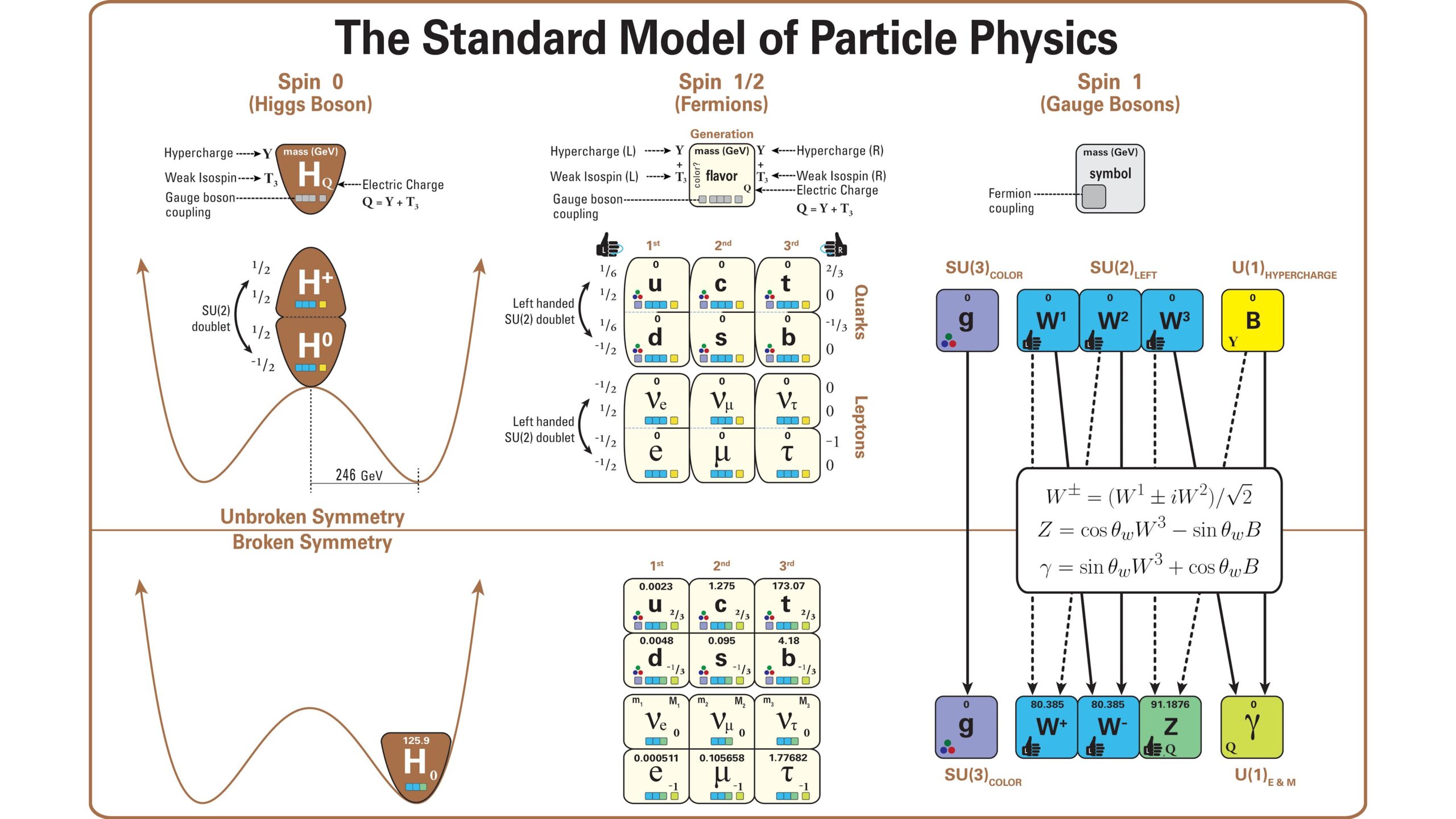
One of the great quests in all of science is to discover, at a fundamental level, what the Universe is actually made of. If you took every amount of matter and energy that existed — or even could exist — and cut it up into its smallest possible chunks, until only something that was uncuttable was left, you’d be left with the fundamental, elementary particles that composed our Universe. In physics, this took us first down to the level of the atom, then to atomic nuclei and electrons, then to protons, neutrons, and electrons, and finally to our modern Standard Model of elementary particles: complete with quarks, charged leptons, neutrinos, their antimatter counterparts, the gluons, the photon, the W-and-Z bosons, and one additional unique particle, the Higgs boson.
Of all of those particles, the Higgs boson is the most recently discovered particle: found only at particle accelerators, like the Large Hadron Collider at CERN, in 2012. But what’s the story of the Higgs boson? What makes it so unique, where does it come from, and how does it fit in with everything else that we know? That’s what Vu H Nguyen wants to know, asking:
“Can you explain the Higgs boson in depth? [It is] difficult for me to understand, but I think this is very important in particle physics.…
Source: Big Think — Read the full article on the original site ↗