


Local and Distributed Large LLM Inference with MLX and RDMA on Mac Studio
Local and Distributed Large LLM Inference with MLX and RDMA on Mac Studio
Read original on Apple Machine Learning Research ↗
Local and Distributed Large LLM Inference with MLX and RDMA on Mac Studio
Read original on Apple Machine Learning Research ↗
Selection-Based Structured Reasoning: Toward Efficient Multimodal Search Agents
Read original on Apple Machine Learning Research ↗
AuthorsMingfei Zhang, Amit Surana, Ziauddin Majid, Chenxi Wang, Michael Xu
Read original on Apple Machine Learning Research ↗
GHARP: Real-Time Gaussian Head Animation from Large-Scale Reconstruction Prior
Read original on Apple Machine Learning Research ↗
Ex-Ante evaluation: Price the risk-adjusted value of the idea via multiple agents making forecasts and stake compute credits/tokens around the proposal’s soundness and viability Brokerage & trade: Licence ideas to executors (e.g, some agents might just generate ideas, others might run laboratories) via fractional licensing.
Read original on Import AI ↗
New benchmark shows how AI models lack intuitive visual reasoning:…Humanity’s Sixth Sense highlights some shortcomings of current AI systems…AI startups Elorian and Scale AI have built and released Humanity’s Sixth Sense, a benchmark that “measures how a model interprets and reasons through information a visual scene implies but doesn’t explicitly show.” Some examples of the types of task in HSS are a picture of a bookcase and being asked whether it can fit more books, or a photo of horses pulling a plough and a question of whether the chains bear the plough’s drag weight. HSS contains 522 questions that cover 288 images and 234 short video clips (totalling 17.6 hours of video). The questions fall into four categories:
Read original on Import AI ↗
Here’s a speech I gave on Saturday the 17th of October at the IMF meeting in Bangkok. This speech is inspired by the megatrend readers have seen me cover this year of AI beginning to operate at the frontier of human science, sometimes autonomously. While we all may quibble over the details, I think it’s evident we’re in the early stages of the singularity, and I wanted to use my privileged position of giving the Per Jacobsson lecture to try and tell the assembled audience of economists, bankers, and policymakers, that they should expect significant, rapid change in the future. In this speech, I focused primarily on how humanity can share in the benefits of AI if we exercise proper…
Read original on Import AI ↗
Tech Tales:The Magical Realism Robot Workshop for Sick Kids[2035, after the uplift]So one of the jobs that no one expected was designing cute robots for sick kids in hospitals.
Read original on Import AI ↗
LLMs are very bad at low-latency tasks:…Realtime-Bench says it’ll be a while till AI systems can play games or do online auctions for you…Researchers have built Realtime-Bench, “a suite of carefully curated dynamic tasks where delayed actions directly affect success”. The test helps evaluate how well modern, general-purpose AI systems can perform tasks where decisions need to be made in real-time. The benchmark consists of 50 interactive game and web tasks, split across 30 web tasks in four categories (travel, e-commerce, service, and security), and 20 game tasks (arcade, puzzle, strategy, and simulation).Who did the research: The benchmark was built by people at the University of Texas at Austin, Ohio State University, University of Illinois at Urbana-Champaign, NVIDIA, Northwestern University,…
Read original on Import AI ↗
A new optical sensor costing just $10 could bring laboratory-level precision to wearable health monitors, potentially allowing people to track blood glucose without needles. The technology could also transform food testing, industrial quality control, and environmental monitoring.
Read original on ScienceDaily - AI ↗
A swimming robot does not necessarily need a bulky motor or powerful mechanical parts to move through water. MIT researchers have demonstrated that a single, carefully engineered layer of living muscle cells can generate enough force to propel a tiny robot forward.
Read original on ScienceDaily - AI ↗
Silicon spin qubits could play a major role in the future of quantum computing because they can be produced using the same semiconductor manufacturing methods that make today's computer chips. However, researchers have faced a significant challenge. When multiple silicon qubits are controlled at the same time, their operations tend to become less accurate. Building practical, large quantum computers will require scientists to control many qubits simultaneously while keeping errors to a minimum.
Read original on ScienceDaily - AI ↗
Tiny magnetic structures called skyrmions could help pave the way for a new generation of computers that process information more like the human brain while using far less electricity. Although most people have never heard of skyrmions, these microscopic magnetic vortices may eventually play an important role in how computers store and process data.
Read original on ScienceDaily - AI ↗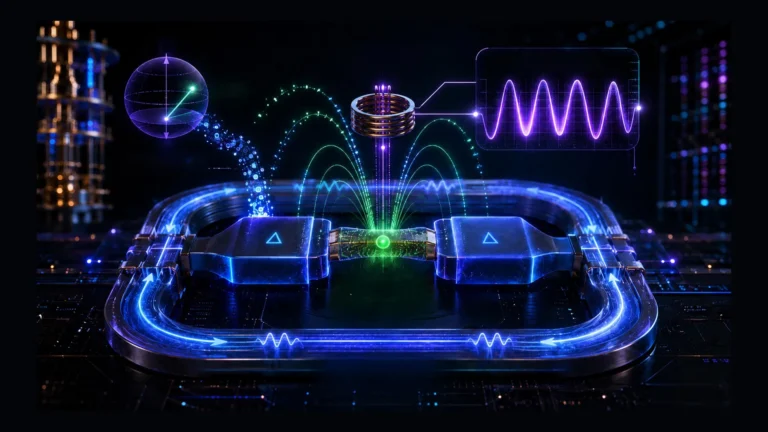
One of the biggest obstacles in quantum computing is surprisingly simple to describe: how do you read information without changing or destroying it? Unlike the bits used in ordinary computers, quantum bits, or qubits, are extraordinarily sensitive to measurement. Trying to determine their state can cause that state to collapse, potentially erasing the very information scientists want to retrieve.
Read original on ScienceDaily - AI ↗
Regina Barzilay, MIT’s School of Engineering Distinguished Professor of AI and Health, and James Collins, MIT’s Termeer Professor of Medical Engineering and Science, are the recipients of the 2026 Pritzker Prize for AI in Science Research Excellence.
Read original on MIT News - AI ↗