


Ask ten people what artificial general intelligence means and you will get ten answers. Worse, the answers quietly shift every time a machine passes one of them.
A few years ago, a computer that could write working software, pass professional exams and hold a sensible conversation about almost anything would have looked like the finish line. Today all of that is routine, and the verdict is still “not yet.” In October 2026, coverage reported that OpenAI had released 722 mathematics manuscripts in 372 families, produced by an unreleased internal model. Whatever you make of those manuscripts, the idea that these systems are narrow tools does not survive contact with what they now do.
And still nobody agrees that we have arrived, or what arriving would even look like.
I think that is because the question is built wrong. We keep asking how much a system can handle. The questions that decide whether it is useful, safe, or even understandable are different ones. What frame is it working in? Who chose that frame? What does the frame hide? What value is it trying to make visible?
This article argues for a different discipline: System-Level Context Alignment Engineering to the Value We Aspire To, or SLCAE. It is the deliberate design of the frame an agent works in, so that what it already holds becomes recognisable and what it lacks becomes visible. It applies to a person, a team, and a model in exactly the same way.
It also argues for relief. If education ends at certificates, jobs will always feel scarce, because certificates now live in the box that AI fills cheapest. If education includes the middle layer, learning to recognise value and to build the context where that value can be seen, then possibilities multiply. Not magically. Practically. Because for any question, there are many contexts, and for any value, there are many contexts that could produce it.
The loop in two lines
Let Q be the question, C be the context, and V be the value that is recognised.
1. Working in someone else’s context to see value
V = f(Q,C)
Give the same question a different context and the value you can read changes. This is the credentials route. You enter a frame someone else built, a syllabus, an exam, a hiring process, a benchmark, and you prove you can produce value inside it.
2. Creating a context aligned to value
C = f(Q,V)
Start from the value you aspire to, then build the context where that value can appear. This is the portfolio route. You do not ask for permission inside someone else’s frame. You build a demonstration, a prototype, a workflow, a case study, a small service, where what you hold becomes visible.
Both are valid. Both are needed. The mistake is to live only in the first and call that education complete.
That is the set of all contexts that would return that value for that question. Your job, whether you are a person or a model, is not to find the one true context. It is to enumerate, test, and choose a context from that fibre, cheaply, and to drop it fast if it does not produce the value.
Why does that imply infinite possibilities? Because C is not one variable. A context is a bundle: the framing of the question, the tools allowed, the data shown, the audience, the metric for success, the time allowed, the examples given, the checker used, the role assigned. Change any one and you have a new context. The combinations are effectively unbounded. That is why “we have run out of jobs” is the wrong diagnosis. We have run out of givencontexts. We have not run out of contexts we can build.
What nobody can know: the four boxes
I use a simple map, which I call the Ignorance Awareness Matrix. It comes from two questions. Do you hold the knowledge? And do you recognise that it applies?
| Recognition-Action Taxonomy / Ignorance Awareness Matrix | Recognised | Unrecognised |
|---|---|---|
| Known | KR: Known and Recognised. What you have and can use. Your language, your trade. | KU: Known but Unrecognised. You hold it, but you do not see that it matters here. |
| Unknown | UR: Unknown and Recognised. A gap you can see. You know you do not know. | UU: Unknown and Unrecognised. A gap you cannot see, because you have no idea anything is missing. |
The Ignorance Awareness Factor, IAF, is the practice of using behaviour, not self-report, to place a pattern in one of these boxes, then moving it on purpose.
The second box, KU, is the strangest and the cheapest place to start. In the old story, a water bearer carries two pots every morning. One has a crack and arrives half empty. The cracked pot is ashamed. Then the owner points to the path. Flowers have grown along the cracked side all this time, because the leak has been watering them. The knowledge was always there: the pot leaks. What was missing was a frame in which a leak is useful. Nothing about the pot changed. What changed was what it was for.
The fourth box, UU, is the one that matters for the AGI argument, because it cannot be emptied. Any thinker has finite capacity, and the space of things worth knowing is not finite. Something always sits outside what the thinker can recognise. I have written this up as an epistemic incompleteness argument in a working paper that has not been through peer review. The core is short: a finite store against an unlimited space leaves a remainder. Gödel showed something similar inside formal mathematics, and Turing did for what computers can decide. My claim is only that the shape is parallel, not that it is the same theorem. There is one important difference. Their limits are fixed. This remainder shrinks when you change what the thinker is looking at. It just never reaches zero.
Three things follow:
1. More breadth cannot finish the job.Each new capability shrinks the unseen part. None removes it.
2. Seeing something changes the map.When you turn a blind spot into a visible gap, you immediately see what lies beyond it. The frontier grows as you walk toward it. Anyone who has finished a degree knows the feeling.
3. None of this is about machines in particular.It applies to a surgeon, a regulator, a founder and a language model in exactly the same way. So “as capable as a human” cannot be the finish line either. The human finish line is not at infinity.
Part 1: V = f(Q,C) — the same question, a different value
If value depended only on the question, context would be decoration. It is not. Change the context and the same question returns a different value, for people and for machines.
1. The 6 and the 9.Paint a 6 on the ground, and two people standing at opposite ends will read it as a 6 and a 9. Same mark, same ground. The question “what is written here?” has a different answer because the viewing context is different. Machine parallel: the same image, rotated or cropped differently, is classified differently by the same vision model. Nothing in the pixels changed except the frame.
2. One plus one is 10.In base ten, one plus one is two. In base two it is written 10. Leibniz described counting with only two digits in the late seventeenth century, and the full account appeared in 1703. He did not overturn arithmetic. One plus one never stopped being two. He built a new context on top of notation everyone already had, one in which the written answer, and so the point of the exercise, was different. Then, for a long time, the link to machines was missing. In 1937, Claude Shannon showed at MIT that Boolean algebra could describe electrical relay and switching circuits. Two-state arithmetic now had somewhere to live. The frame came first. The proof came later. Machine parallel: the same quantity, represented as text, as code, as a table, or as a diagram, is solved or failed by the same model depending on representation.
3. The same number, two professions.A number on a blood test report means nothing to an engineer and everything to a doctor. The fact is identical. The frame decides whether it is worth anything. Machine parallel: the same lab value, given to a general chatbot versus given to a clinical workflow with reference ranges, patient history, and a checker, produces a different quality of answer.
4. The same CV, three contexts.Ask “is this person qualified?” in a credential context and you get a list of degrees. Ask it in a portfolio context and you get proof of work. Ask it in a trial context, a one-week paid project, and you get behaviour. Same person, same question, three different values. This is why credentials and portfolios are not substitutes. They are different C for the same Q.
5. The same student, two assessments.Ask “does she understand fractions?” with a timed exam and you measure speed under stress. Ask it with a teaching task, “explain fractions to a younger student,” and you measure depth and articulation. Many students who look weak in the first context look strong in the second. Machine parallel: a model that fails a multiple-choice benchmark can succeed at the same knowledge when asked to generate an explanation and then have that explanation checked.
6. The same model, three contexts.Ask a small language model a question with no context, then with retrieval, then with retrieval plus a verifier. Research on in-context learning, retrieval-augmented generation, and chain-of-thought reasoning shows the same pattern again and again: the model has not changed, the weights have not changed, but the value returned changes because C changed. In my own small studies, described below, a supplied context beat a model-chosen context by 24 to 2 for one model and 16 to 1 for another on 100 questions. The model did not get smarter. The frame got better.
7. The same fact, two frames.Tversky and Kahneman showed that logically equivalent descriptions lead people to choose differently. When options were described in terms of lives saved, 72% preferred the certain option. When the identical options were described in terms of lives lost, 78% preferred the gamble. Same Q, same outcomes, different C, different V. Machine parallel: the same model, prompted with a gain frame versus a loss frame, will rank the same options differently.
8. The same defect, two factories.In one factory, a cracked pot is waste. On a path where flowers need water, it is irrigation. In one company, an employee who asks too many questions is “slow.” In a research team, the same trait is “thorough.” Value is not in the trait alone. It is in the trait in a context.
This is the forward direction. It explains why benchmarks without a description of context are half a result. A score is V for a particular C. Report the frame with the score, or you have not reported the result.
Part 2: C = f(Q,V) — the same value wanted, a new context built
Here the direction reverses. The agent or the experimenter selects the context becauseof the value at stake, not because the context was given. This is not new. Many proven studies already show it informally. They never formalised it as a fibre. The contribution here is the formalisation: given Q and desired V, which C belong to the set that returns that V?
The rule for inclusion is strict: a study belongs here if the context is selected because of the value, not because it was handed over.
Attention is value-selected
Frequency illusion, also called Baader-Meinhof.After you learn a word or concept, you suddenly see it everywhere. The world did not change. Your Q changed, your V changed to relevance, so you select C, contexts where you notice it. The cause is two processes: selective attention and confirmation bias. Once something is flagged as interesting, your brain starts noticing it. The signal was always there, you just were not tuned to it. Machine parallel: once a user flags a topic as valuable, a retrieval system reranks the same corpus and suddenly “finds” documents that were always there.
Novelty bias.A new intervention looks better simply because it is new. Here V equals novelty, so C equals the new tool, new method, new frame is selected. After the novelty fades, V drops, and the same C is abandoned. That is C selected by V, not by evidence. Machine parallel: a lab chases a new architecture because it is new, not because it fits the deployment context.
Inattentional blindness, the invisible gorilla.Daniel Simons and Christopher Chabris showed the failure to perceive something fully visible when attention is engaged elsewhere. Roughly half of viewers counting basketball passes missed a person in a gorilla suit. Your Q equals count passes, your V equals accuracy on passes, so your C equals only the players in white. The gorilla is not in that C. Machine parallel: a model with a narrow attention window misses a critical token that sits outside the context it was given to weigh.
Value-driven attentional capture.Attention can be captured by previously reward-associated stimuli, even if they are currently task irrelevant. Attention prioritises stimuli both voluntarily, according to context-specific goals, and involuntarily, through capture driven by value. Work by Anderson and colleagues showed that past reward shapes present attention. V learned in the past selects C now. Machine parallel: a model fine-tuned with reward learns to over-attend to phrasing that previously earned reward, even when it is irrelevant to the current question.
Memory is value-selected context
Encoding specificity, context-dependent memory.Godden and Baddeley found scuba divers who learned a list underwater recalled them better when tested underwater than when tested on land. The general principle is that when people encode information, they do so in specific ways. To get V equals recall, you must return to C equals encoding context. That is C = f(Q,V) in memory. Machine parallel: an embedding retrieval system works best when the query is encoded in the same way as the stored passage. Change the encoding context and recall collapses, even though the knowledge is still stored.
Misinformation effect.Elizabeth Loftus and Palmer showed that after exposure to incorrect information, a person may misremember the original event. A leading question with a different verb changes speed estimates and later recall. The question is Q, the value the questioner wants is V equals a violent crash, so the context C equals the verb “smashed” versus “hit” is selected to produce that V. Memory is then reconstructed inside that C. Machine parallel: a leading prompt steers a model to hallucinate a detail, and the model then treats its own output as context for the next answer.
Choice is value-selected context
Framing effect.As above, the same outcomes framed as gains versus losses produce opposite choices. The frame is chosen because of the value the designer wants to elicit.
Decoy effect, asymmetric dominance.Huber, Payne, and Puto showed adding a third option that is clearly inferior to one option but not the other shifts preferences toward the dominant option. The designer selects C equals choice set with decoy, to get V equals choice of target. Machine parallel: adding a decoy option to a model’s ranking task shifts which answer it prefers, even when the decoy is never chosen.
Nudge, choice architecture.Thaler and Sunstein showed small changes in how choices are presented reliably shift behaviour without forcing any outcome. A nudge is any aspect of the choice architecture that alters behaviour in a predictable way without forbidding options. Default, order, salience are C. They are chosen by the architect because of V equals organ donation, savings, healthy eating. Machine parallel: the system prompt, the default tools, the order of options, and the guardrails are the choice architecture for a model. They are C selected for V.
Action and prediction are value-selected context
Active inference.Karl Friston proposes agents maintain equilibrium through minimisation of surprise or uncertainty. Active inference explains how the agent decides which action to take by considering the course of actions that fulfils its prior beliefs about preferred observations. The agent does not just react to C. It acts to select a future C that will produce preferred V with low surprise. That is the most formal neuroscience version of C = f(Q,V).
Affordances, Gibson.An affordance is what a context offers to an agent with a particular body and goal. Same rock is seat, step, or weapon depending on Q and V. C is not objective, it is C relative to V. Machine parallel: the same API is a tool, a threat, or noise depending on the agent’s goal and permissions.
Implementation intentions, Gollwitzer.If situation C occurs, then I will do A to get V. You pre-select C in advance because you know your future self will not select it spontaneously. That is explicit C = f(Q,V) as a self-nudge. Machine parallel: a guardrail that says “if this trigger appears, then run this check” is an implementation intention for a model.
Design is value-selected context
Designing Your Life prototyping.Burnett and Evans describe choosing V equals coherence and energy, then prototyping C equals Odyssey Plans, conversations, shadow days to test if that V appears. If not, you discard C and sample another from the fibre F_q(v). Machine parallel: an agent team prototypes three workflows for the same task and keeps the one where the desired value appears.
Episodic future thinking, affective forecasting.Gilbert and Wilson show humans simulate a future C to predict V, then choose C based on predicted V. The error is that simulation itself is a C that distorts V. Machine parallel: a model that simulates a rollout to predict success is also distorting the prediction by the simulation’s assumptions.
Do not claim we discovered C = f(Q,V). Claim we formalised what these studies show separately. Each of them is one fibre, one F_q(v), without the math. The equation gives them a common language: given Q and desired V, which C belong to the set that returns that V? And when the agent cannot enumerate that set from its own state, the inverse is weak, even if the forward is strong.
The other half of attention
In 2017, a paper from Google researchers argued that attention was all you need, and the field largely took them at their word. Attention is a way of deciding which parts of the input matter most for the task in front of you. It is a brilliant mechanism, and scaling it is a large part of why today’s chatbots can do what they do.
But attention works on a context that has already been handed over. It decides what to weigh inside the frame. It says nothing about why this frame, who put it there, or whether something else belongs in it. Scaling attention, data and parameters makes the first part better every year. The second part is left to whoever writes the prompt, wires up the pipeline or runs the hospital.
SLCAE is the second part, made into a discipline.
A small test, and what it showed
I have run three small studies to see whether any of this shows up in practice. They are my own working papers, they have not been peer reviewed, and I will describe them with their limits attached.
In the first, I took two small, cheap models (gemma3:4b and gpt-4o-mini) and asked them 100 questions, once plain and once with a single human-written hint added to the context. The hint turned a wrong answer into a right one on 17 questions for one model and 11 for the other. It turned a right answer wrong on 2 and 0. I also compared a context I supplied with a context the model picked for itself. The supplied one won on 24 questions to 2 for one model and 16 to 1 for the other. In a side test of 25 claims about machine-made discoveries, adding a verification step lifted accuracy from 0.64 to 1.00 in one model and from 0.80 to 0.92 in the other, and brought false acceptances to zero.
The second study was deliberately plain. I trained a classifier on small images of handwritten digits and then changed only how the images were presented, by rescaling and re-centring them. That change carries no label and no answer. Across 200 repeated runs, the number of items the classifier held but failed to recognise fell from 195.8 per run to 20.4. Nothing was taught. The same data, seen differently, became usable.
The third asked a model to choose which context would help it most from a menu of four. It picked the helpful one in 95 of 100 menus, where chance would be 25. But when it then answered using its own pick, it scored 0.47, against 0.35 for a randomly chosen context. Choosing well and then using the choice well turned out to be separate skills.
Now the limits, which matter as much as the results. The hints in the first study stated the relevant fact outright, so most of the improvements, 43 of 47, were really a fact being installed. That is the ordinary route to a better answer. It does not isolate what I am arguing for. Only the second study isolates a change of frame with nothing added, and it used a toy classifier, not a language model. A frame can also do damage. In the same digit study, a denoising step made things much worse: 1,766 items fixed against 12,276 broken. A frame aimed at the wrong problem is worse than no frame. The models were small, the lab was a single one, and no human participants were involved. The test that would settle whether a frame alone, with no answer inside it, moves a language model is written and has not yet been run. So this is a proof of concept, and I would be misleading you if I called it more.
What the machine-written proofs do and do not show
The biggest recent example is the one most people point to. On 6 October, according to coverage of OpenAI’s release, the company published 722 mathematics manuscripts in 372 families, produced by an unreleased internal model. Many come with machine-checkable Lean proofs, though not all. The model was reportedly set about 4,000 problems, and the average result used compute equivalent to roughly three hours of thinking on its top consumer plan. OpenAI’s own notes caution that some of the unformalised results could have problems.
The headline claim is bigger. In early September OpenAI said its model had proved a version of the Navier-Stokes problem, one of the seven Millennium Prize problems. As of the reports I could read, mathematicians were still checking it. The Clay Institute says it will recognise a solution only after peer-reviewed publication and community vetting. There is also a public dispute over credit with researchers who posted related results the day before, and accounts differ on exactly which version of the problem was settled. I am treating it as a claim, not a fact.
So I will use these results as a worked example, not as evidence for my argument, because they cannot be both. Here is what the matrix says about them.
For most of us, the content sits in the wrong box. Hand a research-level proof to a general reader and it is like a page in a language you have never studied. The symbols are visible and the meaning is not. For a few specialists it is a known gap. For everyone else it is unrecognised altogether. That we cannot follow it says something about our frame. It does not by itself say anything about the machine’s.
Nothing in a proof arrives from outside its axioms. A theorem is already implied by what it is built on. Mathematicians knew this long before computers. Finding a proof is uncovering what was already entailed. If these results hold, the systems moved true statements from the unseen box into the seen one. That is real and valuable, and I do not want to shrink it. It is also true of every theorem a human has proved, which means it cannot on its own favour my account over anyone else’s.
Checking is a way into the known box that does not need understanding. A formal verifier like Lean can confirm each step without anyone grasping the whole. Where a checker exists, trust can come before comprehension, which is why the Lean files matter more than the press releases. Even there a frame question remains. Experts are still asking whether the formal statement faithfully captures the original problem. Where no checker exists, which is most of life, we are back to people understanding what they are being told.
SLCAE: the middle layer that makes us irreplaceable
Here is the picture from ODEFTO Labs that ties the research to jobs. I call it the Value Creation Cycle: From Academic Knowledge to Market Monetisation.
Section 1: Input. The Academic Foundation. The Commodity Layer.What everyone has access to: formal degrees, diplomas, transcripts, general certifications, standard school and college curriculum, YouTube, Udemy and internet courses, online and offline institutions. Standardised, theoretical, broad, compliance-driven. It acts as baseline validation and an HR filter. Necessary but insufficient to generate independent income. Market value: LOW. Baseline, commodity.
Section 2: Process. The Value Transformation Engine. The ODEFTO Core. The largest section.This is the middle layer that makes us uniquely irreplaceable. It is learning to recognise how we see value and how we can build context by knowing what is being valued.
It has three layers:
Layer 1, The Knowledge Core:Domain knowledge and systems thinking, how industries really work. Business acumen, policies, procedures, people, situations, risk, value dynamics. Intrinsic motivation and curiosity exploration, not following the crowd.
Layer 2, The Cognitive and Execution Engine:Analytical thinking and creative thinking. Problem finding over problem solving. Do not just solve, find better problems. Leadership, motivation, time and resource management. Dealing with stressful and risky situations.
Layer 3, The Articulation Bridge:Positioning, communication, distribution, consistency. Translating raw thinking into persuasive, clear market messages. Creator and seller concept. If you join an organisation, do not chase the next salary hike. Learn how systems work, how people are, how to increase value.
Section 3: Output. The Monetisation Layer. The Commercial Destination.Base layer: validated applied skills plus solved market pain points. Terminal output has two paths. Path A: High-Value Employment, Job. Understand value creation dynamics across roles. Become irreplaceable, not just salary-focused. Path B: Entrepreneur, Creator. Create value, productise knowledge, consulting, specialised services. Characteristics: results-driven, problem-focused, exchange-oriented. Market value: MAXIMUM. Direct revenue, capital.
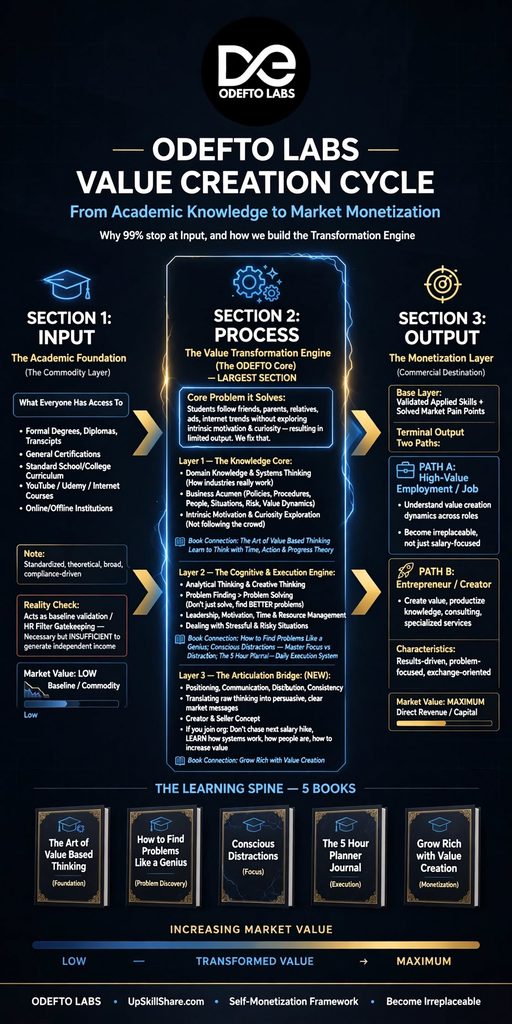
Why 99% stop at Input? Because Input is visible, testable, and rewarded by institutions. Process is invisible until it works. Nobody gives you a certificate for “noticed that a leak could water flowers.” Yet that is the skill that turns a commodity into a living.
This is also why the question “How do you become irreplaceable?” has two different answers depending on which equation you use.
If you use only V = f(Q,C), you become irreplaceable by being the best inside someone else’s context. You collect more credentials, you fit the frame more tightly. That works until the frame becomes cheap. When AI can fill the Known and Recognised box for almost any credential, fitting tighter is a race to the bottom.
If you also use C = f(Q,V), you become irreplaceable by building the context where your particular KU becomes KR for someone else. A nurse who has spent ten years watching how a ward really runs looks ordinary inside the nursing frame. Inside a frame where hospitals are buying scheduling tools, that same knowledge is rare expertise most software designers will never have. The nurse did not learn a new fact. She moved her knowledge into a new C where its V could be recognised.
The same holds for machines. A model evaluated only on benchmarks is a credential. A model deployed with the right tools, the right verifier, the right workflow, and the right audience is a portfolio. The first is replaceable by the next model. The second is hard to replace because the context itself is the product.
Why jobs are not scarce in the way we fear
Most jobs exist inside a context somebody else built. A company is a context. So is a platform, a marketplace, a profession, a software tool. When someone builds a new one, they create the places where other people can work, and they also create their own. That is how new entities come to exist, and why new kinds of jobs appear with them. Operating inside a context is a job. Building one makes room for many.
AI changes the arithmetic in one believable way. A great deal of the known work, the drafting, the first-pass code, the bookkeeping, the design variations, can now be done by one person with a good tool. That lowers the cost of trying a new context, and it makes very small companies, sometimes a single person, more feasible than they used to be.
Now the conditions. This is a prediction, not a result. Most new contexts fail, and AI does not choose the frame or carry the risk for you. Some existing jobs will shrink while others appear, and the transition will be uneven and sometimes painful. For a new context to turn into a living, it takes three things at once. Someone has to recognise value that others have not yet. They have to be able to test that cheaply. And eventually other people have to recognise the value too. If any of the three is missing, you have an experiment, not a company.
That is the relief this article offers, and it is not naive. It does not say “there will always be jobs.” It says: scarcity is not a fixed pie of jobs. Scarcity is a shortage of contexts where value can be recognised. And contexts can be built. That is trainable.
It also means education is not complete when you finish the certificate. The certificate is Input. The Process layer is the rest of education: learning to see your own KU, learning to name your UR, learning to shrink UU by standing somewhere new, and learning to articulate the result so someone else can see it. That is SLCAE as a curriculum for humans.
For machines, SLCAE is a curriculum too. We need to train and evaluate three abilities separately: using a context you are given, choosing one, and writing one from scratch. Today’s models are good at the first and, in my small tests, much weaker at the last. We also need to decide whether to answer based on recognition, not only confidence. In my digit study, a gate based on recognition cut accepted errors from 0.186 to 0.051 while keeping the same share of answers. A gate based on confidence alone did not do as well. Ignorance has to be measured. Asking a model to rate its own blind spots does not work. In my tests, models gave either the same number every time or numbers that tracked nothing. Behavioural measures, which watch what the model does, did separate one domain from another.
The working procedure
Here is a working procedure that applies to a person, a team, or a model.
1. Identify the frame the agent is in now, and the pattern it is failing to tell apart.Name Q and C explicitly. What question is being asked, and in what context?
2. Place that pattern in one of the four boxes, using what the agent does, not what it says about itself.Behaviour, not self-report.
3. Name the value you aspire to.What V would count as success here? For whom? This is the step most people skip. They try to improve C without naming V.
4. Enumerate the fibre.List three to five contexts that could plausibly return that V for that Q. Do not look for the perfect context. Look for a cheap one you can test.
5. Pick the cheapest channel that can carry a change.A conversation, a one-page offer, a small prototype, a prompt change, a re-centred image, a different example set. Make the change.
6. Measure again.Did anything move between boxes, and did it produce value? Did KR expand from KU? Did KR expand from UR? Did UU shrink a little?
7. Repeat until the result is good enough for the purpose.Good enough is not perfect. Perfect is UU equals zero, which never happens.
What would change
I should be fair to the labs first. They already do a great deal of context work: retrieval, tools, agents, long prompts. My complaint is that this is treated as plumbing around the model, when it is the thing that decides whether the model’s capacity gets used at all. Taking it seriously would change a few specific habits.
For the people building models.Report the frame with the score. A benchmark result with no description of the context it ran in is half a result. Treat using, choosing, and writing context as separate abilities. And decide whether to answer based on recognition, not only confidence.
For the people deploying them.Fix the frame for each setting. A hospital ward, a power grid and a classroom each mean something different by “the system,” and each has a different frame of reference. Success there is not a leaderboard rank. It is whether things that were invisible to the people involved become visible and useful. Where a result can be checked by machine, build the checker, and spend scarce human attention where no checker can exist.
For everyone else.All of this applies to people, and that is the part I find most hopeful. Reframing, mentorship and learning by immersion are context alignment for humans. Organisations that throw away a defect before anyone has proposed a frame in which it is useful lose it by design. The question stops being whether the machine or the human is more intelligent. It becomes how each can be put in a position where what it holds gets recognised.
What I am not saying, and what would prove me wrong
The argument is narrower than its slogan, and I think it is stronger for that.
I am not saying breadth is useless. Models can use a frame at all because they are general. That is what makes in-context learning work. My claim is that more breadth alone cannot finish the job.
I am not saying the idea of AGI is meaningless. I am saying the debate cannot be settled by adding breadth, because the frame that defines “general” keeps moving. There is no single AGI or ASI point to wait for. Waiting is the wrong strategy. Learning to recognise and to build context is the strategy.
I am not saying machines are below humans, or above them. They do some things far better than most people and fail at things a child manages, so the honest picture is uneven. The incompleteness argument applies to both sides.
And I am not saying my evidence is conclusive. It is not. It is small, early and mine.
Here is what would show I am wrong. Take a hint that states no answer and carries no fact, only a different way of looking at the question. If that fails to improve a language model on questions where it already holds the knowledge, my strong claim is dead. If it helps just as much on questions that need facts the model does not have, then it was never about recognition, only about prompting. If a frame aimed at the wrong problem helps as much as one aimed at the right problem, the frame does not matter in the way I say.
That last point is the one that separates my view from the plain observation that better prompts help. A generic account predicts a general lift. Mine predicts help in some places, none in others, and harm when the frame is wrong. Those are different predictions, and they can be told apart. The test is designed and the protocol is written. It has not been run.
A self-audit you can do tonight
You do not need a model or a lab for this. A notebook and an honest hour will do.
1. Whose idea was my current goal?Trace it back to a person, a place or a fear. If you cannot find where it came from, that tells you something.
2. If the certificate, the title and the salary band did not exist, what would I be doing?Write the first thing that comes to mind, not the sensible one.
3. What do I know that nobody around me values?That is your KU box. Include odd things: a hobby, a language, a past job.
4. Which gap can I name but keep putting off?That is your UR box. Pick one and set a date.
5. Who sees the world differently from me, and when did I last ask them?Someone from another field, another city, another generation. Ask what my plan is missing.
6. What does my plan take for granted?Write the plan and its assumptions, give both to an AI, and ask it to list what the plan assumes and what a sceptical outsider would challenge. Then check what it says. It is a prompt for your thinking, not a verdict.
7. What is the smallest, cheapest test I could run in the next month to find out whether a different frame has value?A conversation, a small prototype, a free trial, a one-page offer. Aim for something you can drop without regret.
If you take only two of these, take the first and the last. Know where your goals came from, and then test something small.
What this argument has been missing
A fair reader will push back, and some of the pushback is right.
A wrong frame costs something. In my own digit experiments, a frame aimed at the wrong problem did not just fail to help. A denoising step fixed 1,766 items and broke 12,276. Building your own context is not automatically good. A large part of the skill is testing a frame cheaply and dropping it quickly when it does not work.
You cannot see your own blind spots alone. That is what makes them blind. You need other people, other fields and outside views, and an AI can be one of them. But it is a frame too, with blind spots of its own, which is partly why it helps and partly why it should not be trusted without checking.
Value has to be recognised by somebody else in the end. Binary arithmetic was written up in 1703, and its link to circuits came in 1937. Few contexts get recognised on a convenient schedule. A private context that nobody else values is a fine hobby, and sometimes it becomes a breakthrough. To become a company it needs other people to recognise what you saw.
Access is not equal. I said earlier that knowledge is now a few seconds away. That is true for people with a connection, a device, the right language and the time to use them. Many people do not have all four. And equal access to facts is not equal access to frames, which often come from who you know and where you grew up. That is the exact problem I started with, and a society that cares about this should treat the frame itself as something to share.
Whose value is it? A context built around what I value can be bad for the people outside it. Aligning a system is partly a technical job and partly a question about who gets to say what counts as value. I do not have a clean answer to that one, and I would be suspicious of anyone who says they do.
One more, because it is practical. You still have to eat. Nothing here is advice to quit a job or abandon a certificate. Exploring a new frame is usually something you do alongside the old one, in small, cheap steps, until you know whether it holds.
Depth, not breadth
The field has spent a decade asking how much a system can handle, and that question has produced astonishing results. It will keep producing them. But the part nobody can see never shrinks to nothing, for a model or for a person, and the gains left over are mostly in how well we match what an agent holds to the frame it works in.
Attention taught us how to weigh what is already in front of us. The next discipline has to teach us how to choose what goes in front of us in the first place, and to notice what we have left out.
You do not have to leave your job, drop your certification or stop wanting a raise. Those things are real, and plenty of good lives are built on them. What you do need to know is that they sit inside a frame, that somebody drew it, and that other frames exist. The same is true for the models we are building, which is why the research and the personal question turn out to be one question.
The skill that was scarce for a long time was holding the answer. That one is getting cheap. The scarce one now is knowing which question is worth asking, and from where. Leibniz took ordinary digits and wrote arithmetic in a different base, and a lot followed from it. Plenty of innovation starts like that, with someone standing in a slightly different place.
If you work in a hospital, a classroom, a lab, a factory or a newsroom and have seen a problem dissolve when someone changed how it was framed, I would like to hear about it. If you build or test these systems and want to try to break the argument, the experiment is there to be run. Either way, I would rather find out I am wrong than stay comfortable.
Sources and further reading
OpenAI Releases 722 Math Manuscripts From an Unreleased AI Model, Unite.AI, on the 6 October 2026 release. Mathematicians still checking the Navier-Stokes proof that OpenAI claims to have solved, The Tufts Daily, September 2026. OpenAI Claims a Navier-Stokes Proof, Amid a Dispute Over Credit, NYU Shanghai RITS.
For V = f(Q,C) and C = f(Q,V) research: Godden and Baddeley on context-dependent memory; Simons and Chabris on inattentional blindness; Loftus and Palmer on the misinformation effect; Tversky and Kahneman on framing; Huber, Payne, and Puto on the decoy effect; Thaler and Sunstein on nudge and choice architecture; Friston on active inference; Gibson on affordances; Gollwitzer on implementation intentions; Burnett and Evans on Designing Your Life; Gilbert and Wilson on affective forecasting; Anderson and colleagues on value-driven attentional capture; Vaswani and colleagues on attention; Brown and colleagues on in-context learning; Lewis and colleagues on retrieval-augmented generation; Wei and colleagues on chain-of-thought reasoning.
Ones and Zeros, Infostory, on Leibniz’s 1703 account of binary arithmetic and Shannon’s 1937 thesis. Binary code, Wikipedia, on Shannon’s thesis A Symbolic Analysis of Relay and Switching Circuits.
The digit and language-model studies mentioned here are the author’s own working papers and have not been peer reviewed. The pictures and placements are illustrative and show kinds of agents, not measurements.