


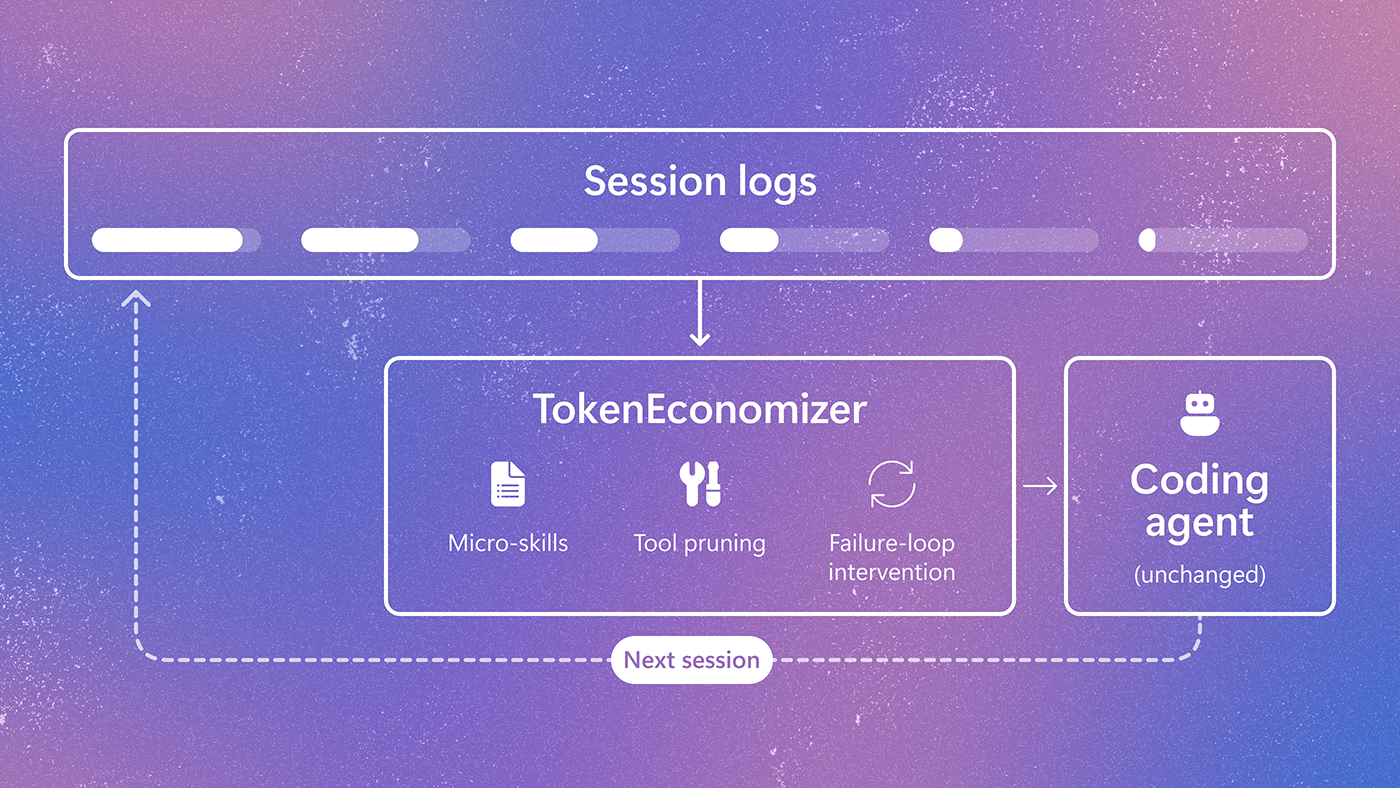
AI coding agents are increasingly help developers fix bugs and build features largely on their own, but every interaction with their models consumes tokens. In each session, an agent sends instructions, tool descriptions, and session history to its model. Most efforts to reduce this cost focus on individual tasks. Yet developers return to the same repositories, giving agents an opportunity to learn from previous work. Without that learning, an agent may repeatedly rediscover how to run tests, load tools it never uses, or spend dozens of turns revisiting the same error.
In our paper, TokenEconomizer: Experience-Driven Black-Box Cost Control for Coding Agents, we ask a simple question: can experience in a repository help an agent solve future tasks more efficiently? TokenEconomizer, an open-source plugin from UC Berkeley, Microsoft Research, and Microsoft Security, turns completed sessions into guidance for subsequent ones. It reduces waste without changing the agent or its underlying model, so developers can use it alongside the coding agents they already rely on.
We first profiled Claude Code on 60 tasks from SWE-Bench, a benchmark of real bug fixes in open-source Python projects, running each repository’s tasks in sequence. Three kinds of waste recurred:
We also tested three popular open-source plugins, each built around a fixed cost-saving strategy. Each lowered costs in some repositories but not others. Together, these findings suggest that effective cost control must adapt to the repository, rather than apply the same strategy everywhere.
Source: Microsoft Research — Read the full article on the original site ↗