

Users of a knowledge-grounded application expect it to remember them, not only to search well. They ask follow-up questions that make sense only in the context of the previous turn. They expect an answer about a policy or a procedure to reflect what they told the application about themselves last month. And they still expect every answer to be grounded in the documents they are allowed to read, with citations. Whether the application is a customer support assistant, a document chat inside a SaaS product, or an internal assistant over company policies, the expectation is the same.
Meeting that expectation is hard, because the context that would sharpen a search lives outside the knowledge base. A user’s location, role, or product tier was often mentioned in an unrelated conversation weeks ago. To use it, the application has to store every conversation, extract durable facts from it, decide which facts matter for the current question, and inject them into the request. When many users share the application, every one of those steps also has to be isolated per user, and so does every document.
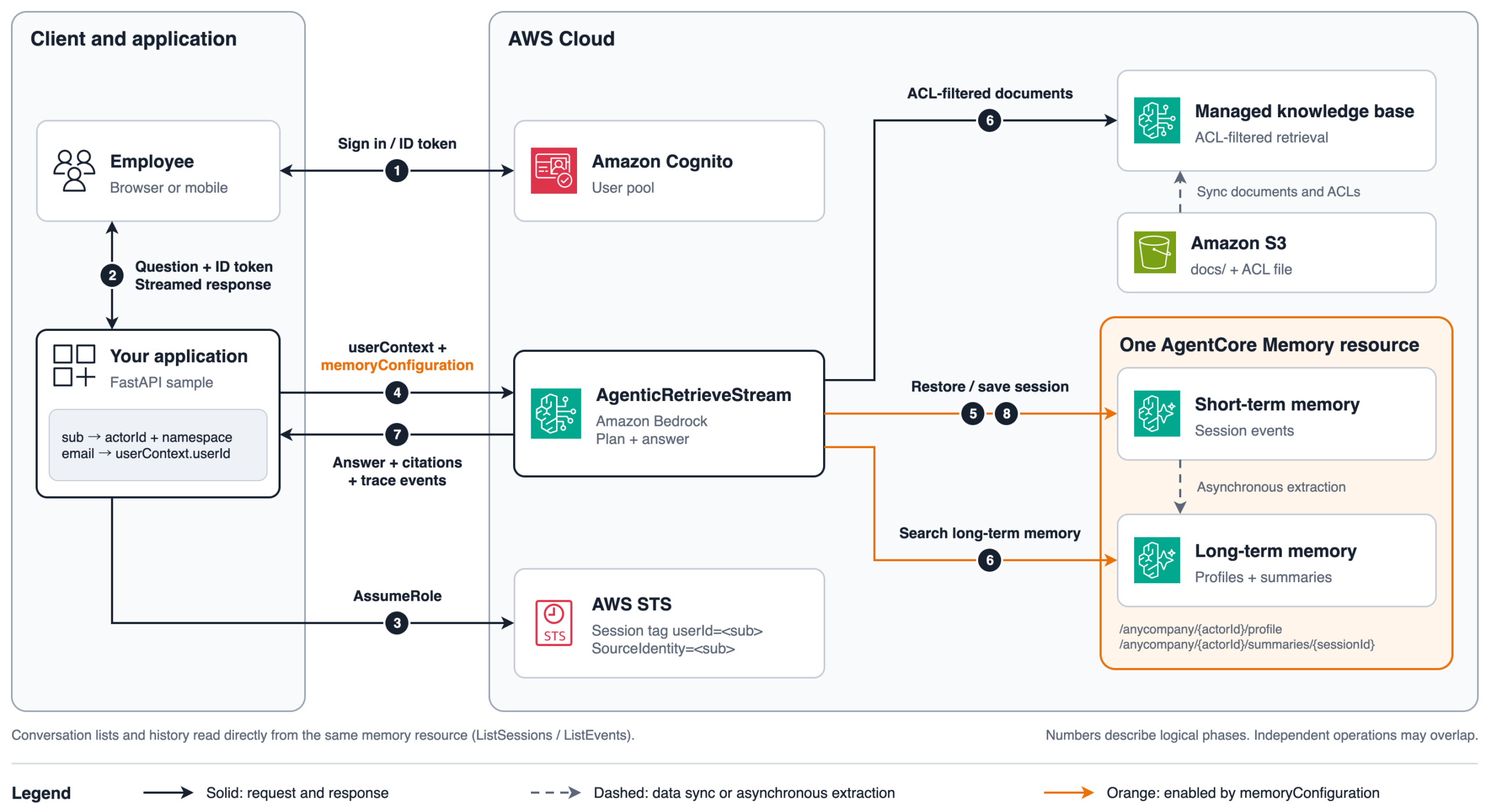
Amazon Bedrock Managed Knowledge Base and Amazon Bedrock AgentCore memory, a capability of Amazon Bedrock AgentCore, now take over these steps: storing each conversation, extracting facts from it, and bringing the relevant facts into the search. You turn this on by adding a memoryConfiguration to the AgenticRetrieveStream request, which makes AgentCore memory a retrieval source alongside your knowledge base. Within the same call, the service restores the conversation, and the planner decides on its own when a fact about the user would help. It retrieves that fact from long-term memory and uses it to compose the sub-queries it sends to the knowledge base. After generating the answer, the service saves the turn back to memory. The same request carries a userContext, so the knowledge base returns only the documents that the user’s access control lists (ACLs) allow. The integration is opt-in and backward compatible. Your application keeps only what is genuinely yours: authenticating the user and passing who they are.
Figure 1: Architecture of the memory-aware employee assistant. The application authenticates the user and constructs the request (steps 1–4). Amazon Bedrock Managed Knowledge Base restores the session, retrieves information, returns an answer, and saves the exchange to AgentCore memory (steps 5–8). Short-term events and long-term records belong to the same memory resource.
Source: AWS Machine Learning Blog — Read the full article on the original site ↗