


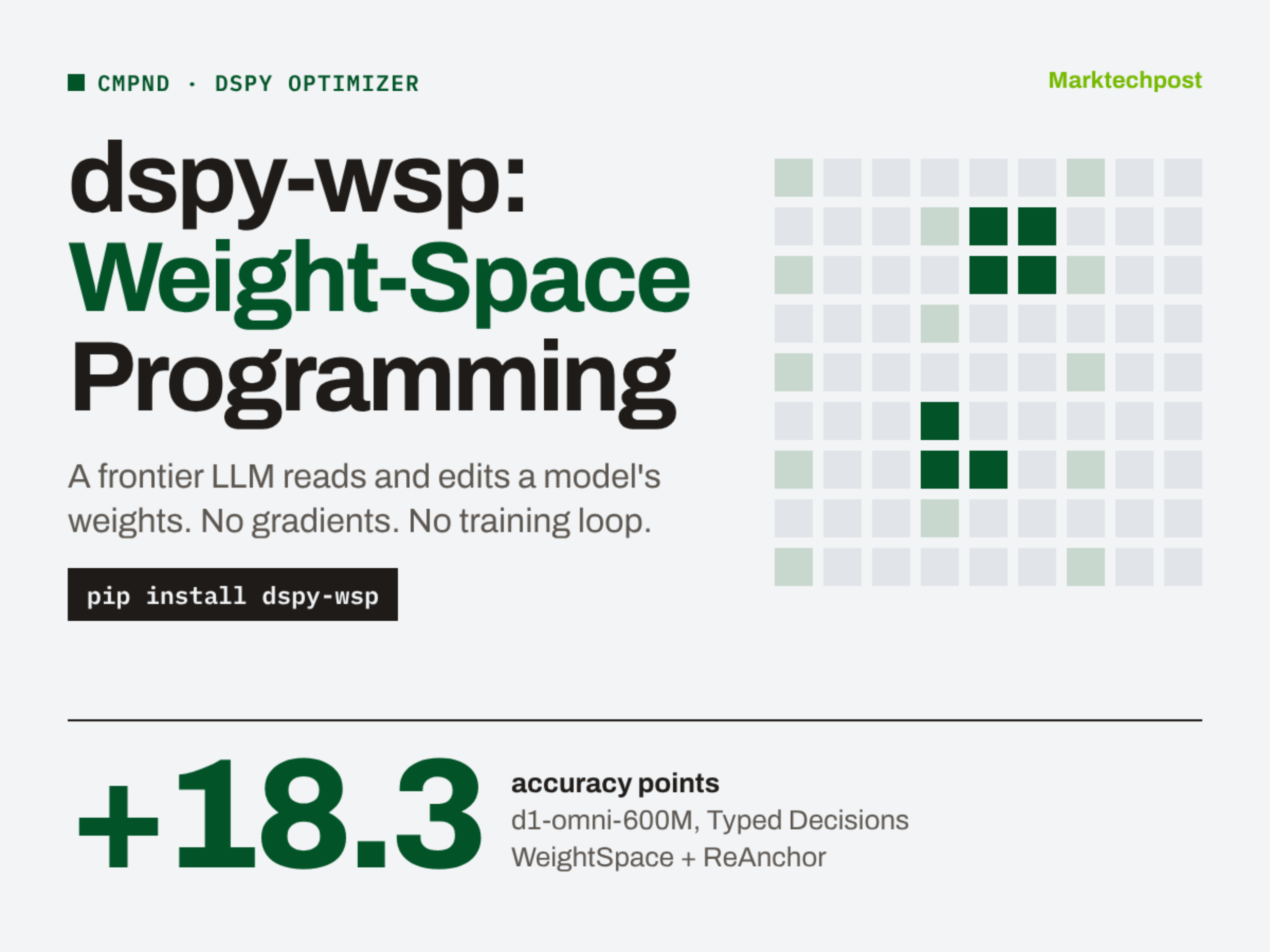
Cmpnd has released dspy-wsp, a prototype optimizer that brings weight-space programming to DSPy. Weight-space programming is a technique in which a frontier LLM reads another model’s weights and edits them directly. There are no gradients, no training loop and no fine-tuning dataset. dspy-wsp packages this as WeightSpace, an optimizer that plugs into any DSPy program and metric. In Cmpnd’s tests, about $5 to $10 of GPT-6-Astra calls improved every decision model they tried. You can check the deployment options and specs here through our GPULeaderboard.com chrome extension.
Weight-space programming (WSP) treats a neural network’s weights as a program that can be read and rewritten. The idea comes from MIT research: Sparks of Weight-Space Programming.
A frontier model (the research team used GPT-6-Astra) looks at weight tensors, reasons about what each part computes, and changes them to match a goal written in plain English. The research team stresses that WSP names an emerging capability, not a fixed method. Gradients were banned in their experiments, but the concept does not rule them out.
The research post frames WSP as the next step after using LLMs to optimize text artifacts. Earlier work let LLMs hill-climb on prompts, harnesses and training code. Weights were left to Adam or to trained weight-generating networks. WSP argues LLM reasoning can now reach the weights directly.
Source: MarkTechPost — Read the full article on the original site ↗