


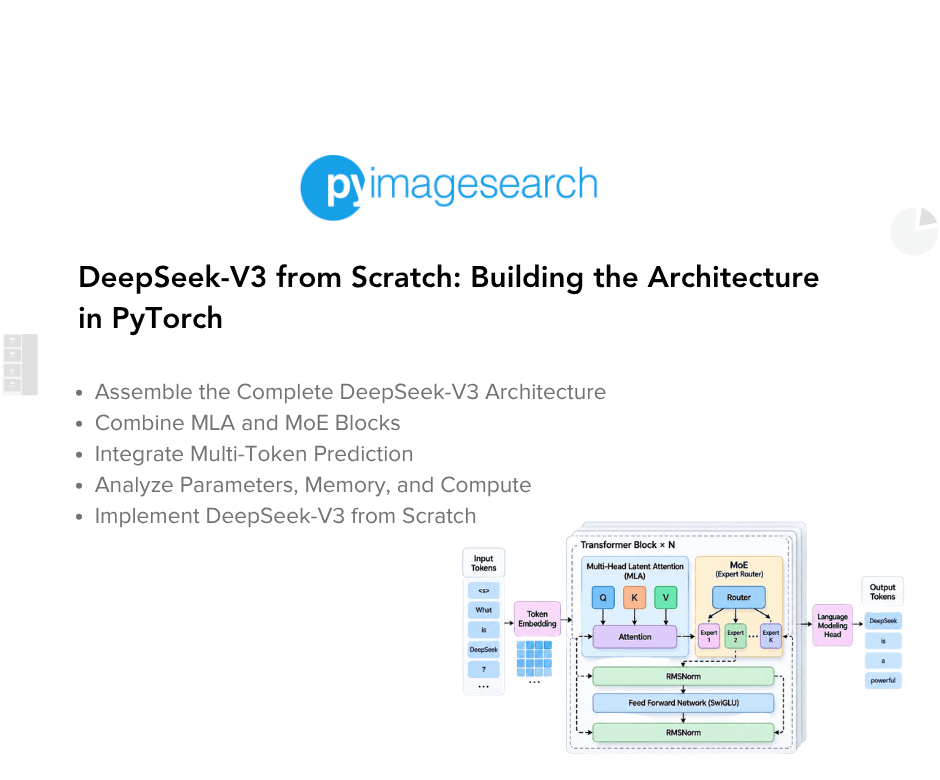
Across the first 4 lessons, we have carefully constructed the building blocks of DeepSeek-V3: starting with its configuration and Rotary Position Embeddings (RoPE), advancing through Multihead Latent Attention (MLA), scaling capacity with the Mixture of Experts (MoE), and using Multi-Token Prediction (MTP) to improve training efficiency and enable faster inference through speculative decoding. Each of these innovations has added a vital piece to the architecture, preparing us for the next major milestone: bringing everything together into a unified system.
In this lesson, we will focus on assembling the full DeepSeek-V3 architecture. This is where theory and implementation converge: integrating RoPE, MLA, MoE, and MTP into a cohesive model that reflects the design principles of DeepSeek-V3. We will walk through how these components interact, the structural choices that make them synergize effectively, and the practical considerations for building a scalable, efficient language model. By the end, you will have a complete architecture blueprint, ready for the final lesson in the series, where we will implement the DeepSeek trainer and bring the model to life through training.
This lesson is the 5th in the 6-part series on Building DeepSeek-V3 from Scratch:
To learn about DeepSeek-V3 and build it from scratch, just keep reading.
Source: PyImageSearch — Read the full article on the original site ↗