


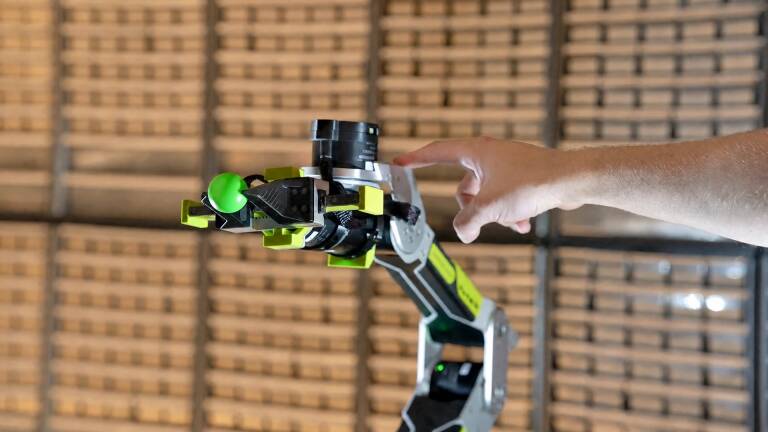
Build a responsive gravity-compensation loop with Pinocchio, a Seeed Studio reBot arm, using a simple Holoscan graph in Python or C++
Picture guiding a robot arm by hand while its motors supply just enough torque to support its weight and keep the robot upright. This simple interaction, a useful starting point for robots that learn by demonstration, manipulate objects, or work alongside people, depends on a gravity-compensation loop.
Building such a loop is only possible by continuously calculating the inverse dynamics of the system based on precise models of all the links of the robot arm, their dimensions, masses, and moments of inertia. This calculation, which needs to be done rapidly with low jitter, requires knowing the current state of the robot, so gravity-comp demos are an excellent proof of life for both the robot model and the runtime that’s executing these algorithms.
NVIDIA Holoscan 5 introduced robotic control alongside streamlined sensor processing. In this tutorial, we’ll build custom Holoscan SDK operators and wire them into a graph. We’ll test the code on a real robot and use the Holoscan SDK’s built-in Nsight Systems annotations to inspect latency and jitter.
Source: NVIDIA Technical Blog — Read the full article on the original site ↗