


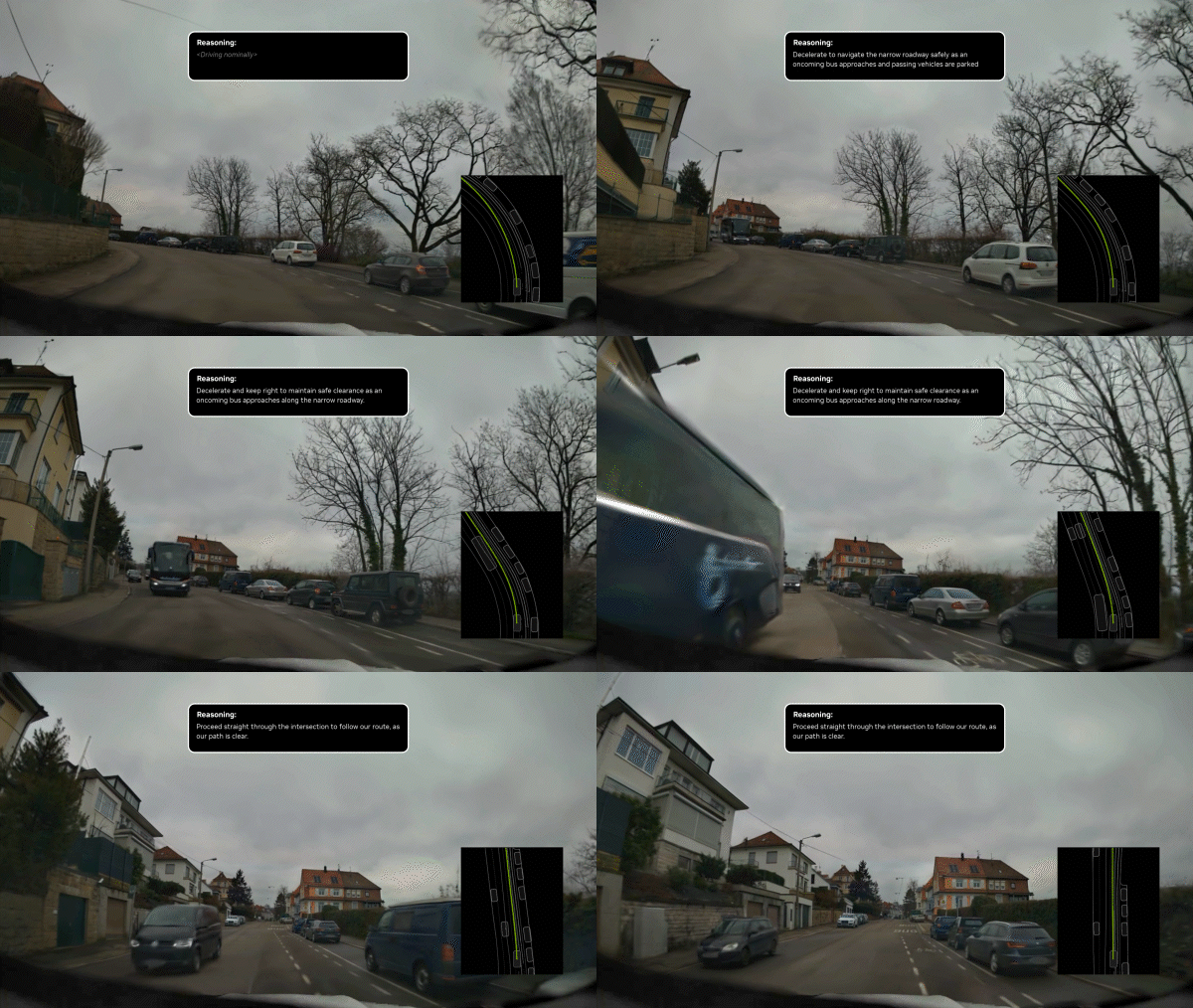
Autonomous vehicle (AV) developers need reasoning models that can operate within the compute and latency constraints of an onboard system. Larger models provide a foundation for developing these capabilities, but moving them into a vehicle requires additional work to reduce model size, preserve useful reasoning, and validate performance on the target hardware.
NVIDIA Alpamayo 2 Edge addresses this need with an adaptive reasoning vision-language-action (VLA) model designed for real-time operation on NVIDIA DRIVE AGX Thor. Built on the 2B Nemotron-based reasoning backbone of NVIDIA Cosmos 3 Edge and paired with a diffusion action expert, it leverages surround-camera observations, temporal context, and navigation inputs to generate Chain-of-Causation (CoC) reasoning and future driving trajectories. It reasons adaptively, generating reasoning only when needed, reducing unnecessary token generation and conserving inference compute during routine driving.
Alpamayo 2 Edge is post-trained with closed-loop reinforcement learning (RL) in NVIDIA AlpaGym, improving closed-loop driving performance by 48.9% on top of the best-performing checkpoint without closed-loop RL. Together, these capabilities give developers a strong, edge-ready foundation for bringing reasoning-based driving into an onboard stack.
Making a reasoning model compact enough for onboard deployment introduces a key challenge: preserving the quality of its reasoning and driving behavior as model size is reduced. This requires a way to measure reasoning quality and use that feedback to improve the model. NVIDIA AlpaJudge is the human-calibrated evaluation and reward model used in Alpamayo 2 Edge development to evaluate reasoning traces, select higher-value training data, and provide RL rewards.
Source: NVIDIA Technical Blog — Read the full article on the original site ↗