


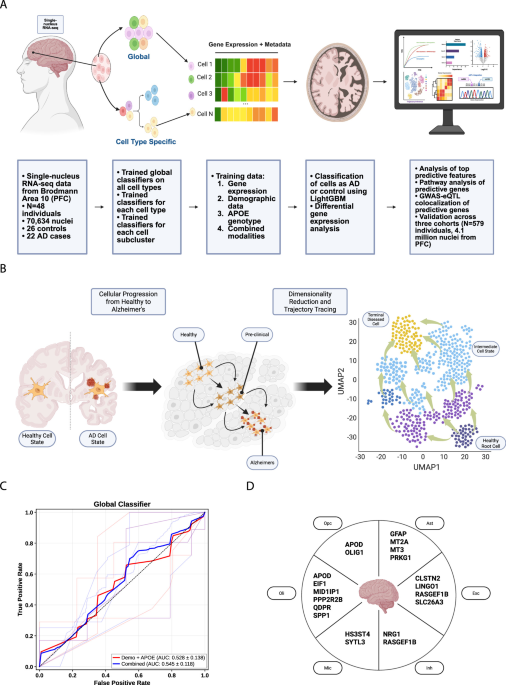
Univariate differential expression analysis dominates single-cell transcriptomic studies of Alzheimer’s disease, yet marginal testing alone cannot resolve multivariate disease-associated structure or distinguish clinical from neuropathological signatures. Here we introduce TriSCOPE, a framework integrating multivariate predictive modeling, donor-aware differential expression, and pseudotime inference, applied to six Alzheimer’s disease snRNA-seq datasets comprising ~4.2 million nuclei from 627 donors. Across six major brain cell types and 41 subclusters, we identify cell-type-specific predictively expressed genes that are largely non-overlapping with differentially expressed genes, revealing disease-relevant signals invisible to univariate approaches. Conditional GWAS–eQTL colocalization anchors a subset of these predictively expressed genes to inherited Alzheimer’s disease risk loci, including 27 genetically supported gene–cell type pairs (among them ARL17B, JAZF1) with no significant differential expression. Integration across all three analytical branches nominates high-confidence convergent programs including astrocytic stress markers (such as GFAP, MT2A), neuronal signaling genes (like RASGEF1B, LINGO1, NRG1), and microglial and oligodendrocyte regulators (including SYTL3, SPP1, APOD). Comparison of clinical and neuropathological models reveals cell-type-specific divergence between cognitive and pathological Alzheimer’s disease signatures. Key predictively expressed genes including ARL17B, LINGO1, and APOE replicate across independent cohorts, with cross-cohort generalizability confirmed across all three analytical branches of TriSCOPE.
Alzheimer’s disease (AD) is a progressive neurodegenerative disorder marked by the accumulation of amyloid-β plaques, intracellular neurofibrillary tangles (NFTs) in neurons, and cognitive decline, and is inextricably linked with age1,2,3,4. Despite decades of research, AD continues to affect millions worldwide and remains a major public health challenge5,6. Single-nucleus RNA sequencing (snRNA-seq) has revealed cell-type-specific transcriptional alterations in AD7,8, but most studies rely on univariate differential expression (DE) analyses, which identify hundreds to thousands of marginally associated genes per cell type without resolving redundancy among correlated transcripts or distinguishing which genes remain informative when modeled jointly. As a result, DE alone cannot capture the multivariate structure of disease-associated transcriptional programs or identify disease-relevant genes whose signal emerges only when modeled jointly with covariates.
Multivariate machine learning offers a complementary approach: by introducing implicit regularization and competition among correlated features, supervised models prioritize genes that contribute independent predictive information beyond other transcripts and known covariates such as age, sex, and APOE genotype9,10,11. Rather than serving as a prognostic tool, machine learning in this context functions as a hypothesis-sharpening instrument, compressing thousands of candidate genes into a focused, multivariately informative subset that can then be interrogated through orthogonal genetic and trajectory-based analyses.
Here we introduce TriSCOPE, an integrative machine learning framework that combines: (i) multivariate predictive modeling using AutoML, (ii) differential expression analysis, and (iii) pseudotime-based trajectory inference. By incorporating orthogonal evidence beyond univariate fold change, TriSCOPE enables convergent validation of disease-relevant genes and reduces false positives12. Here we applied TriSCOPE across six snRNA-seq datasets comprising ~4.2 million nuclei from 627 donors (Table 1)7,13,14,15, all from the Dorsolateral prefrontal cortex (PFC), a region centrally involved in the executive dysfunction characteristic of clinically manifest AD16.
Source: Nature - Machine Learning — Read the full article on the original site ↗