


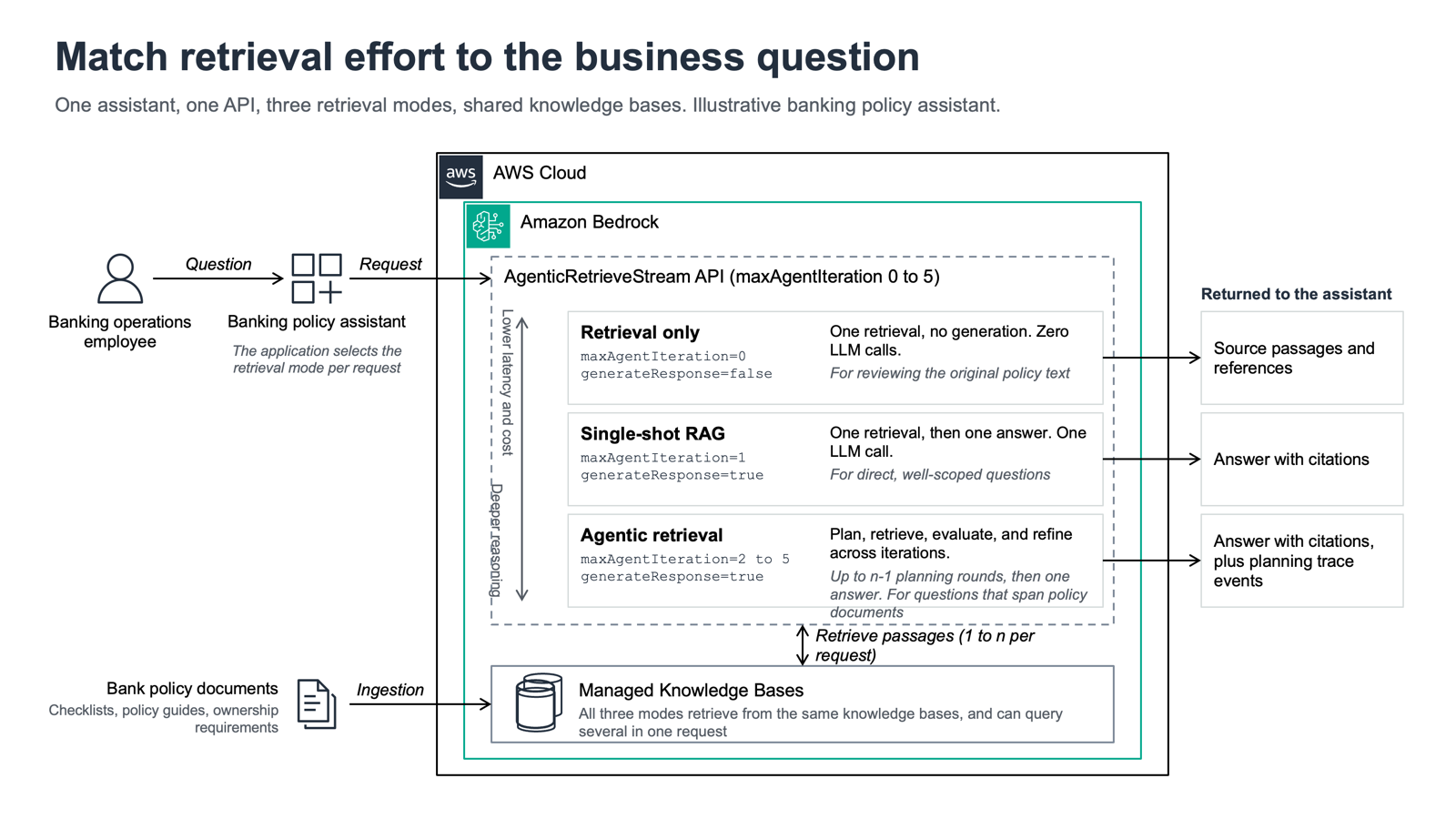
A banking operations employee starts the morning by asking an internal AI assistant which documents are needed to open a business account. The answer is in a single checklist. A few hours later, the same employee asks how those requirements differ across sole proprietorships, LLCs, and partnerships with multiple owners. That answer is spread across several policy guides. One assistant has to handle both questions, quickly and cheaply for the first and thoroughly for the second. Applications need a way to match retrieval effort to each request without building separate systems for simple and complex questions.
Amazon Bedrock Managed Knowledge Base now supports single-shot Retrieval Augmented Generation (RAG) and retrieval-only requests through AgenticRetrieveStream. With single-shot RAG, the service searches your knowledge bases once and uses a foundation model (FM) to generate an answer from the passages it finds. With retrieval-only requests, the service returns the matching passages without generating an answer, so your application or the user can work with the source text directly. These modes join the existing agentic retrieval, where the service plans and runs multiple searches before answering. You can now use the same API for both of the employee’s questions: single-shot RAG for the checklist lookup and agentic retrieval for the cross-policy comparison.
In this post, we explain how the new settings work and when to use each mode. We use an illustrative internal banking policy assistant to show how single-shot RAG handles direct questions and how agentic retrieval supports comparisons across policy documents. We also show how to configure retrieval-only requests when an employee needs to review source passages rather than a generated answer.
Agentic retrieval helps an assistant answer questions that require more than one search. A foundation model breaks the question into sub-queries, searches the relevant knowledge bases, and evaluates whether the results provide enough information to answer the original question. If it identifies gaps, it can refine the search and retrieve additional evidence, within the configured iteration limit.
Source: AWS Machine Learning Blog — Read the full article on the original site ↗