


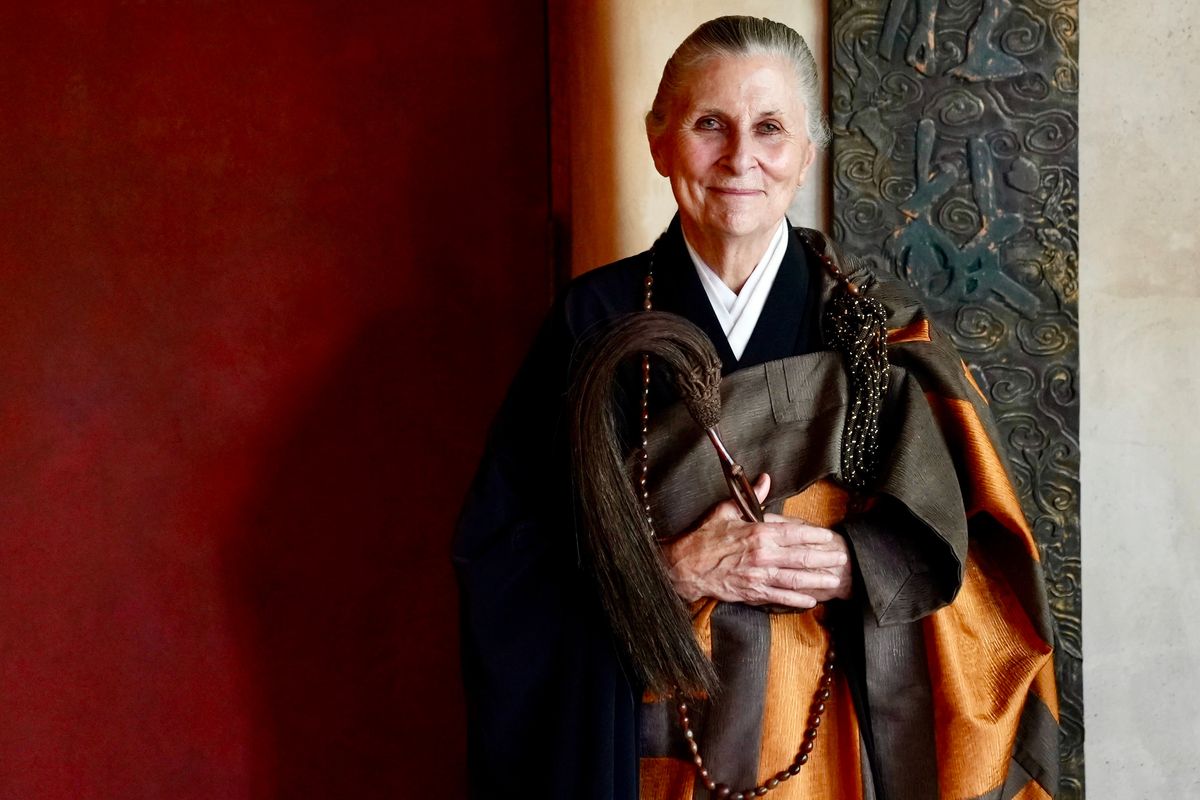
Six weeks after two open-heart surgeries in 12 days, Roshi Joan Halifax invited me for a visit. She was recovering, but feeling ‘weak as a kitten’. When I’d last seen her, three or four years earlier, her hair had been shorn in a Zen tonsure; now it hung in a lush, grey-streaked braid to the middle of her back. She was pale and short of breath.
As a physician and her friend, I was reluctant to press on with the interview, but she wanted to begin. She was staying with Wendy Lau, her close friend, an emergency physician and Zen priest whose home overlooks Upaya, the Zen centre Halifax established in 1990 in the foothills above Santa Fe in New Mexico. We sat on Lau’s back porch, drinking tea.
Halifax is a medical anthropologist, a Buddhist teacher and a caregiver to the dying, who has worked with the suffering of others for more than 50 years: in burn units and jail clinics, in remote Himalayan villages, at the bedsides of people for whom there was nothing left to cure. She learned that the qualities that drew her there could also pull her under, and more than once they did. When she found her way back, it was Buddhist practice that helped her remain steady enough to help.
Halifax had almost died. She had gone into the operating room at Stanford cheerful, she told me – upbeat, confident. Surgeons repaired her heart’s mitral valve. Coming out of anaesthesia, intubated, she was certain the tube was positioned incorrectly. She couldn’t speak, so she made writing motions until someone put a pen in her hand, and – stoned, half-conscious – she wrote glottis. Wendy Lau understood. They fixed it.
Source: Aeon — Read the full article on the original site ↗