


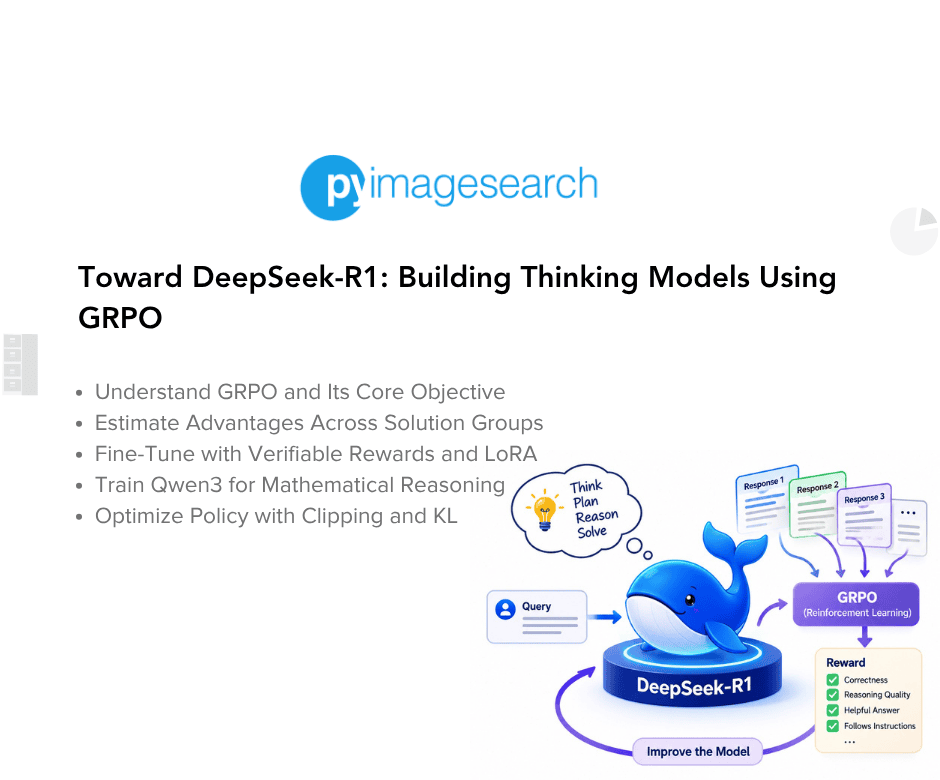
The journey from DeepSeek‑V3 to DeepSeek‑R1 marks a pivotal shift in how we think about language models: not just as pattern recognizers, but as reasoning agents. While V3 focused on architectural innovations (e.g., multi-head latent attention (MLA), mixture of experts (MoE), and multi‑token prediction (MTP)), R1 introduced a new dimension: the ability to think through problems step by step. At the heart of this breakthrough lies Group Relative Policy Optimization (GRPO), a reinforcement learning technique designed to refine models beyond next‑token prediction, enabling them to tackle complex reasoning tasks with verifiable outcomes.
Unlike traditional fine‑tuning methods, GRPO leverages the idea of relative advantage within groups of solutions. Instead of rewarding a model for producing a single correct answer, GRPO evaluates multiple attempts, compares their relative quality, and uses this structured feedback to guide learning. This makes it particularly powerful for domains (e.g., mathematical reasoning), where correctness can be objectively verified and where diverse solution paths provide rich signals for improvement. In practice, GRPO can further train small language models (e.g., Qwen3) using verifiable rewards for answer correctness and output format.
In this bonus lesson, we will explore how GRPO works, why it excels in reasoning tasks, and how to apply it to post‑train smaller models. We will walk through the core GRPO objective, its clipped surrogate function, and Kullback-Leibler (KL)…
Source: PyImageSearch — Read the full article on the original site ↗