


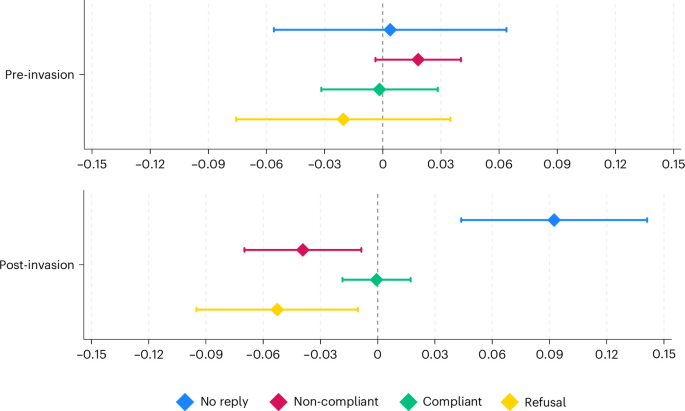
Here, using two rounds of natural field experiments based on an audit-study approach, we investigated whether sanctioned Russian government officials retain access to the international financial system. Researchers sent 7,081 email solicitations to intermediary firms in 202 countries and jurisdictions to establish shell companies and set up corporate bank accounts. Responses to sanctioned names (middle initial modified) are compared with equivalent solicitations from non-sanctioned placebo names. Round 1 results in December 2020 reveal no statistically significant difference in financial access for the sanctioned names compared with placebo. Round 2 findings in May 2022, after the Russian invasion of Ukraine, indicate that sanctioned individuals’ access to international corporate services and banking was significantly reduced (drop in non-compliant response rates: 4.0 percentage points, 95% confidence interval 1.2–6.8, P = 0.006, Cohen’s d = 0.207). The results suggest that factors related to the war and not sanctions law proved decisive in constricting sanctioned individuals’ access to the global financial system.
Economic sanctions have become the main tool of international coercion short of war. Conventional sanctions block trade or financial relations with targeted states1,2,3,4. Recently, however, ‘smart sanctions’ applied via private firms have targeted individuals and companies, rather than whole countries, aiming to constrict their access to the financial system5,6,7,8,9 (Supplementary Information, section 1.1). The most important current such sanctions target Russian officials, but research has questioned their effectiveness10,11,12,13 and raised concerns about unintended consequences14,15,16. Do these sanctions effectively deny targeted individuals access to the financial system?
Lack of data availability and a focus on country-level analysis has limited prior research. Previous work has failed to credibly identify the causal effects of sanctions owing to the many confounding factors involved in their application. This problem echoes causal inference challenges faced by other related areas of international social science such as civic behaviour17,18,19 and environmental stewardship20,21 that randomized control trials have addressed. Thus, this study tests the effectiveness of financial sanctions targeting individual Russian officials via a two-stage natural field audit experiment before and after the February 2022 invasion of Ukraine.
The results reveal that sanctioned names before the invasion produced no significant difference in access to global-banking and company-incorporation services compared with placebo names. After the invasion, however, the sanctioned names received significantly fewer responses than placebo, cutting the baseline response rate roughly in half. Ominously, sanctioned names still received many positive responses; factors related to the war diminished access to global finance for sanctioned individuals, but far from completely. Throughout the text, we use ‘sanctioned names’ to refer to names in our experimental treatment condition, which were names drawn from the Magnitsky sanctions list but with middle initials modified.
Source: Nature Human Behaviour — Read the full article on the original site ↗