


AI agents increasingly handle work that depends on what changed today, such as security advisories, product releases, prices, and regulations. A model’s training data can’t answer those questions, so agents need web search. For production use, teams also need results they can cite, and control over which sources count. They want search queries to stay inside their cloud environment because those queries often reveal internal work.
The Web Search API in Amazon Bedrock AgentCore is now available. It gives agents and applications current web results through a single API call, signed with the AWS credentials they already use. AWS serves every query from a web index that Amazon operates, and doesn’t send it to a third-party search engine.
Each result includes the page’s title, URL, publication date, and an extract relevant to the query. Requests can include or exclude domains, and limit results to a publication date range. On AWS Lambda, Amazon Elastic Container Service (Amazon ECS), or Amazon Bedrock AgentCore runtime, your agent calls the API with its execution role. There’s no search API key to store or rotate. Web Search on Amazon Bedrock AgentCore is also available through AgentCore Gateway, a capability of Amazon Bedrock AgentCore. There, one administrator source policy covers every agent and Model Context Protocol (MCP) client.
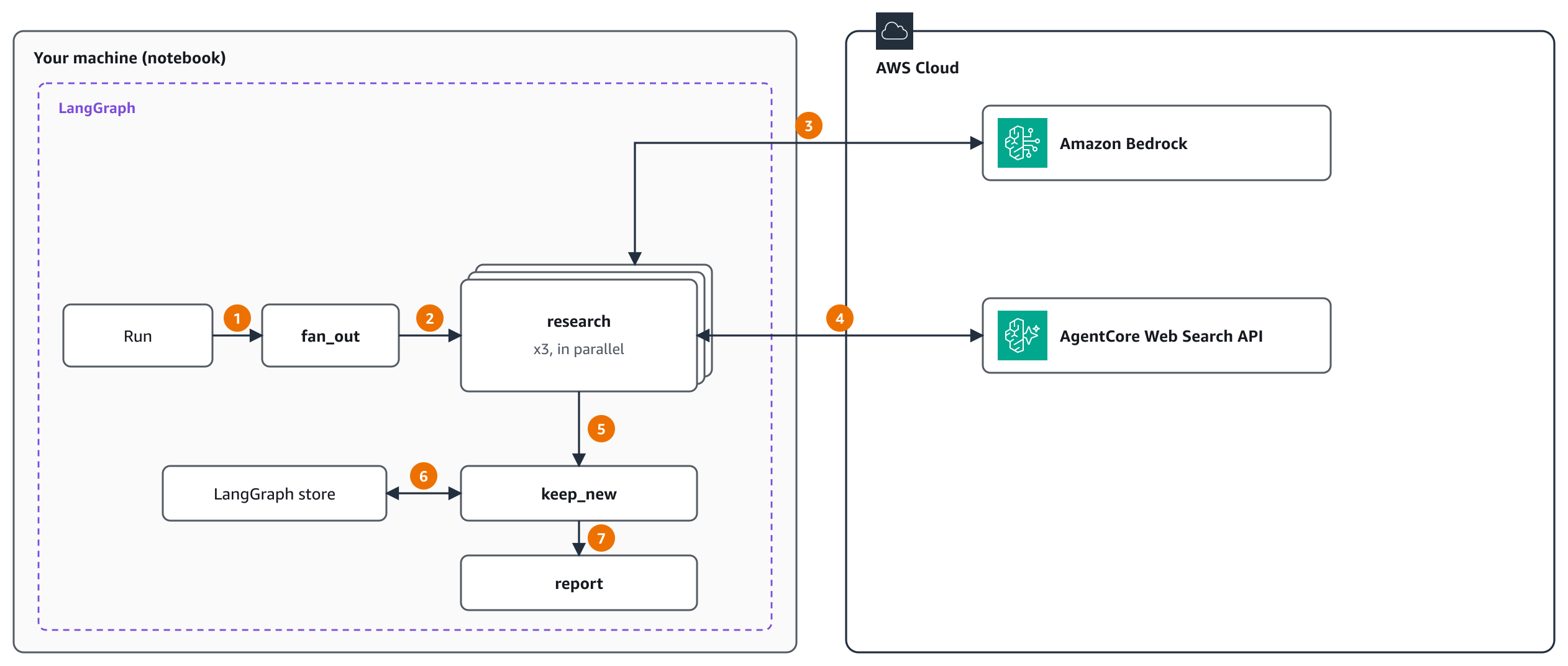
For LangChain developers, the AgentCore web search tool in LangChain’s AWS integration now calls the Web Search API. One function call gives an agent current, cited search results. The tool can also hold rules that the model can’t change, such as a date window, a source blocklist, and a search budget. It returns its results as data that your code can check. It works with LangChain agents, with LangGraph, the orchestration framework that runs them, and with Deep Agents, which adds subagents, a virtual filesystem, and context compression.
Source: AWS Machine Learning Blog — Read the full article on the original site ↗