


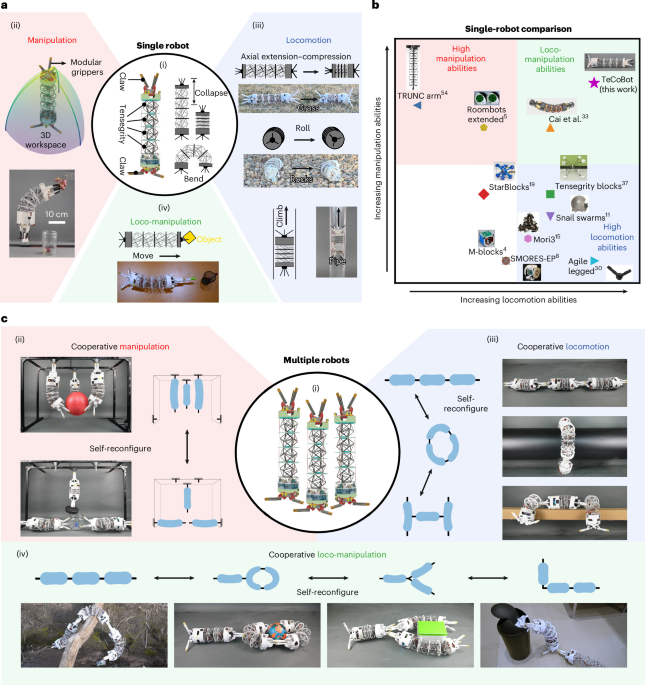
Robots that can change their morphologies and behaviours for different tasks and environments hold great promise for adaptable, multifunctional systems. Modular reconfigurable robots can achieve such functionalities by docking and rearranging individual units, but most rely on rigid modules that lack structural compliance, resulting in limited capabilities. Continuum robots offer compliance through flexible backbones, yet they cannot self-reconfigure into task-adaptive multi-robot configurations. Here we introduce a modular reconfigurable robot that unifies the advantages of both architectures by combining a tensegrity-based compliant body with claw-based connection mechanisms. Each robot can manipulate and locomote independently, and multiple robots can self-reconfigure into different morphologies (for example, chains, loops, branches) for cooperative manipulation and locomotion. We demonstrate the robots’ capability across diverse tasks and environments, including coordinated object manipulation and transport, multimodal locomotion, and loco-manipulation in real-world scenarios. These results lay a foundation for adaptable and multifunctional robotic collectives, with broad potential applications in manufacturing, space exploration and search-and-rescue operations.
This is a preview of subscription content, access via your institution
Prices may be subject to local taxes which are calculated during checkout
The source data underlying the figures are available on figshare at https://doi.org/10.6084/m9.figshare.33578671 (ref. 69). File-by-file descriptions, including column definitions and units, are provided in the README accompanying the deposit. Source data are provided with this paper.
Source: Nature Machine Intelligence — Read the full article on the original site ↗