


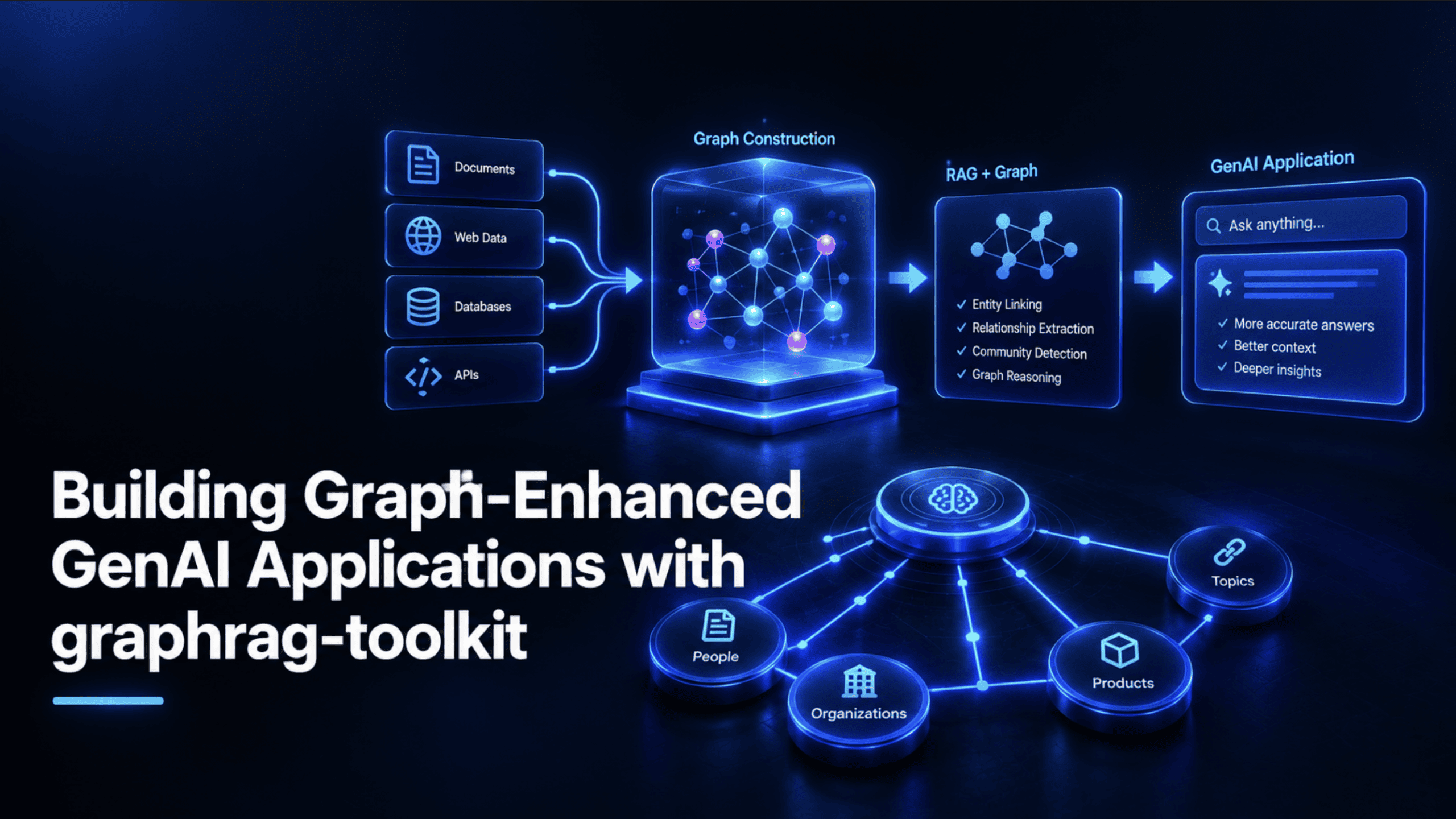
Learn how graph-enhanced RAG connects related facts that plain vector search misses, then build a multi-hop research assistant with AWS Labs' open-source graphrag-toolkit, Neo4j, and pgvector.
A standard retrieval-augmented generation (RAG) chatbot handles "what does the return policy say" without any trouble: it finds the chunk, hands it to the model, and it's done. Ask it something like "how does the return policy interact with the warranty terms for international orders," and it starts to wobble. That answer isn't sitting in any single chunk. It requires connecting two separate pieces of the document that were never near each other in the source text, and a vector search that only measures how similar each chunk sounds to the question has no way to make that connection on its own.
That specific gap — a system that finds relevant text but can't follow relationships between pieces of it — is exactly what graph-enhanced retrieval exists to close. This article walks through what that actually means, introduces AWS Labs' open-source graphrag-toolkit, and then builds a real, working graph-enhanced research assistant from scratch, with every piece of code checked directly against the toolkit's own documentation rather than assumed from memory.
Graph-enhanced RAG, usually shortened to GraphRAG, is retrieval that queries a knowledge graph rather than a plain vector index, so an application can follow actual relationships between pieces of information instead of only finding text that sounds similar to the question. Neo4j's own explainer frames this as combining the retrieval strengths of a knowledge graph — explicit entities and the relationships between them — with the generative fluency of a large language model (LLM), so the model reasons over connected facts rather than isolated fragments of text.
Source: KDnuggets — Read the full article on the original site ↗