



|
Getting your Trinity Audio player ready...
|
When meeting new individuals or known individuals in new circumstances, we intuitively map out their relationships—not merely through direct experience, but by inferring new connections on the basis of prior relational knowledge. How such relational knowledge is represented and used in the brain remains a long-standing question in cognitive neuroscience. Here, using a behavioural task and computational modelling, we show that participants (N = 36) leveraged existing knowledge of relational structures to infer new relationships, facilitating adaptation in changing environments. Whole-brain neuroimaging identified consistent representations of relational structure in the hippocampus. To investigate the causal link between hippocampal representations and inference, we used neural network simulations to predict the behavioural effects of disrupting such representations. Consistent with this prediction, transcranial ultrasound stimulation of the human hippocampus (N = 20), transiently modulating its activity, disrupted structure-based inference (P < 0.001, Cohen’s d = −0.89, 95% confidence interval −1.41 to −0.36), providing empirical evidence for a causal role of hippocampus in relational-structure learning and structure-based inference.
We have an increasingly detailed understanding of the neural mechanisms that underlie learning and decision-making; we understand how people and other animals learn about the values of options, how options are compared, and the neural circuits that mediate these processes1,2,3,4. In the real world, however, our ability to make flexible decisions in changing environments surpasses what might be expected if we had to learn about options anew each time circumstances change. This is because, as we experience how one thing has changed in a new environment, we make inferences about other things in that new environment even before experiencing them directly5,6. This ability is particularly salient in abstract and social domains, where we often intuitively extend knowledge from one relationship to infer others. However, it remains unknown how this is accomplished in the brain.
One possibility is that the brain can build mental models of the environment7,8,9 to inform our predictions in the face of changes or even reversals in circumstances. The hippocampus (HPC) has been implicated in mental models that represent not only spatial relations10, but also conceptual and social relations11,12. There is, however, particularly in humans, little evidence to link such hippocampal representations to decision-making in changing environments. In the current study, we show that HPC extracts the underlying relational structure from a dynamic environment to facilitate learning of new relations. More importantly, we further demonstrate that these representations are causally important for structure-based inference during new learning. This causal link is established by using focused transcranial ultrasound stimulation (TUS), to temporarily modulate bilateral HPC activity. As a deep brain region, HPC has been inaccessible to conventional non-invasive methods in humans13. TUS, however, can precisely, safely and reversibly modulate deep brain activity, as demonstrated by recent work with animal models14,15,16,17,18,19,20,21, allowing us to assess the causal effects of HPC disruption.
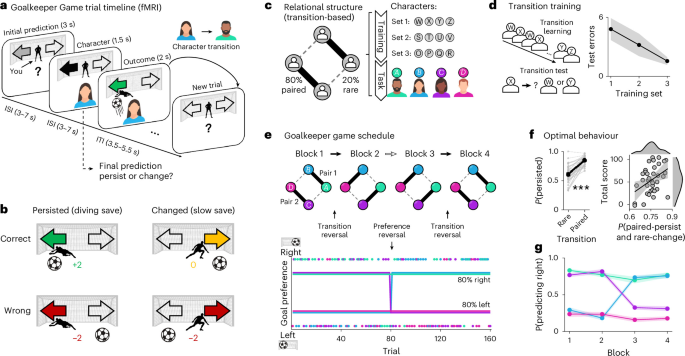
Through a series of experiments, we empirically assess the possibility that learning in changing environments is facilitated by knowledge of relational structure. We find that this is indeed the case even in the simple world of an artificial game (Fig. 1). In…
Source: Nature Human Behaviour — Read the full article on the original site ↗
Get the best of this topic in your inbox
Join the newsletter. A short, useful digest, no spam.



