



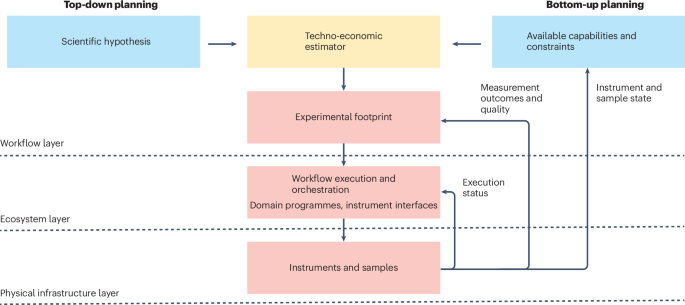
Autonomous scientists enabled by large language models and agentic reasoning have become a compelling narrative for accelerating research. Here we pose that labaoratory autonomy is not primarily a text problem, as experiments have to be run in the world of instrument-addressable actions and constraints, and planned based on costs, latencies and rewards. We argue for a bottom-up foundation for self-driving laboratories that complements language-first planning by introducing frameworks that translate hypotheses into decisions executable on real tools. We propose three operational principles. First, self-driving laboratories should adopt an information-efficiency objective that maximizes decision-relevant information per unit experimental cost. This requires combining comprehensive data acquisition with minimal, decisive experimental design. Second, hypotheses should be compiled into experimental footprints defined by accessible actions, constraints, observables and decision rules. Third, reward design should be treated as a central bottleneck in closed-loop experimentation, especially when high-dimensional measurements must be mapped to utility or extended to sequential decision-making. We frame self-driving laboratories as long-horizon, out-of-distribution discovery systems where accelerating the full experiment–model–decision loop and emphasizing physical and chemical knowledge discovery over short-term correlations is necessary to translate lab-scale optimization into durable technological and manufacturing impact.
This is a preview of subscription content, access via your institution
Prices may be subject to local taxes which are calculated during checkout
Sapkota, R., Roumeliotis, K. I. & Karkee, M. AI agents vs. agentic AI: a conceptual taxonomy, applications and challenges. Inf. Fusion 126, 103599 https://doi.org/10.1016/j.inffus.2025.103599 (2026).
Source: Nature Machine Intelligence — Read the full article on the original site ↗
Get the best of this topic in your inbox
Join the newsletter. A short, useful digest, no spam.