


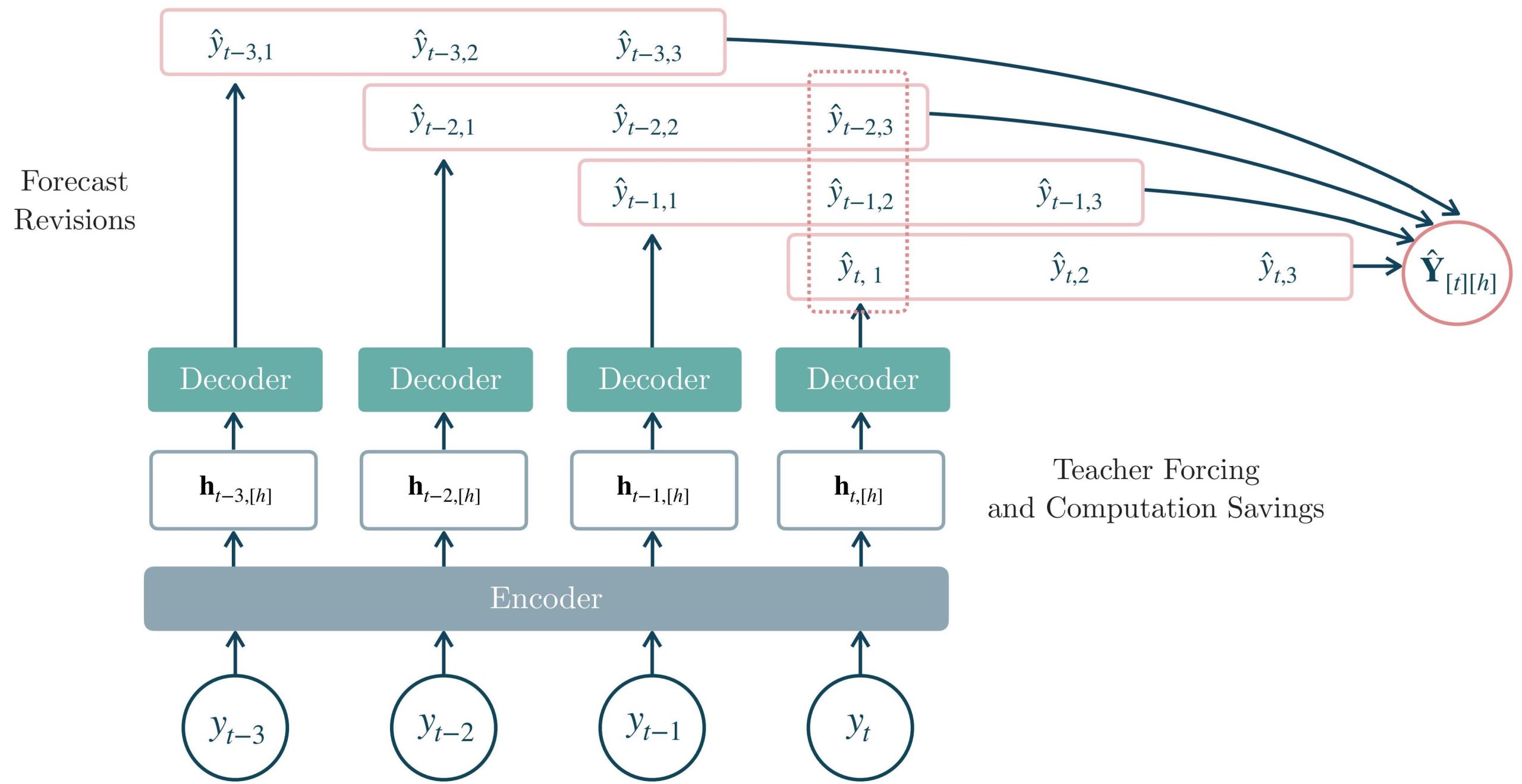
Based on: Potosnak, W., Wolff, M., Cao, M., Ma, R., Konstantinova, T., Efimov, D., Mahoney, M.W., Oreshkin, B., & Olivares, K.G. "Forking-Sequences: Statistically and Computationally Efficient Multi-Horizon Forecasting with Reduced Volatility." Transactions on Machine Learning Research, 2026.
(Disclaimer: Code implementation not used in the paper; not affiliated with Amazon — provided as a reference for forking-sequences and forecast ensembling)
In Part I, we introduced forking-sequences, a neural network architectural design that jointly encodes and decodes a time series across all forecast creation dates (FCDs) in a single forward pass. We showed why it's a statistically and computationally more efficient training paradigm than window-sampling. In Part II, we turn to a different but equally important problem: forecast volatility.
Accuracy is usually the headline metric for a forecasting model, but it isn't the only thing that matters in production. As a multi-horizon forecasting system operates over time, it generates multiple overlapping forecasts for the same future target date — one from each new FCD as more data becomes available. This sequence of updates is a forecast revision, and how consistent (or erratic) those revisions are is what we define as forecast volatility.
Source: CMU Machine Learning Blog — Read the full article on the original site ↗