



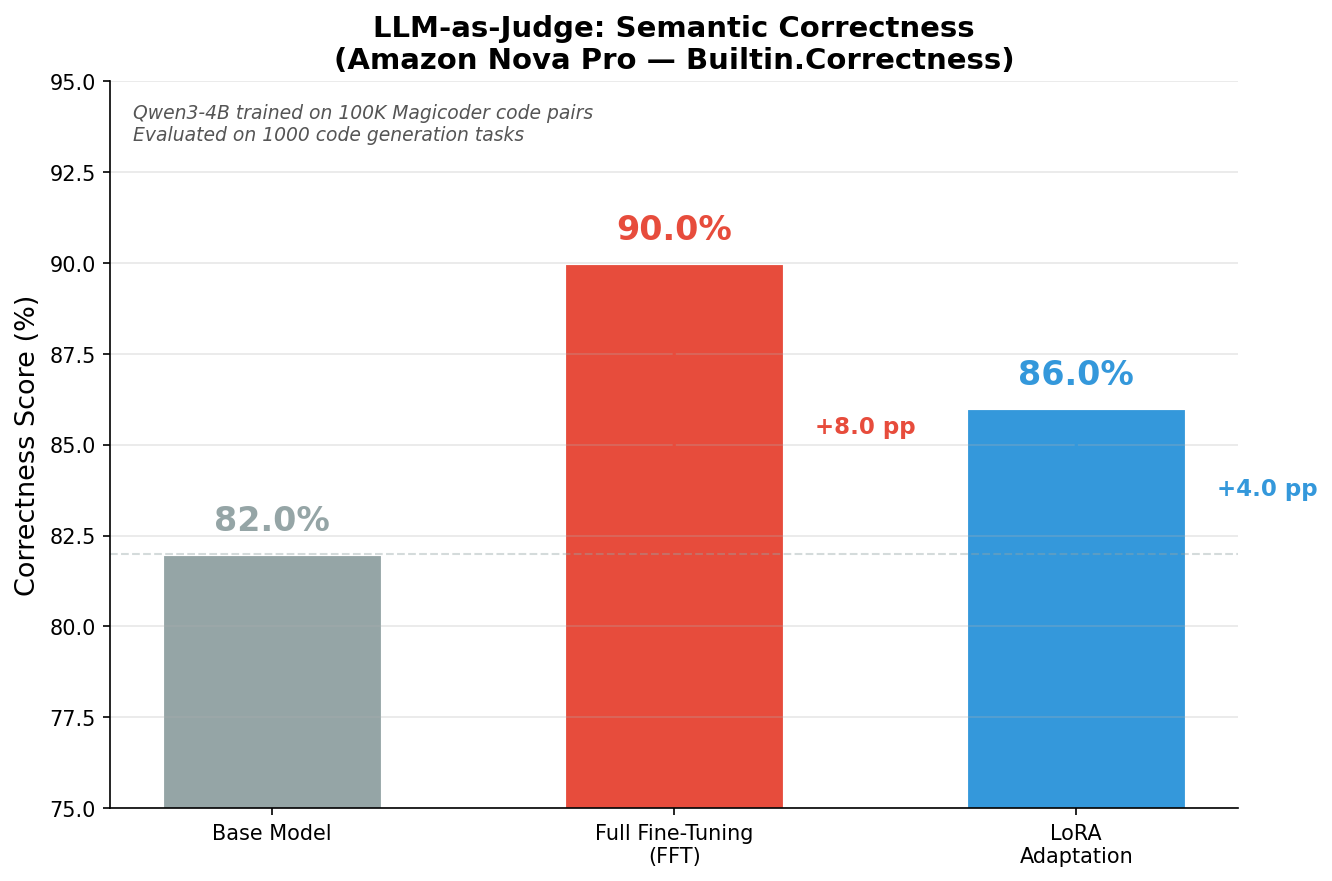
Fine-tuning is the process of continuing to train a pretrained large language model (LLM) on a company’s own data so it adapts to a specific domain, task, or style rather than relying on general-purpose knowledge alone. For businesses, the value is twofold. A fine-tuned model delivers measurably better accuracy on domain-specific work while reducing costs: a smaller specialized model can match or exceed a frontier model on your task at a fraction of the per-token inference price. Those savings compound across millions of requests. Fine-tuning has therefore become an essential process for businesses looking to get more value from LLMs at lower costs.
Parameter-efficient fine-tuning (PEFT) methods like Low-Rank Adaptation (LoRA) have emerged as a practical solution for fine-tuning LLMs to downstream tasks, reducing GPU capacity requirements by updating only a small subset of LLM parameters. LoRA aims to strike a balance between efficiency and expressiveness, however, the low-rank nature of the weight update inherently limits the representation power of LoRA fine-tuned models, potentially compromising performance on complex tasks. This trade-off hampers the ability of LoRA methods to capture complex patterns needed for diverse tasks. To address these challenges, Full Fine-Tuning (FFT) updates model parameters simultaneously, overcoming the low-rank limitations so LLMs can fully absorb complex domain-specific knowledge.
Amazon SageMaker AI Serverless Model Customization now supports Full Fine-Tuning (FFT), so you can achieve superior model quality without managing infrastructure. There is no GPU provisioning, cluster setup, or distributed-training configuration required. In this post, we explore when and where FFT consistently outperforms LoRA across key benchmarks, examine the spectral properties of model weight matrices that explain this quality gap, provide practical hyperparameter tuning guidelines backed by controlled experiments using SageMaker AI Serverless Model Customization, and show you how to get started with FFT on SageMaker AI.
Model customization types like LoRA reduce trainable parameters by freezing the pre-trained model’s weights and injecting small, separate pairs of replacement matrices (called low-rank matrices) into the model layers. This works well for simple adaptations, but the low-rank structure inherently limits the representation power of the fine-tuned model. As tasks grow more complex and datasets scale beyond tens of thousands of examples, LoRA hits an accuracy plateau where increasing rank (and thus trainable parameters) fails to bridge the accuracy gap with standard fine-tuning. This plateau reveals that the performance gap isn’t simply because of fewer parameters. It’s caused by rank deficiency itself. The low-rank update can’t capture the full complexity of the weight changes needed for deep task adaptation.
Source: AWS Machine Learning Blog — Read the full article on the original site ↗