



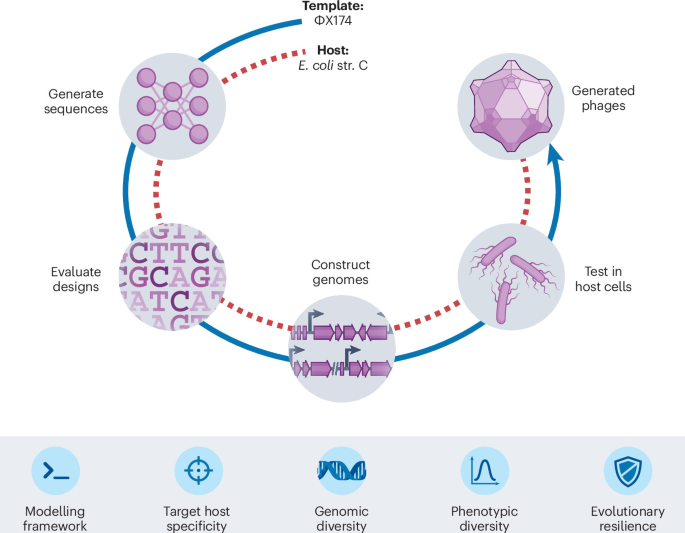
Biological design has been successful at the scale of individual genes and gene circuits, but designing genomes remains more difficult. Genomes consist of coding sequences, regulatory elements and structural features carefully orchestrated for complex, emergent functions, where a single misplaced nucleotide can be lethal. Thus, navigating the space of possible genome designs is too intractable for rational engineering and experimental screening alone.
Advances in generative AI algorithms, combined with large amounts of publicly available sequencing data, have enabled the development of genome language models (gLMs). Rather than being given explicit biological rules or labels, gLMs learn functional constraints of genomes by training on millions of DNA sequences across all of life, with the simple objective of predicting the next nucleotide in a sequence. Once trained, a gLM can assign probabilities to or generate DNA sequences. In principle, this function makes it possible to explore regions of genomic sequence space that are evolutionarily plausible but have not yet been observed in nature.
This is a preview of subscription content, access via your institution
Prices may be subject to local taxes which are calculated during checkout
Source: Nature - Machine Learning — Read the full article on the original site ↗
Get the best of this topic in your inbox
Join the newsletter. A short, useful digest, no spam.