



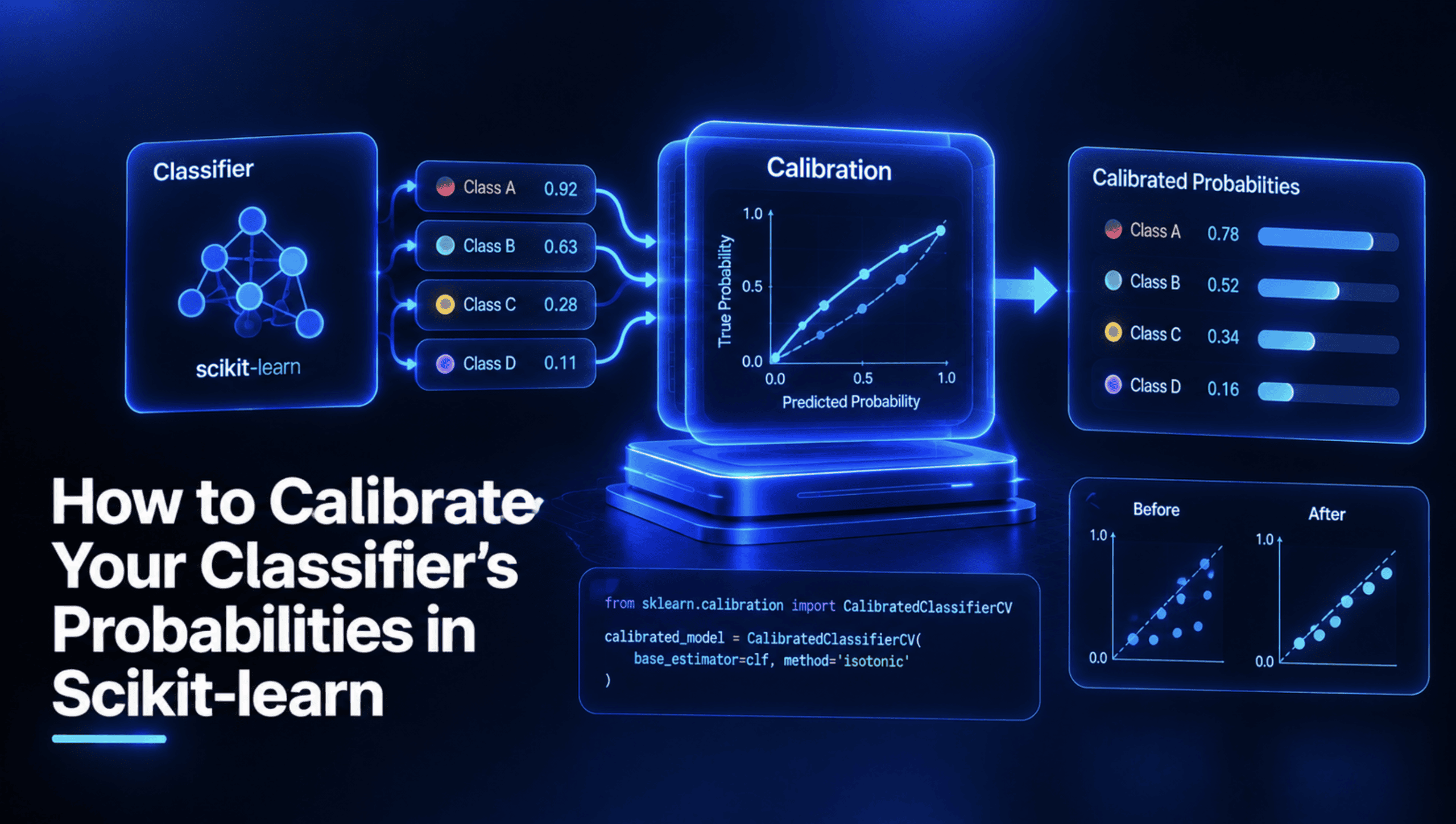
In this tutorial, you will train two scikit-learn classifiers on a real dataset, expose their miscalibration with a reliability diagram and a Brier score, and fix it with Platt scaling and isotonic regression
Your model says 0.9. You treat it as a 90% chance, set a threshold, and build a decision on top of it. Then you check the predictions the model scored near 0.9 and find that noticeably fewer of them were right. Nothing is broken. The model ranks cases well, and it is still a poor judge of how sure it should be.
That gap between a score and a real probability is what calibration closes. In this tutorial, you will train two scikit-learn classifiers on a real dataset, expose their miscalibration with a reliability diagram and a Brier score, and fix it with Platt scaling and isotonic regression. By the end, you will know how to calibrate classifier probabilities in scikit-learn and how to pick the right method for your data.
A well-calibrated classifier lets you read predict_proba as a confidence level. In the words of the scikit-learn user guide, among the samples that get a score close to 0.8, about 80% should actually belong to the positive class.
Source: KDnuggets — Read the full article on the original site ↗
Get the best of this topic in your inbox
Join the newsletter. A short, useful digest, no spam.