


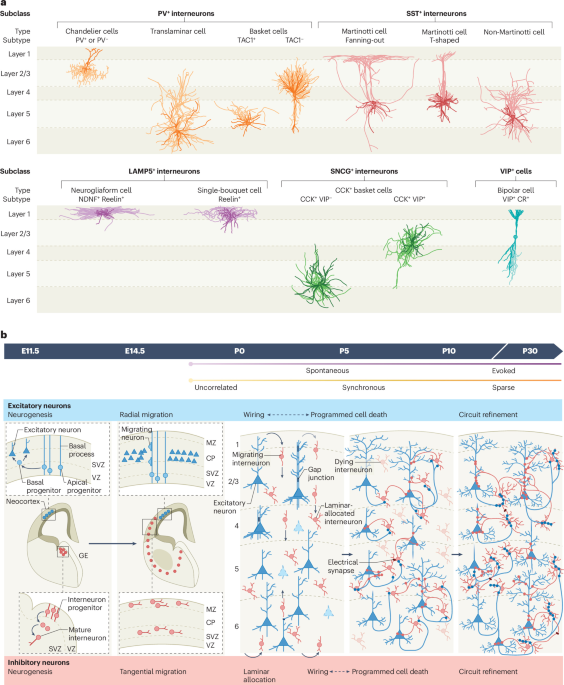
The mammalian cerebral cortex undergoes profound functional changes during early postnatal development. During this period, neurons generate spontaneous electrical activity long before sensory experience, coordinating into distinct patterns of synchronous activity. Traditionally, neuronal activity has been viewed as instructing interneuron development by modulating transcriptional programmes, morphology and connectivity.
However, accumulating evidence in rodents reveals that this relationship is bidirectional: cortical interneurons are not merely passive recipients of activity-dependent signals but also active architects of developing network dynamics. They regulate spontaneous activity transitions from gap-junction-mediated synchronous events to large, synaptically driven bursts, and later to sparse firing characteristic of mature circuits. Critically, different interneuron subtypes mature at distinct timelines and orchestrate transitions in network activity.
Activity-dependent mechanisms, in turn, regulate interneuron wiring, programmed cell death, diversification and terminal differentiation. This reciprocal dialogue between interneurons and network activity is essential for establishing functional cortical circuits. This is a preview of subscription content, access via your institution Prices may be subject to local taxes which are calculated during checkout
Source: Nature Reviews Neuroscience — Read the full article on the original site ↗