



|
Getting your Trinity Audio player ready...
|
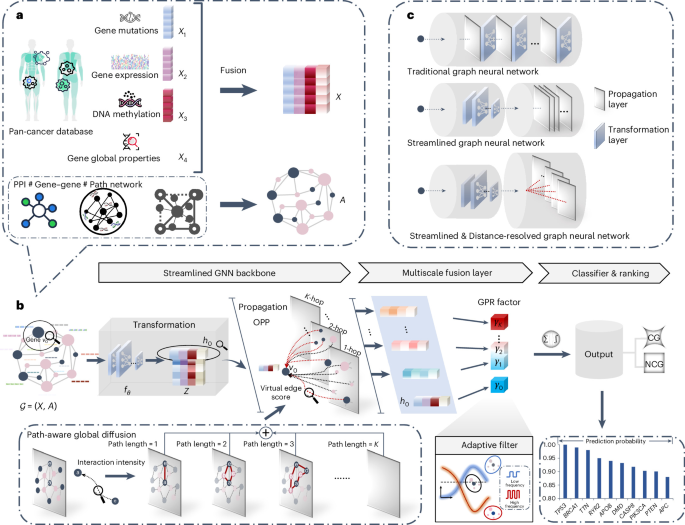
Systematic screening for cancer genes (CGs) is still a central goal in precision oncology, yet integrating sparse and spatially dispersed oncogenic signals to identify testable candidates remains challenging. Here we present CGMap, an interpretable graph-learning framework that uses a width-oriented parallel architecture to prioritize potential CGs from biomolecular networks and trace mechanistic cues.
By constructing distance-resolved channels, CGMap localizes spatially dispersed CG signals across multiple topological scales while avoiding representation homogenization. A global diffusion module quantifies gene cooperativity along pathway contexts and yields traceable virtual interactions that map predictions to potential regulatory hypotheses, providing intrinsic interpretability for model decisions.
Across multiple biomolecular networks in a pan-cancer setting, CGMap analysed 12,022 genes, consistently outperformed existing methods while remaining computationally efficient and prioritized 70 reliable candidates, including those previously unannotated in established databases. Importantly, the prioritized candidates were associated with the suppression of tumour-related phenotypes, including reduced cell proliferation, migration and invasion, along with a shift of epithelial-to-mesenchymal transition (EMT)-related features toward a non-mesenchymal state, as supported by parallel loss-of-function assays across cancer and non-malignant cell lines.
This is a preview of subscription content, access via your institution Prices may be subject to local taxes which are calculated during checkout
Source: Nature Machine Intelligence — Read the full article on the original site ↗
Get the best of this topic in your inbox
Join the newsletter. A short, useful digest, no spam.



