



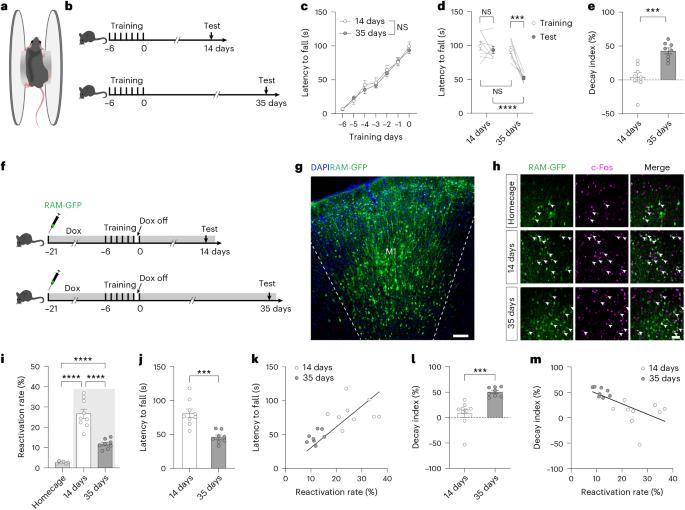
Experience-dependent changes in myelination are important for motor learning, with newly generated oligodendrocytes contributing to the formation of new myelin. However, motor memories decay over time and the underlying mechanisms remain largely unexplored. Here we show that motor memory decay is linked to changes in memory-associated myelin sheaths resulting from microglial phagocytosis in mouse brain. Mechanistically, reduced activity of motor memory engram cells lowers oligodendrocyte expression of the ‘don’t eat me’ signal from Cluster of differentiation 47 (CD47), facilitating microglial phagocytosis and driving myelin loss. Knockout of CD47 from motor memory-associated oligodendrocytes increased microglial phagocytosis of myelin sheaths and accelerated the decay of motor memory, whereas overexpression of CD47 showed opposite results. Moreover, microglia phagocytose myelin sheaths and synapses independently. Our findings reveal that microglial phagocytosis of motor memory-associated myelin sheaths leads to the decay of motor memory. Since various types of memory require myelination in the brain, this mechanism may contribute to the decay of other memory types.
This is a preview of subscription content, access via your institution
Prices may be subject to local taxes which are calculated during checkout
All data are available in the main text, figures, the extended data figures and the Supplementary Information. Source data are provided with this paper.
Source: Nature Neuroscience — Read the full article on the original site ↗