


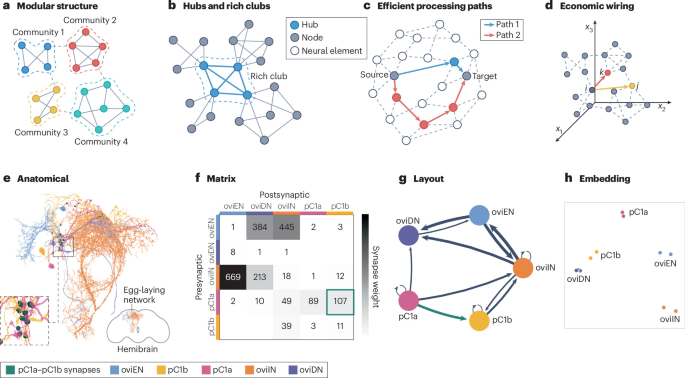
Although network science has offered insight into the organization and function of nervous systems, much of this work has focused on mesoscale, interareal connectomes. This leaves open the question of whether similar organizational principles apply to nanoscale connectomes, where individual neurons and synapses are the focus. These neuron-level datasets are uniquely complex, necessitating the refinement of existing tools and the development of new ones to handle their distinctive structure. Network science offers a range of approaches for analysing these data. Here, we focus on community detection, a family of methods for identifying subnetworks of functionally related neurons. We suggest that finding such communities could be valuable for several reasons: they could help us understand how modular organization supports adaptability and specialization, serve as a method for dimension reduction, and potentially aid in the discovery of new functional circuits. By reviewing some early applications and discussing contemporary methods, we aim to provide a roadmap for future studies in this emerging field, as we anticipate the arrival of new and more complex datasets.
This is a preview of subscription content, access via your institution
Prices may be subject to local taxes which are calculated during checkout
The larval D. melanogaster connectome data used for Figs. 3 and 4 are from ref. 14. The axon–dendrite synapse table was used for all figures.
Source: Nature Reviews Neuroscience — Read the full article on the original site ↗