



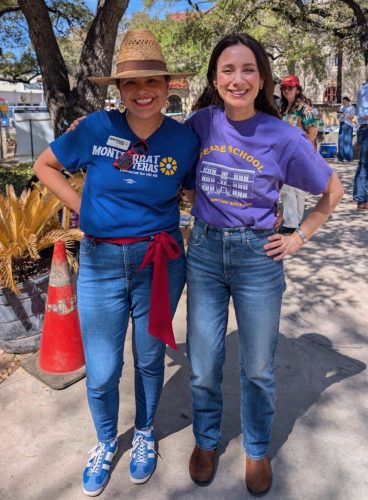
Democrat Montserrat Garibay, who won Texas House District 49 in this month’s history-making election, told The 74 she has big plans for education when she assumes her new role in January.
Garibay will take the seat vacated by Gina Hinojosa, who successfully challenged Republican Greg Abbott for governor, denying the conservative Trump ally a fourth term and becoming the first Latina to lead the state.
“I’m really proud and grateful,” Garibay said of her own Nov. 3 victory. “I spent the past year listening to people at their doors, and I am ready to take their stories, their needs and what they’re asking us to change to the Capitol.”
And she’s not just celebrating her own success, but that of her party: Democrats took control of the Texas House for the first time in 24 years.
“Seeing Democrats do so well in a state as red as Texas gives me hope and reiterates the power of grassroots organizing,” Garibay said. “I think about the young people we registered who were voting for the first time, the union members who showed up for us, and the volunteers who kept knocking on doors. That’s what democracy looks like to me.”
The 47-year-old is walking into this radically changed landscape as a newcomer, having never run for political office before.
Garibay was born in Mexico City and came to the United States at age 12, unable to speak English — and without citizenship.
She started her post-secondary education at community college before earning her bachelor’s and master’s degrees from the University of Texas at Austin.
She later became the vice president for certified employees with Education Austin, a merged local union affiliated with the American Federation of Teachers, the National Education Association and the AFL-CIO. She also served as secretary-treasurer of the Texas AFL-CIO.
Garibay spent eight years as a bilingual pre-K teacher at the Austin Independent School District before serving in the U.S. Department of Education during the Biden-Harris administration, starting in 2022.
She was first a senior labor relations advisor before taking over as director of the Office for English Language Acquisition. While there, she led the effort to return the Title III program, which funds and supports English learners, to her office from the Office of Elementary and Secondary Education, where it had been for 15 years.
“Bringing it back gave the state and local education leaders a team of 16 career staff with expertise in educating English learners,” Garibay said. “We could answer districts’ and states’ questions, share current research and connect educators with professional development they could use in their classrooms.”
As for her history with the governor-elect, their shared office is not the first time the two have crossed paths: Hinojosa was the first person Garibay voted for — as an Austin school board candidate in 2012 — after she became a U.S. citizen.
She spoke to The 74 a week after the election about the education issues she deems most important. The conversation has been edited for clarity and length.
You came to this country unable to speak English. What was that like for you as a student?
I remember sitting in class and knowing some of the concepts in Spanish but being unable to explain what I knew in English. I was placed in remedial classes. The language I spoke at home — and all the knowledge I carried in that language — was too often treated as a problem.
My ESL teacher, Mrs. Hernandez, changed my experience with school. She gave me challenging work and expected me to do it. She built a relationship with my mother and made school a place where my sister and I felt safe. That combination mattered. I knew I could make mistakes as I learned English, and I knew she expected me to keep learning.
I carried that with me when I became a bilingual pre-K teacher in Austin ISD.
What will be your biggest priorities in education when you assume office in January?
Right now, the way our schools get funded is by daily attendance. We want to make sure that we change that to enrollment. (Chronic absenteeism remains a major challenge for schools across the country. It’s also impacts their funding when allocations are based on daily attendance.)
The 89th Texas legislature under Gov. Greg Abbott approved $1 billion for the launch of the voucher program for school year 2026-27.
The comptroller has already asked lawmakers to double its funding.
First-year records showed that at least 70% of students awarded vouchers had previously attended private school or been homeschooled.
I oppose expanding the program. I want public reporting of who received vouchers, how providers spend the money and what services participating schools provide to students with disabilities and English learners.
My budget priority is to raise the basic allotment and better fund special education and bilingual education in the public schools that serve our communities.
Tell me more about how you might amplify bilingualism.
Being bilingual is a superpower, and in Texas it’s a skill we need every day.
Think about a nurse explaining a diagnosis to a parent or a small business owner serving customers in their own language. I want more Texas students to graduate able to do that kind of work in two or more languages.
In the legislature, I want to expand access to high-quality dual language programs, invest in recruiting and preparing bilingual teachers and strengthen Texas’s recognition of biliteracy through the Seal of Biliteracy (which honors a high school graduate’s proficiency in two or more languages).
I also want school districts, community colleges and employers to work together so students can use their language skills in career and technical education, internships and apprenticeships.
Bilingual students can be the next entrepreneurs in our communities, investing and providing services in multiple languages.
And what will you do to protect Plyler v. Doe, the landmark 1981 Supreme Court decision that guarantees a student’s right to a public school education regardless of their immigration status?
We’re working on a bill right now to make sure we support and protect the access of our students to public education. We’re taking a look at different bills that have happened in New York and different areas.
New York passed a bill that really protected Plyer v. Doe.
Plyler is the law, but we have seen the attacks on it.
Now, with a new governor here in Texas, I think things are going to be different, but I want to make sure that we have those protections no matter what governor we have. That is something that is very dear to me.
Many young immigrants have seen their hopes for college dashed because the government has taken direct aim at the funding that allows them to attend. What might you do about that?
Texas was the first state in our country to offer in-state tuition to qualifying undocumented students. It passed with bipartisan support in 2001, and Gov. (Rick) Perry signed it. It gave students who grew up here and graduated from Texas high schools a chance to pay a rate that made college possible.
A federal court order ended that access in 2025. (The Department of Justice sued 27 states and other entities for offering in-state-tuition. Texas did not fight the administration’s edict.)
I came to Texas undocumented and was the first in my family to go to college. My sister was in the first class of undocumented students receiving in-state tuition.
Education transformed my life. I think about the high school seniors in our district who are now devastated and are trying to figure out how to attend college.
I want to help restore an affordable path to those students. They’ve done the work to graduate, and I want them to be able to keep learning, build a career and give back to the communities that raised them.
I taught bilingual pre-K in Austin ISD for eight years. I saw how much children grow when they have a consistent place to learn, play and build relationships. I also know that a pre-K seat only gets a family so far if the school day ends before a parent’s shift does.
I want Texas to expand access to full-day pre-K for 3- and 4-year-olds and increase access to childcare scholarships for working families.
Public schools and community childcare providers can partner to offer care before and after the school day.
We also need to make sure providers have the resources to pay early educators fairly and keep classrooms open. Families need care they can afford, trust and count on throughout their workday.
Source: The 74 — Read the full article on the original site ↗
Get the best of this topic in your inbox
Join the newsletter. A short, useful digest, no spam.