


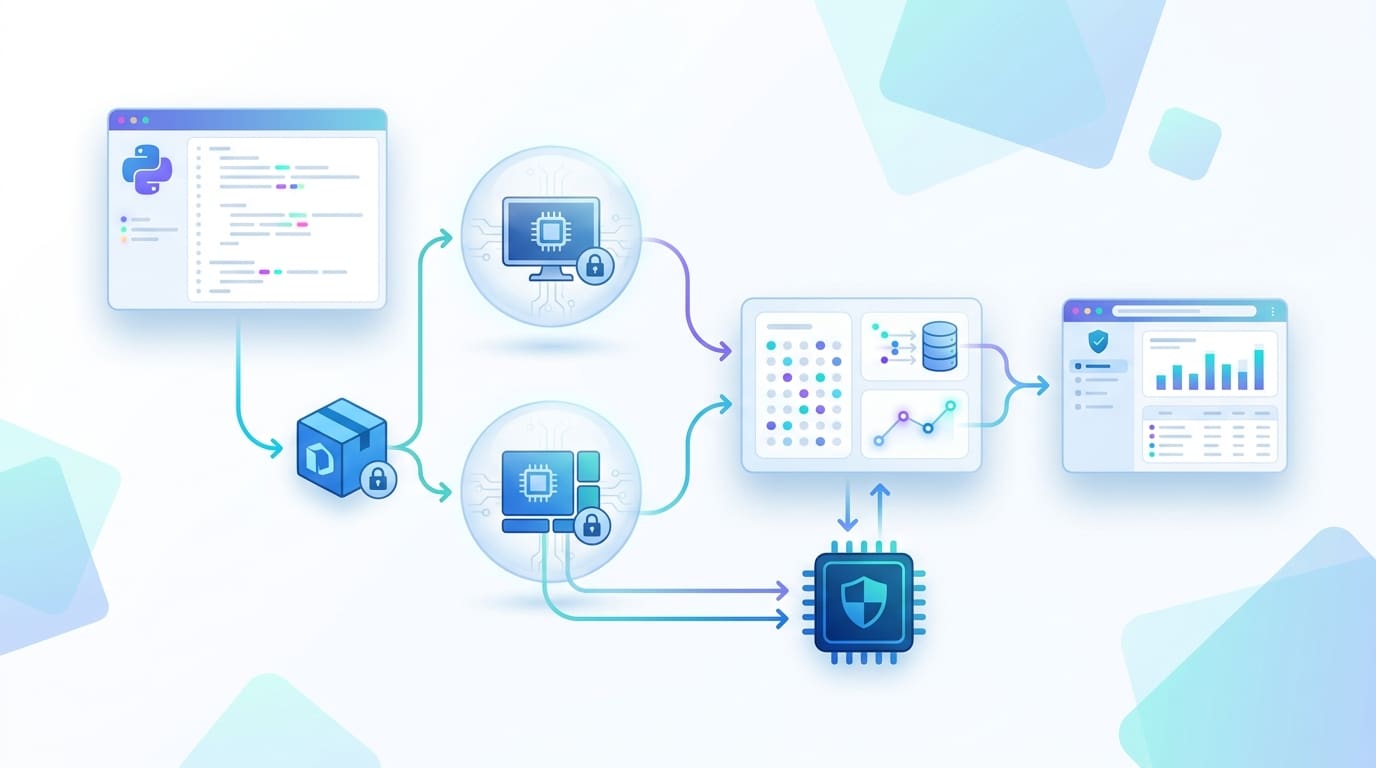
In this article, you will learn how to sandbox the code an AI agent writes by running it in a limited subprocess, a hardened Docker container, and a Firecracker microVM, and how to compare their safety and latency.
An agent that writes and runs code is only as safe as the place that code runs. Sandboxing AI agent code execution means putting a boundary around that place, and the boundary you choose decides what a bad program can reach. This article gives a code-writing agent a real execution tool, then runs it three ways: a limited subprocess, a Docker container, and a Firecracker microVM. You will test each against the same hostile programs and compare safety with latency. If you would rather start from hosted options, check out this article that covers five code sandboxes for your AI agents. Here we build the layers ourselves, so you can see what those platforms do underneath.
Untrusted code can eat resources, read secrets, call internal services, or break out of its boundary. The tiers differ in where that boundary sits. A subprocess is the lightest option: a child process with limits on CPU, memory, and file size, sharing the host’s kernel and files. A container adds namespaces and cgroups, yet it is still a set of processes on the host’s kernel, which is why Docker’s own docs note that a container has no resource limits unless you set them. Escapes happen: in November 2025, three runc vulnerabilities let attackers break out of containers. A microVM gives each sandbox its own kernel behind a hypervisor. Docker describes this as a hardware boundary, and AWS says its Firecracker-based Lambda MicroVMs share no kernel between sessions. One more point from Docker’s post applies to every tier: file access, network policy, and secrets should be defined before the agent runs, by infrastructure and not by the agent.
You need Python 3.10 or newer. The subprocess tier uses Linux features (resource limits and unshare), so run it on Linux or in WSL. The Docker tier needs Docker installed. The microVM tier needs an E2B account and API key. The agent loop needs an Anthropic API key, but you can skip it and go straight to the tests.
Source: Machine Learning Mastery — Read the full article on the original site ↗