


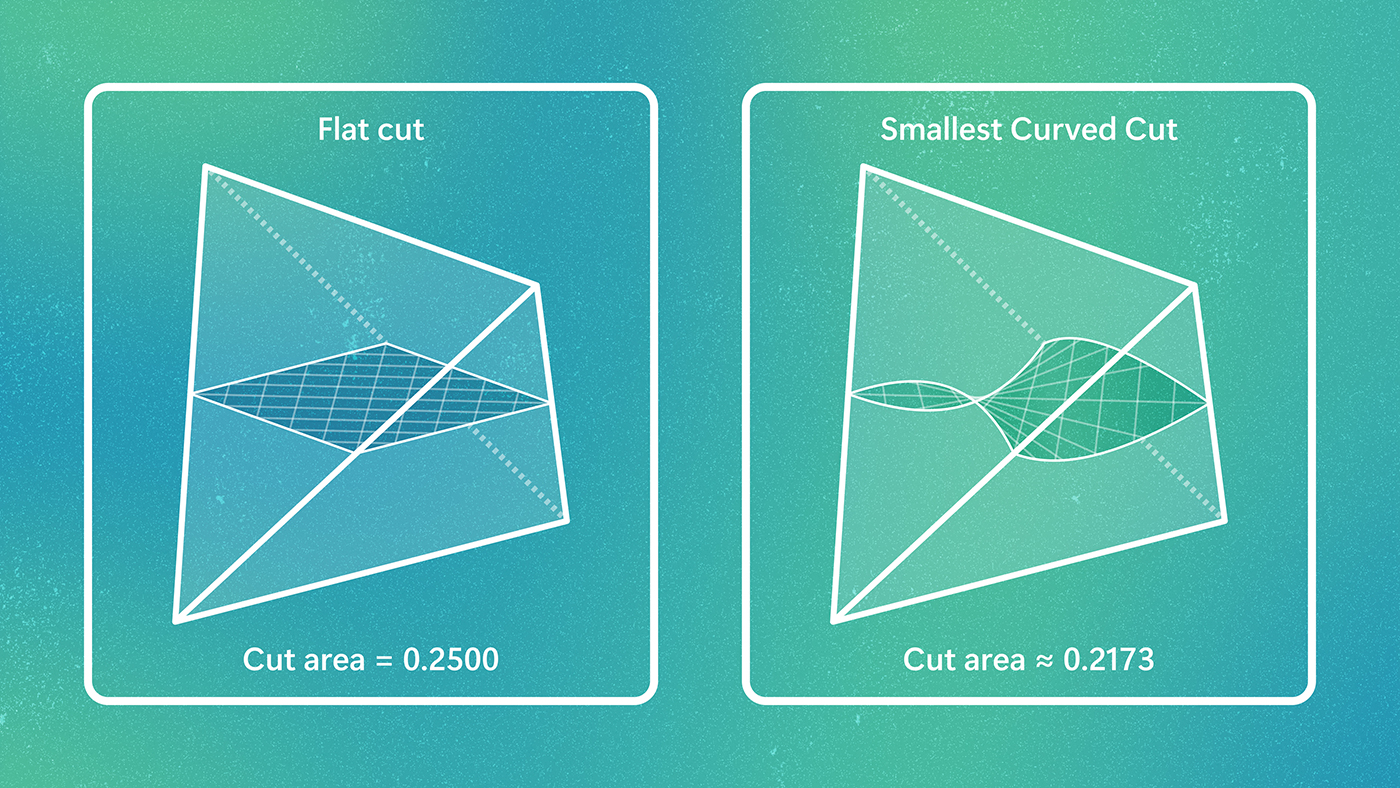
For decades, a fundamental question about the difficulty of computing in high-dimensional spaces has resisted proof. New research resolves this question, removing a major theoretical obstacle to understanding the efficiency of randomized algorithms used across science and computing.
The Kannan–Lovász–Simonovits (KLS) conjecture was proposed in 1995. It asks whether, for a broad class of high-dimensional probability distributions, the best flat or hyperplane cut is always nearly as effective as the best cut of any shape. More precisely, KLS predicts that the two differ by no more than a universal constant, regardless of the number of dimensions. This would establish a dimension-free geometric principle with important consequences for high-dimensional geometry, probability, and theoretical computer science. Because the geometry of these cuts governs how quickly random walks can explore a distribution, KLS also plays a central role in the theory of high-dimensional sampling.
Source: Microsoft Research — Read the full article on the original site ↗