


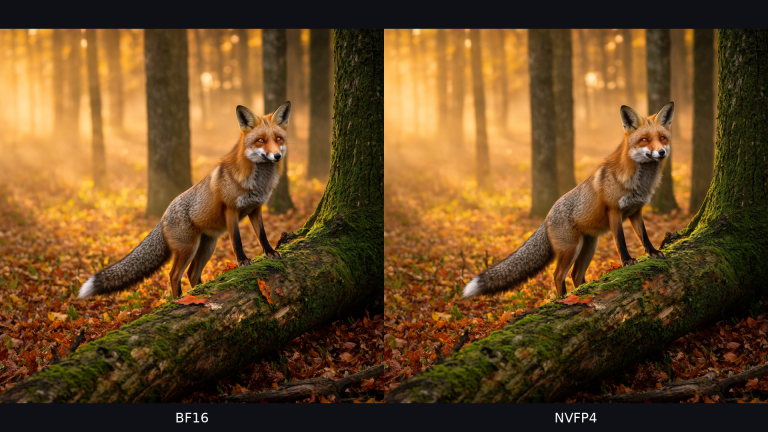
When deploying diffusion models in design tools, image editors, and visual production workflows, developers must account for inference latency. Generating an image requires multiple sequential passes through a model with billions of parameters, and higher resolutions increase attention costs.
FLUX 3 Image Klein is an image editing and generation model from Black Forest Labs (BFL) trained on NVIDIA GB200 NVL72 and optimized for NVIDIA GPUs. It offers Base and distilled checkpoints for different latency and fidelity requirements.
This tutorial shows how to configure FLUX 3 Image Klein in NVIDIA TensorRT LLM VisualGen to take advantage of fused kernels, multi-GPU parallelism, FP8/NVFP4 support, caching, and attention optimizations. It compares latency and changes in generated outputs across optimizations. In the reported 2048×2048 tests on a single NVIDIA B200 GPU, combined optimizations delivered up to 3.46x faster text-to-image (T2I) and 4.45x faster image-to-image (I2I) generation for FLUX 3 Image Klein Base compared with uncompiled BF16 inference. The tutorial includes deployment instructions and YAML configurations for applying these optimizations to your workloads.
FLUX 3 Image Klein combines Qwen3-VL-4B-Instruct for text conditioning, a diffusion transformer (DiT) to refine image latents, and an autoencoder to decode latents into images and encode I2I reference inputs. Klein processes text, noisy target-image, and optional reference-image streams independently before combining them through joint attention.
Source: NVIDIA Technical Blog — Read the full article on the original site ↗