



|
Getting your Trinity Audio player ready...
|
Over the past year, as we built Amazon Quick, our agents went from answering questions to taking actions: scheduling meetings, running research, generating reports. As the system evolved, one problem kept resurfacing: there was no shared definition of the primitives that agentic work is built from. The same few ideas kept getting rebuilt under different names: an actor that does the work, a signal that starts it, a packaged procedure, and a memory that carries lessons forward. This repetition leaked into product design and onto the user.
Take the user who says “monitor my Slack channel and send me a daily digest”. Is that a new agent, a scheduled instruction to an existing one, a workflow, or a skill? These are different questions, but without a shared vocabulary they collapse into one confusing choice.
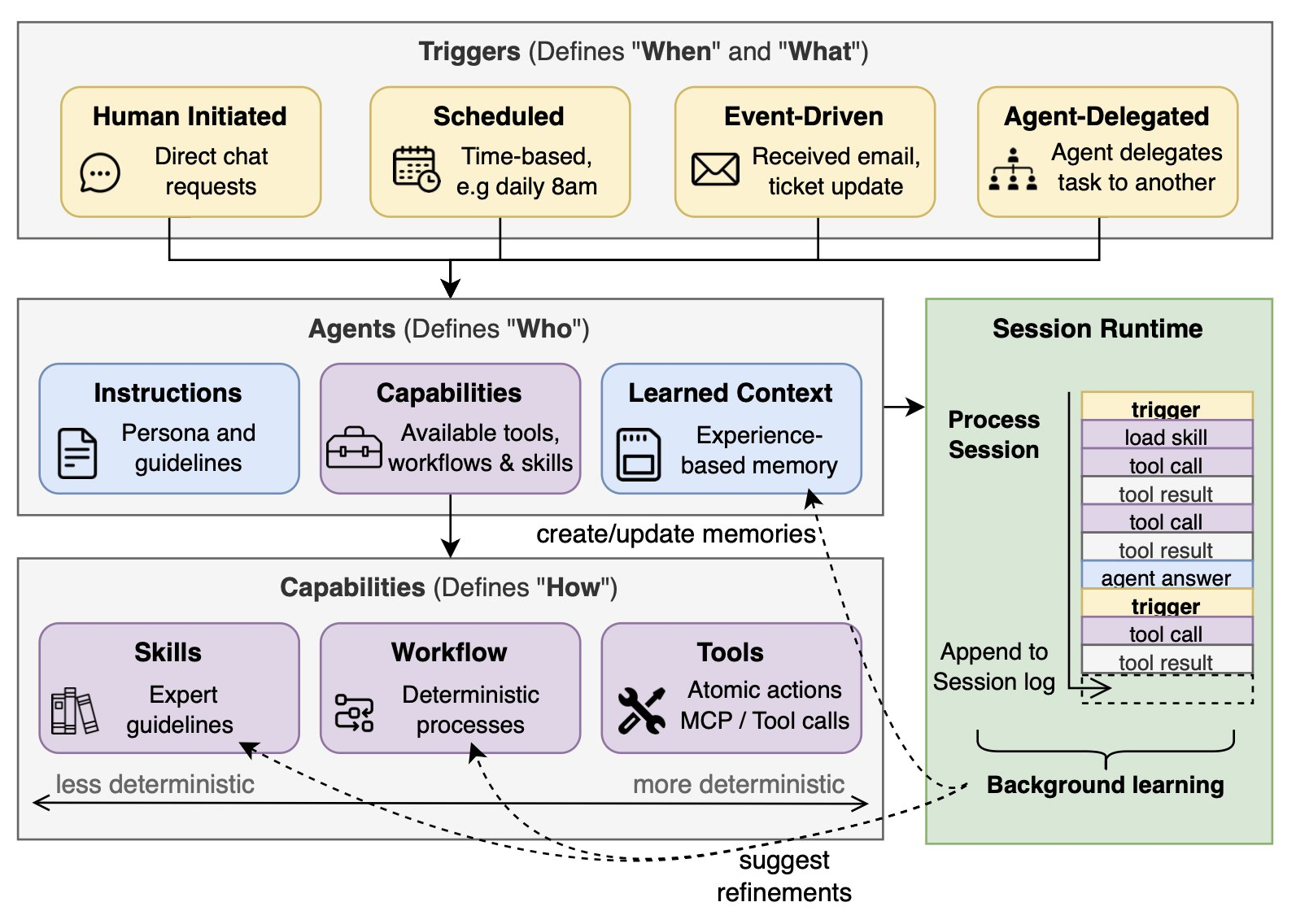
This post shares the taxonomy we converged on: one set of primitives found by decomposing agentic work into four plain questions: When?, What?, Who?, and How? Most of the framework stays invisible to end users by design, but a shared vocabulary makes the system easier to reason about for anyone building beneath it.
Figure 1: How triggers, agents, and capabilities relate, with learning feeding back from the session runtime
Source: AWS Machine Learning Blog — Read the full article on the original site ↗
Get the best of this topic in your inbox
Join the newsletter. A short, useful digest, no spam.



