


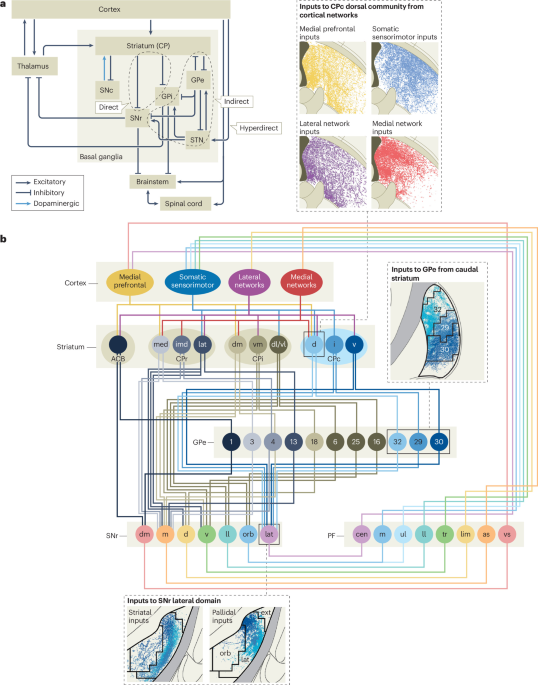
Classical anatomical and physiological studies have established the cortico-basal ganglia–thalamic (CBGT) system as a set of topographically organized, functionally specialized circuits that link the cerebral cortex, basal ganglia and thalamus while allowing convergence and interaction between information streams. Recent advances in mesoscale and single-neuron connectomics now enable these organizational principles to be resolved at unprecedented spatial and cellular scales. Here we synthesize the findings of recent connectomic studies of the CBGT network to define an emerging structural and network framework. Modern connectomic data reveal how parallel processing and information integration are implemented through a multiscale architecture characterized by modular organization, graded and overlapping boundaries, stage-specific patterns of segregation and convergence, and re-entrant interactions among cortical, basal ganglia, thalamic and brainstem nodes. Molecular, transcriptomic and neuronal morphological datasets further reveal spatial heterogeneity that broadly aligns with this connectivity-defined organization. This structural framework provides a foundation for understanding how CBGT networks preserve functional specialization while enabling cross-domain integration and generates testable hypotheses about the links between circuit architecture and neural computation, behaviour and dysfunction in neurological and psychiatric disorders.
This is a preview of subscription content, access via your institution
Prices may be subject to local taxes which are calculated during checkout
Sporns, O. & Betzel, R. F. Modular brain networks. Annu. Rev. Psychol. 67, 613–640 (2016).
Source: Nature Reviews Neuroscience — Read the full article on the original site ↗