


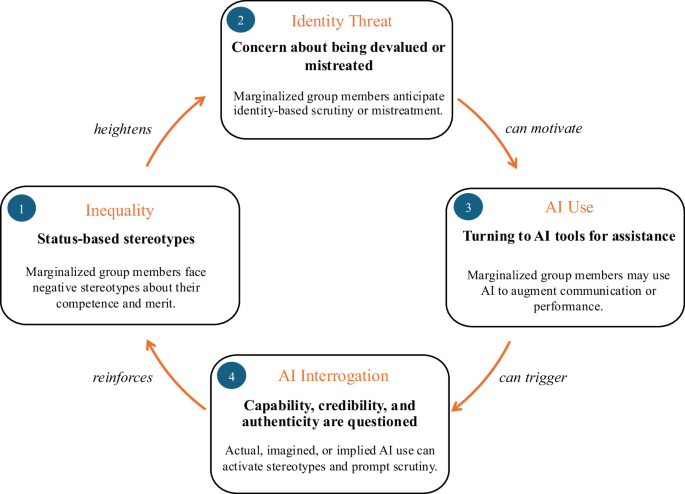
Generative AI enters organizations rife with inequality. Here, we propose a recursive process whereby inequality can drive marginalized group members to use AI, but actual or suspected AI use can reinforce inequality through unequal judgement of communicators’ capability, credibility, and authenticity.
Generative artificial intelligence is one of the most consequential technological advances of our time, but this technology does not enter into a vacuum. It enters a world pervaded with inequalities that people must navigate every day in diverse, unequal organizations. We propose a recursive process that links the use of generative AI to structural inequality, social cognition, and intergroup interactions—leading to a vicious cycle of AI use, stereotyping, and discrimination (see Fig. 1).
Consider the workplace. In racialized organizations, Black and Brown employees are more scrutinized than white employees. In male-normed offices, women are labeled as less suitable for intellectually demanding tasks. In neurotypical and ableist workplaces, neurodivergent and disabled workers face discrimination rooted in assumed incompetence. Within diverse, unequal organizations, marginalized group members often experience social identity threat: the fear of being devalued or mistreated due to one’s social identity1. As a result, they become anxious, closely monitor how others react to them, and may perform worse during exams, interviews, and presentations.
People may use AI tools for multiple reasons, including organizational policies that encourage use, a desire to increase productivity, or curiosity as AI agents become more sophisticated and use becomes more normative. However, marginalized group members may turn to AI—a readily available, anonymous, (seemingly) unbiased collaborator—as a means to reduce social identity threat. There is precedent for marginalized group members using technological tools to reduce threat, with positive effect. For instance, women who hide their social identities through avatars experience less stereotype threat and performance penalties2. Using generative AI may mitigate social identity threat by helping with research, double-checking drafts, or ensuring emails meet professional standards. Regardless of the reason for AI use, how its use is judged will vary. We propose that, while marginalized group members may reach for this tool to reduce the risk of being devalued or mistreated, using AI may ironically increase such risk.
Source: Communications Psychology — Read the full article on the original site ↗