



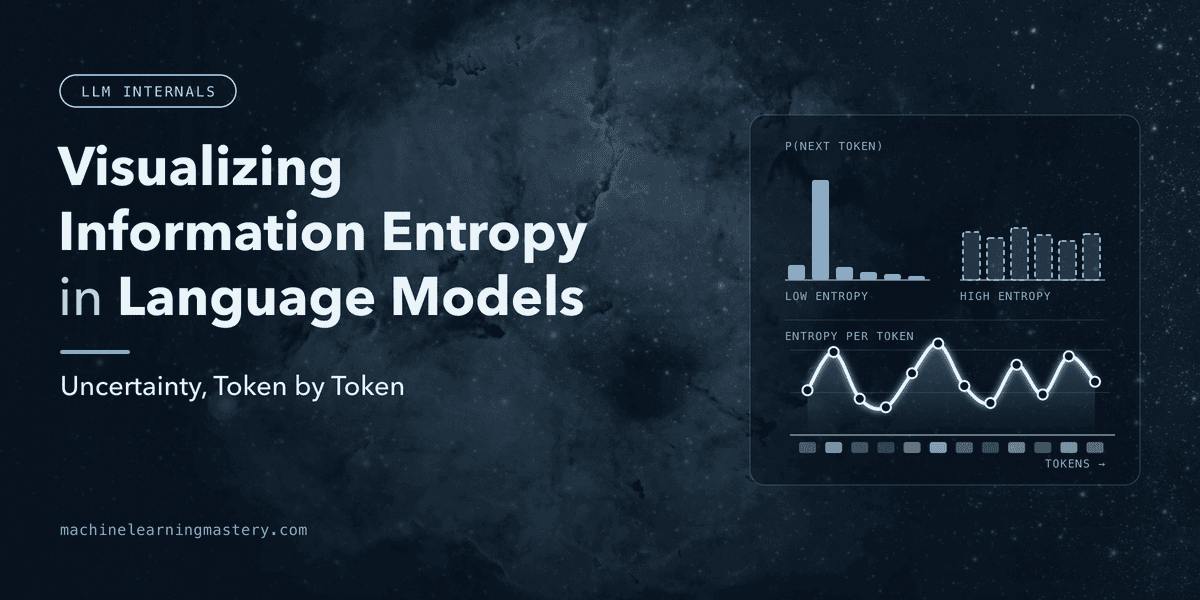
In this article, you will learn how information entropy and cross-entropy loss connect classical information theory to the way large language models are trained to predict the next word.
Ever trained a neural network for classifying images or read a recent paper about large language models (LLMs)? If so, chances are you came across a somewhat intimidating term: cross-entropy loss. Did you know this is the guiding compass for training (via optimization) massive models used on a daily basis, including Gemini, Llama, and GPT? Indeed, yes!
But one question might pop into mind: why “entropy”? Perhaps you might have seen that term in a different context, like information theory. Let’s bridge the gap between these pieces and better understand how entropy and information theory principles are leveraged to teach modern AI systems to “speak”. Once we link these concepts together, we’ll perform a Python-based visualization to better understand how information entropy is used in LLMs.
Let’s trace back to 1948, the year classical information theory was born. Specifically, the concept of information entropy, or simply entropy, was introduced by Claude Shannon as a mathematical measure of uncertainty or “surprise” in a probability distribution. Take two dice as an example: let die A be totally fair, with every roll being unpredictable. When rolling this die, uncertainty is at its maximum, which means entropy would be quantified as high. Meanwhile, suppose die B is strongly weighted to land on its 6 face. You’d rarely be surprised by the outcome, as you’d expect a 6 most of the time: this is a low-uncertainty, low-entropy scenario. In other words, die B’s probability distribution is far from uniform, with a result of 6 being much more probable than the others.
Source: Machine Learning Mastery — Read the full article on the original site ↗
Get the best of this topic in your inbox
Join the newsletter. A short, useful digest, no spam.