


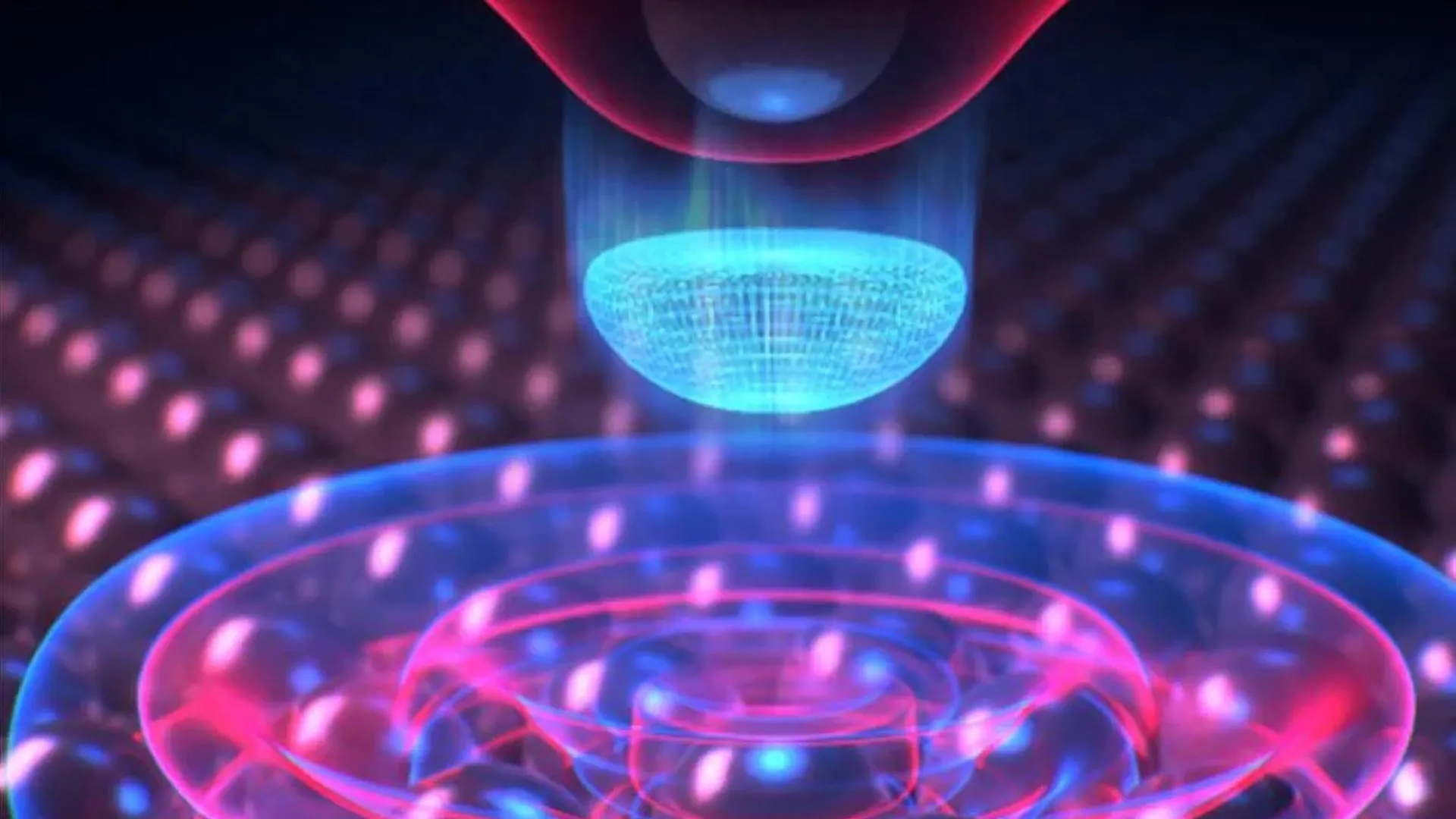
Quantum physics places fundamental limits on what scientists can know about the behavior of particles. Werner Heisenberg's famous uncertainty principle states that certain properties, such as a particle's position and momentum, cannot both be measured with unlimited precision. This restriction is not caused by flaws in scientific instruments. It is built into the laws of nature.
But position and time are different. Heisenberg's uncertainty principle does not impose the same restriction on these quantities. Now, researchers have experimentally demonstrated another fundamental limitation: an electron's location and its behavior over time cannot both be determined with arbitrary precision. Known as the "space-time limit," this newly observed relationship could have major implications for the future of quantum technology and ultrafast electronics.
The discovery comes from an international collaboration involving research groups at the Regensburg Center for Ultrafast Nanoscopy (RUN), led by Profs. Jascha Repp, Rupert Huber, Franz Giessibl, and Klaus Richter, along with a team at the Max Planck Institute in Hamburg led by Angel Rubio.
Understanding how matter behaves at the smallest scales is essential for developing the next generation of technology. Advances in clean energy, quantum computing, and powerful electronics for artificial intelligence all depend on knowing how chemical reactions unfold, how light interacts with materials, and how electrons travel through electronic devices.
Source: ScienceDaily - AI — Read the full article on the original site ↗