


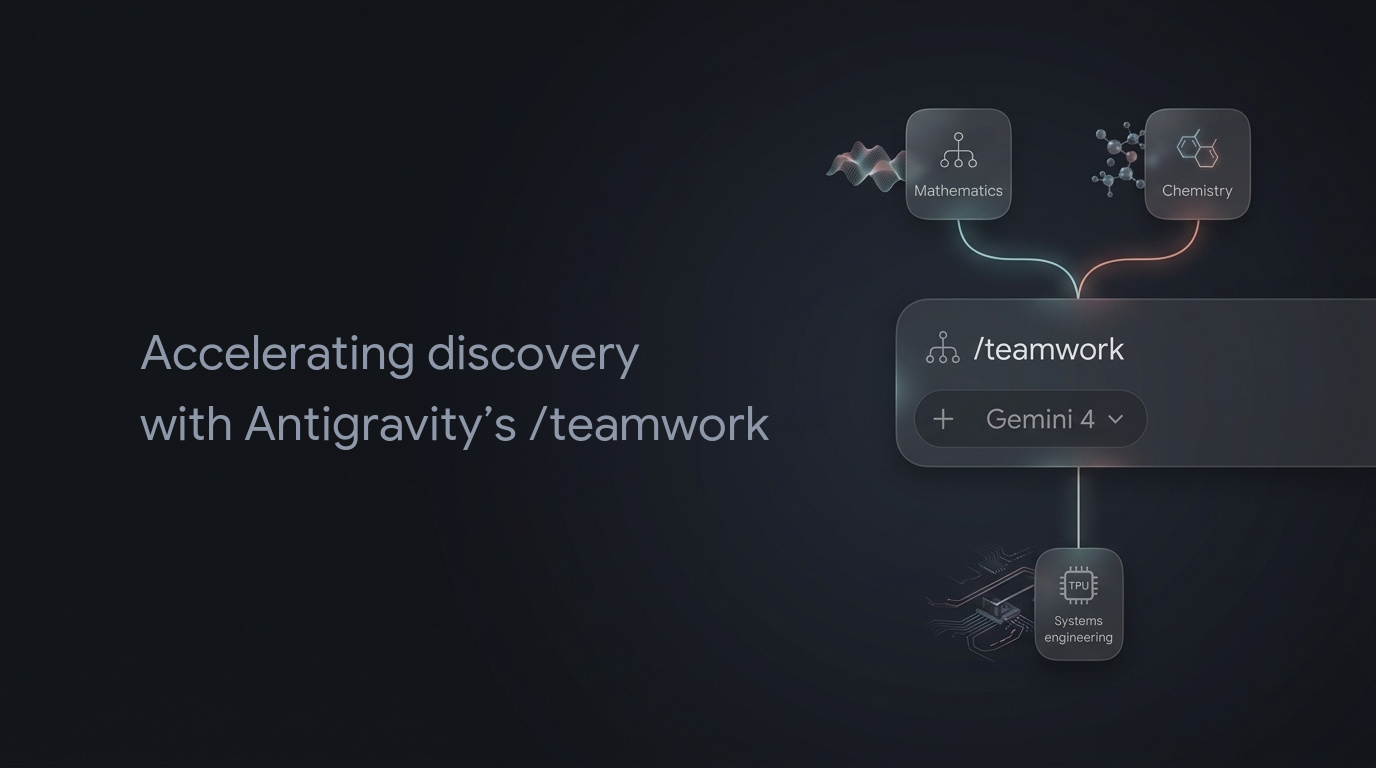
We share recent results from Antigravity’s /teamwork multiagent systems, which enhance human-AI collaborations to solve open problems across mathematics, chemistry, systems software, and ML engineering. All of this work is done in collaboration with human experts, and we are making these tools available externally.
Over the past several weeks, teams across Google and academic partner institutions have tackled open problems in math, science, and complex systems engineering that had remained open for years. Using Gemini 4 Argon, Gemini 4 Carbon, Gemini 4 Hydrogen and multi-agent workflows such as Antigravity’s /teamwork (building on various Gemini models), these collaborations have produced new innovations across information theory, formal verifications, molecular structure discoveries, and kernel optimization, along with several production infrastructure gains at Google. We are making these agentic tools available in Antigravity’s /teamwork (alongside /boost and other agents) so that researchers and developers can apply them to their own work.
Frontier research and systems engineering require navigating vast literature, building custom computational pipelines, testing against physical measurements, and verifying every step. Progress comes from an interactive discovery loop where researchers frame questions and define the theoretical or physical constraints, while long-horizon agents write custom solvers, explore large search spaces, test candidate designs, and check long chains of logic.
Two limits of current language models motivate /teamwork's design. First, model generation can be unpredictable, leaving a gap between a single attempt and finding the correct answer. The system bridges this gap by pairing parallel exploration with dedicated falsifiers (e.g., the Lean 4 proof checker, unmodified software test suites, execution simulators, web search, or hardware counters) to automatically verify which candidate solutions work.
Source: Google Research Blog — Read the full article on the original site ↗