
Evaluating the Evaluators: Investigating LLM Judges for Personalized Writing Style Assessment
Evaluating the Evaluators: Investigating LLM Judges for Personalized Writing Style Assessment
Read original on Apple Machine Learning Research ↗

by ODEFTO Group

Evaluating the Evaluators: Investigating LLM Judges for Personalized Writing Style Assessment
Read original on Apple Machine Learning Research ↗
AuthorsHilal Asi, Vitaly Feldman, Jelani Nelson†, Huy L. Nguyen‡, Kunal Talwar, Samson Zhou§
Read original on Apple Machine Learning Research ↗
Daan van Esch, Senior Technical Program Manager, Google DeepMind and Uche Okonkwo, Senior Program Manager, Google Research
Read original on Google Research Blog ↗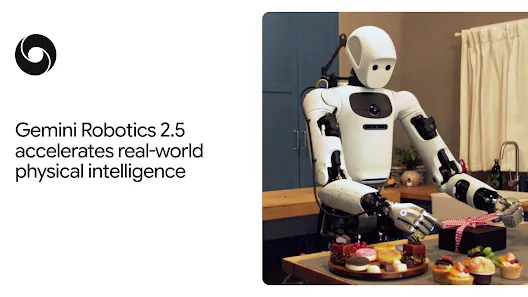
Our most capable vision-language-action model enhances robot dexterity, reliability, and safety
Read original on Google DeepMind Blog ↗
“(1) a thin, conformal 3D-knit form factor (1.5mm fingertip stackup) designed to minimize interference with natural manipulation,
Read original on Import AI ↗
The Conference on Robot Learning (CoRL) takes place November 9–12, 2026, in Austin, Texas. BAIR faculty, postdocs and students will be presenting research at various sessions, including an Early Career Keynote from Professor Negar Mehr. See below for the full schedule of sessions with BAIR members, including papers co-authored with…
Read original on Berkeley AI Research (BAIR) ↗
Humans are intuitive by nature. We can sense meaning beyond the literal words that we encounter. Now, a new artificial intelligence-assisted learning platform developed by MIT engineers is enabling robots to read larger meaning into a human’s natural language commands.
Read original on MIT News - AI ↗
Personal email agents decide, for every message, its type and urgency and whether to draft a reply, create a task or ignore it. In production these decisions are delegated to a generative LLM or to rules, and their error rate is rarely measured: the stored labels were written by the…
Read original on arXiv cs.CL (Language) ↗
PolSAR data presents unique challenges due to its rich and complex characteristics. Existing data representations, such as complex-valued data, polarimetric features, and amplitude images, are widely used. However, these formats often face issues related to usability, interpretability, and data integrity.
Read original on arXiv cs.CV (Vision) ↗
Today, a scientist who wants to simulate a physical process must pick the right tool for that one job, such as a solver built for flowing water or another designed to model the way a protein folds. Each one is hand-coded around the specific equations that dictate how that process…
Read original on MIT News - AI ↗
Inconsistent codes and unstructured text limit the use of wind turbine maintenance records in reliability analysis. A topology-aware large language model (LLM) workflow corrected and enriched 16,316 records from 280 turbines at 31 onshore wind farms over 9.2 years. Maintenance narratives and equipment context guided system-code correction and maintenance-type relabelling.…
Read original on arXiv cs.CL (Language) ↗
Speculative decoding accelerates vision-language model (VLM) inference without altering the output distribution, yet two factors limit its gains. Existing drafters either lack the image evidence required for visually grounded tokens or pay to condition on every visual token, although a short draft block typically depends on only a few image…
Read original on arXiv cs.CV (Vision) ↗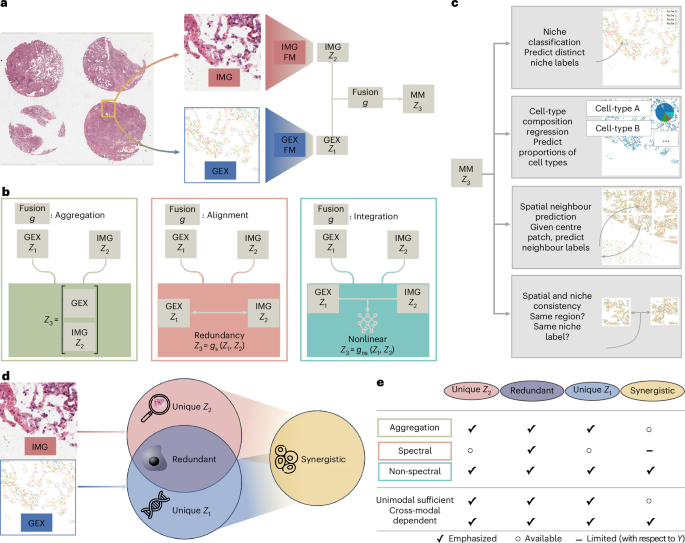
Integrating measurements across modalities and scales into unified quantitative frameworks of cellular function is a central goal in computational biology. Although powerful unimodal foundation models exist, the scarcity of large-scale paired data limits joint multimodal training. This constraint favours compositional foundation models, which fuse frozen unimodal experts through a learned…
Read original on Nature Machine Intelligence ↗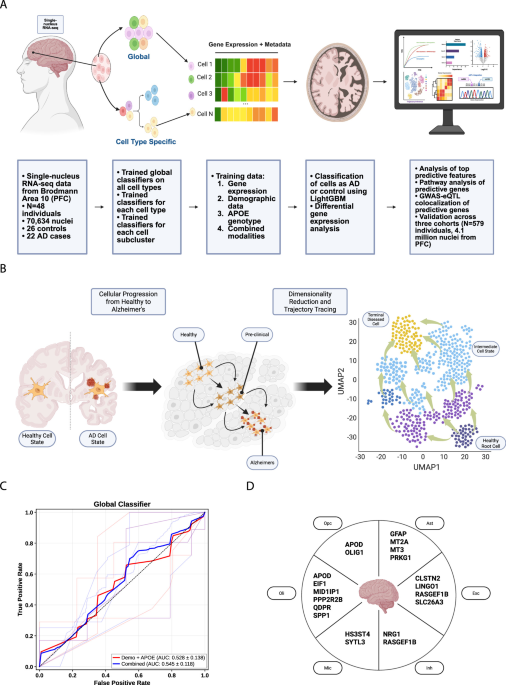
Univariate differential expression analysis dominates single-cell transcriptomic studies of Alzheimer’s disease, yet marginal testing alone cannot resolve multivariate disease-associated structure or distinguish clinical from neuropathological signatures. Here we introduce TriSCOPE, a framework integrating multivariate predictive modeling, donor-aware differential expression, and pseudotime inference, applied to six Alzheimer’s disease snRNA-seq datasets comprising…
Read original on Nature - Machine Learning ↗
Big Math: The Hidden Codes That Run Our World Steven Strogatz & Alex Townsend Little, Brown and Company (2026)
Read original on Nature - Machine Learning ↗Enter your email to receive updates. You can unsubscribe at any time.



