Preloader

All AI News & Discussions

Wieszcz-XIX: A 3.1-Billion-Word Corpus of Pre-1918 Polish and Temporally Bounded Language Models Trained From Scratch
ResearcharXiv cs.CL (Language)1 week ago

Wieszcz-XIX: A 3.1-Billion-Word Corpus of Pre-1918 Polish and Temporally Bounded Language Models Trained From Scratch

Historical Polish is well documented as a language but annotated in machine-readable form only to about a million words for the period this paper covers; the rest sits behind optical character recognition of variable quality. We present Wieszcz-XIX, a corpus of 6.75 billion tokens (about 3.1 billion words) in 294,369…

Read original on arXiv cs.CL (Language) ↗
SRED: Sparse Regional Evidence Distillation Across Magnifications in Whole-Slide Imaging
ResearcharXiv cs.CV (Vision)1 week ago

SRED: Sparse Regional Evidence Distillation Across Magnifications in Whole-Slide Imaging

In computational pathology, high-magnification whole-slide image analysis preserves tissue detail but requires encoding many patches, whereas lower magnification reduces computation by covering a higher field of view per patch while sacrificing detail. Existing cross-magnification distillation matches features that often encode detail unreachable by low-magnification input, sometimes requiring slide-level labels that…

Read original on arXiv cs.CV (Vision) ↗
A multimodal foundation model for molecular and morphologic data in oncology
ResearchNature - Machine Learning1 week ago

A multimodal foundation model for molecular and morphologic data in oncology

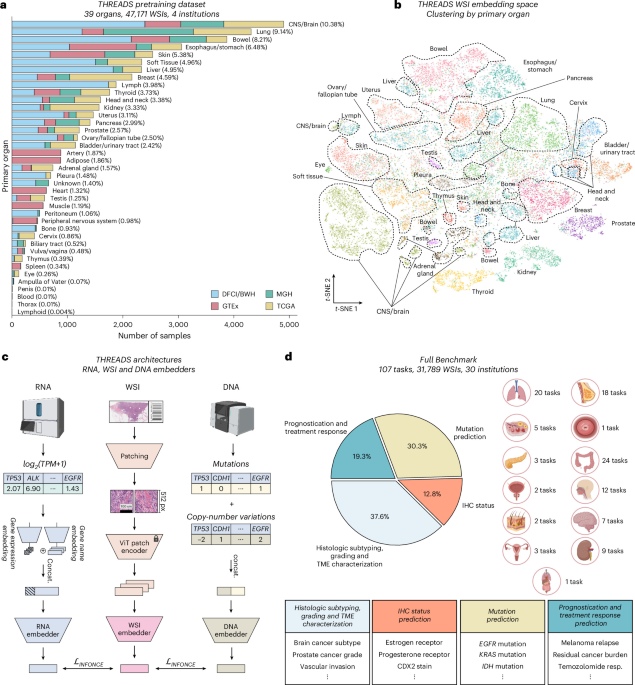
Foundation models are advancing computational pathology by transferring knowledge from large datasets to diagnostic, prognostic and treatment response tasks. Most existing models, however, either operate at the patch level or learn slide-level representations using image-based objectives, coarse tissue labels or pathology reports that vary across institutions and reflect the subjectivity…

Read original on Nature - Machine Learning ↗