


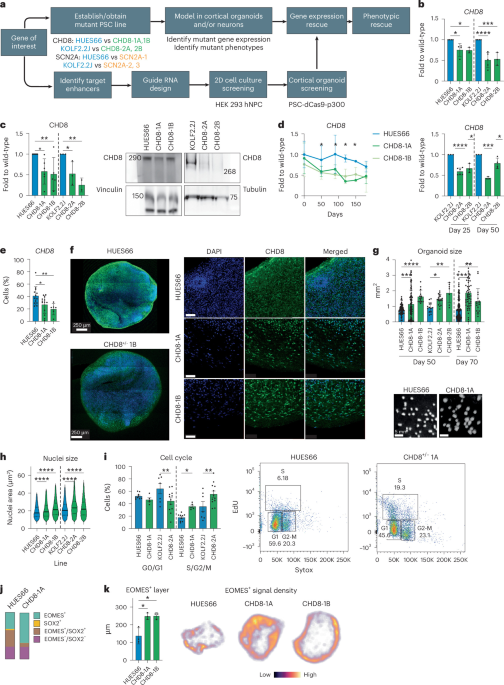
Autism spectrum disorder (ASD) is a highly heritable condition with diverse clinical presentations. Approximately 15% of the genetic susceptibility of ASD is imparted by de novo haploinsufficient mutations of major effect. We mapped enhancers of two high-confidence autism genes, CHD8 and SCN2A, and used CRISPR-based gene activation targeting enhancers (eCRISPR-A) in human pluripotent stem cell (hPSC)-derived excitatory neurons and cerebral forebrain organoids to correct the effects of haploinsufficiency, taking advantage of the presence of a wild-type allele of each gene and endogenous gene regulation. Here we show that eCRISPR-A induced a sustained increase in CHD8 and SCN2A expression specifically in mutant neurons and cortical organoids, with rescue of gene expression levels and mutation-associated phenotypes, including gene expression and physiology. These data support gene activation via targeting enhancers of haploinsufficient genes as a therapeutic intervention in ASD and other neurodevelopmental disorders.
ASDs are neurodevelopmental disorders characterized by impaired social behaviors and repetitive behaviors, often with severe functional impairment, presenting a substantial public health burden1. Although it is highly heritable, a substantial fraction of genetic susceptibility, perhaps up to 20%, is imparted by de novo mutations with major effects2,3.
Studies in familial cohorts, such as the Simons Simplex Collection (SSC) and the Autism Genetic Resource Exchange (AGRE), have identified hundreds of genes increasing autism risk with various levels of statistical support4,5,6,7,8,9. High-confidence ASD (hcASD) risk genes are enriched in transcriptional regulation or synaptic development pathways during the peak of cortical neurogenesis9,10. Studies in model systems implicate haploinsufficiency as the underlying mechanism of many mutations11,12, a model supported by the observation that susceptibility genes are strongly depleted for heterozygous protein-truncating variants in humans.
In the present study, we focused on two well-characterized hcASD risk genes: CHD8 (chromodomain helicase DNA-binding protein 8) and SCN2A (sodium channel protein type 2 subunit alpha)13,14. CHD8 is strongly associated with ASD, and it appears to regulate many other hcASD risk genes involved in neurodevelopment and synaptic function. The SCN2A gene encodes NaV1.2, which is essential for the generation and propagation of action potentials in neurons and is mutated in Dravet syndrome. In cortical development, CHD8 expression peaks during neurogenesis and decreases over time, while SCN2A is expressed later, with onset during mid-fetal development. Thus, in studying these two genes, we aimed to interrogate the efficacy of applying CRISPR-A during development.
Source: Nature Neuroscience — Read the full article on the original site ↗