


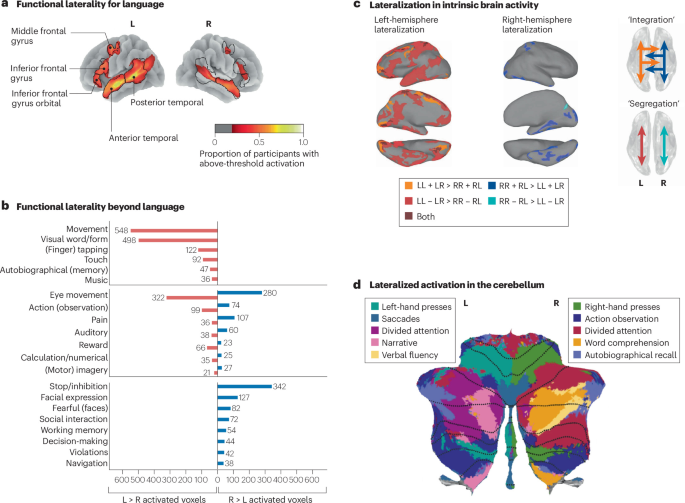
Asymmetry on the left–right axis is an organizing principle of the human brain that is important for diverse cognitive and behavioural functions. Advances in neuroimage analysis, genomics and large-scale data collection in the past decade have transformed our understanding of the biological foundations and multivariate nature of brain asymmetry. In this Review, we synthesize evidence across scales — from functional and macro-anatomical asymmetries and their inter-relations to microstructural, cellular and molecular levels. We examine inter-individual variation and atypical forms of brain asymmetry, which reveal that diverse aspects of asymmetry can vary largely independently across individuals rather than constituting a single trait. In this context, we discuss the developmental origins, lifespan trajectories and genetic architecture of hemispheric differences. We also summarize the relevance of brain asymmetry for neurological and psychiatric disorders and evolutionary changes of brain asymmetry that occurred in humans. Through this synthesis, we illustrate how contrasting the left and right hemispheres provides an informative window into the multi-level brain organization that supports cognition and behaviour.
This is a preview of subscription content, access via your institution
Prices may be subject to local taxes which are calculated during checkout
Vallortigara, G. & Rogers, L. J. Survival with an asymmetrical brain: advantages and disadvantages of cerebral lateralization. Behav. Brain Sci. 28, 575–589 https://doi.org/10.1017/S0140525X05000105 (2005).
Source: Nature Reviews Neuroscience — Read the full article on the original site ↗