


Chronic pain is highly prevalent worldwide, yet its genetic architecture remains to be fully elucidated. Here we leveraged data from 1,235,695 European-ancestry individuals across three biobanks. In a meta-analytic genome-wide association study of multidimensional pain (MP), we identified 343 independent loci, 92 of which were new pain associations. Sex-specific meta-analyses revealed 115 independent loci (12 of which were new) among males (n = 583,066) and 12 loci (2 of which were new) among females (n = 241,266). Multi-omic gene prioritization analyses highlighted 490 genes associated with MP through their effects on brain-specific and blood-specific regulation. Mendelian randomization analyses showed causal associations between MP and psychiatric disorders, substance use disorders and C-reactive protein levels. MP variants also showed pleiotropic associations with several brain imaging-derived phenotypes. This study expands our knowledge of the genetics of pain and its pathogenesis, highlighting the importance of its pleiotropy with multiple disorders and elucidating its multi-omic pathophysiology.
Chronic pain, which is disproportionately prevalent among women, is associated with high rates of morbidity and mortality and a high economic toll1. Despite its growing public health impact, there are no clinically useful objective indicators of chronic pain that could enhance preventive and therapeutic interventions to address it. Genome-wide association studies (GWASs) show promise in identifying biomarkers for pain.
GWASs have identified >170 risk loci for pain conditions2,3,4, which, although highly overlapping, often share a common genetic risk profile5,6 and similar alterations in the central nervous system7. Structural and functional brain changes are thought to reflect the transition from acute to chronic pain8,9. Substantiating these findings using genomics could provide diagnostic and predictive tools to advance personalized pain medicine10,11 and support the development of precision pain treatments12. Furthermore, although pain often co-occurs with psychiatric (for example, major depressive disorder (MDD)), cardiovascular (for example, hypertension) and metabolic (for example, diabetes) disorders4,13, the nature of these associations, including whether they are causal, is not fully understood.
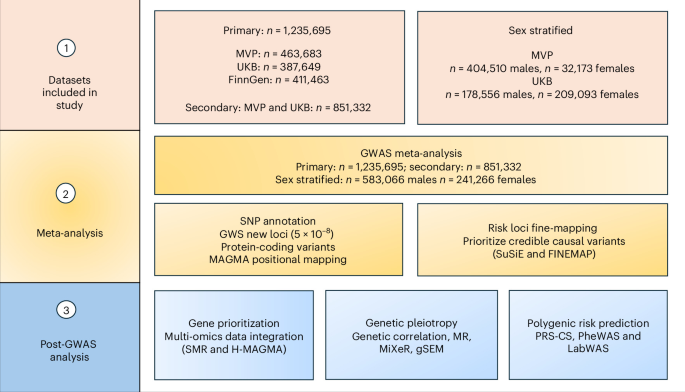
To address these questions, we conducted a meta-analysis of three independent GWASs (Million Veteran Program (MVP), UK Biobank (UKB) and FinnGen), comprising >1.2 million individuals, followed by a sex-specific meta-analysis (male, n = 583,066; female, n = 241,266; Fig. 1). Because pain is assessed through self-reported pain intensity over time in MVP4, the number of painful body sites in UKB2, and diagnosis-based pain codes in FinnGen14, combining them yields a multidimensional pain (MP) trait that captures complementary aspects of pain across the cohorts. This framework includes both shared and unique genetic contributions to the intensity, distribution and diagnosis of pain, providing a more comprehensive view of the genetic underpinnings of pain12. By integrating multiple layers of functional omics data, we identified effector genes for MP, complemented by extensive genetic correlation, univariate and bivariate causal mixture models (using MiXeR), and Mendelian randomization (MR) analyses, a phenome-wide association study (PheWAS) in two independent biobanks and a lab-wide association study (LabWAS).
Source: Nature Neuroscience — Read the full article on the original site ↗