


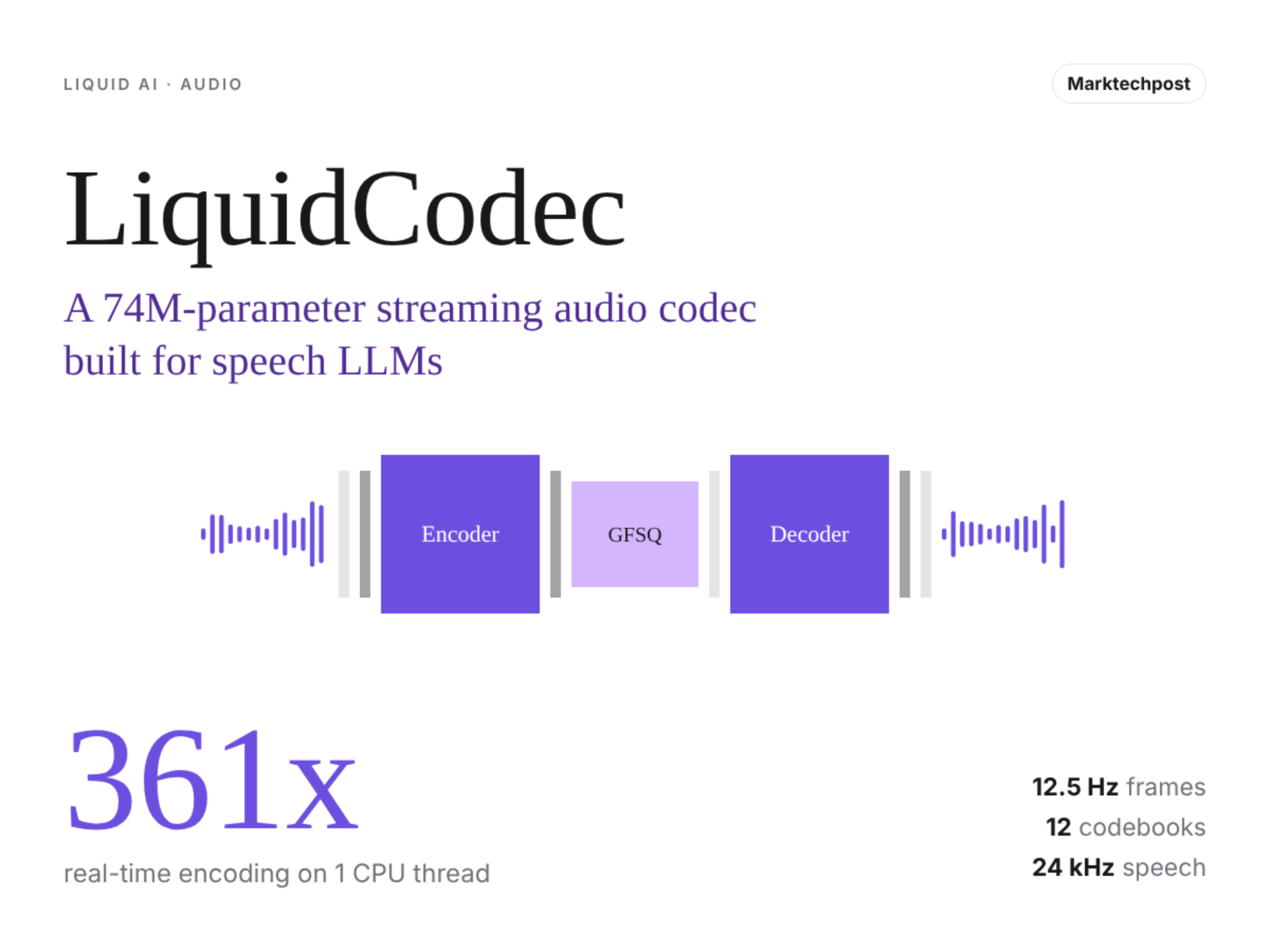
Liquid AI has released LiquidCodec, the audio codec behind its LFM3-Audio-2B and LFM3-Omni-2B models. The LiquidCodec audio codec is a ~74M-parameter streaming speech tokenizer. It turns speech into tokens a language model can predict, then converts those tokens back into audio. Liquid AI had 2 goals: easy-to-predict tokens and fast conversion back to speech. The weights are on Hugging Face.
LiquidCodec is a Liquid AI speech codec that compresses 24 kHz audio into 12 token streams. Each 80 ms frame becomes 12 discrete tokens, per the LFM3-Audio-2B model card. It replaces Kyutai’s Mimi, which Liquid AI used in LFM2-Audio-1.5B. Mimi has 96.2M parameters.
The pipeline is encode, quantize, decode. Liquid AI uses blocks from its LFM3 architecture in both the encoder and decoder. The 2 halves are symmetric, and the encoder is fully causal, which suits streaming.
Quantization uses grouped finite scalar quantization (GFSQ) instead of residual vector quantization (RVQ). In RVQ, each codebook encodes what the previous one missed. GFSQ groups are independent, so all 12 codebooks can be predicted in parallel by MaskGIT-style transformers.
Source: MarkTechPost — Read the full article on the original site ↗