


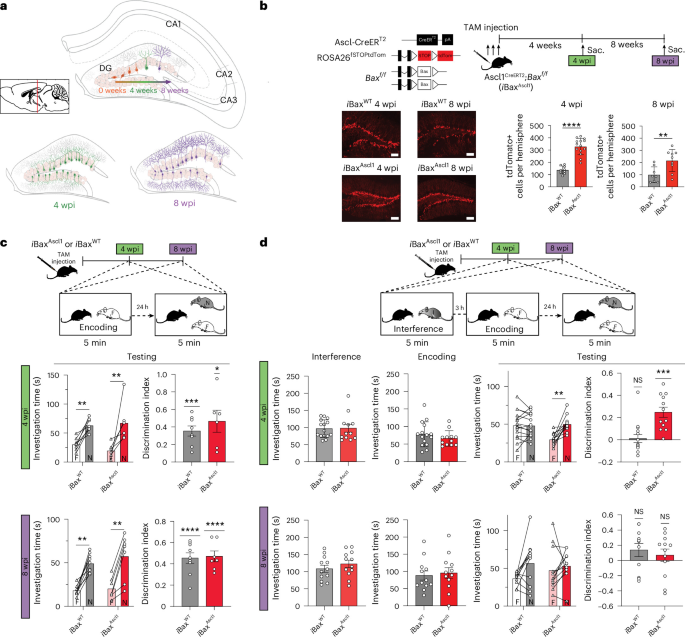
Immature adult-born dentate granule cells (abDGCs) show heightened synaptic and structural plasticity and preferentially contribute to hippocampal-dependent memory. Protracted maturation (neoteny) of abDGCs in higher mammals is posited to offset the decline in adult hippocampal neurogenesis by supporting increased plasticity. Here we found that selective, synchronous expansion of 4-week-old immature, but not 8-week-old mature, mouse abDGCs promotes recruitment of fast-spiking parvalbumin-expressing inhibitory interneurons (INs) in hippocampal CA3 and CA2, increases feed-forward inhibition, decreases social memory interference and enhances social memory consolidation. In vivo local field potential recordings in dorsal CA1 and CA2 revealed increased baseline power, amplitude and duration of sharp-wave ripples, as well as enhanced rate modulation by social experience. Inhibitory neuron-targeted chemogenetic manipulations implicate dorsal CA3 and CA2 INs, including parvalbumin-expressing INs, as necessary and sufficient for social memory consolidation following and sans neotenic expansion of abDGCs, respectively. Our findings suggest that neoteny of abDGCs supports cognition by increasing feed-forward inhibition in DG–CA3 and DG–CA2 and promoting network oscillations that underlie memory consolidation.
This is a preview of subscription content, access via your institution
Prices may be subject to local taxes which are calculated during checkout
All data and materials used in this study are available in some form to any researcher for purposes of reproducing or extending the analysis.
Source: Nature Neuroscience — Read the full article on the original site ↗