


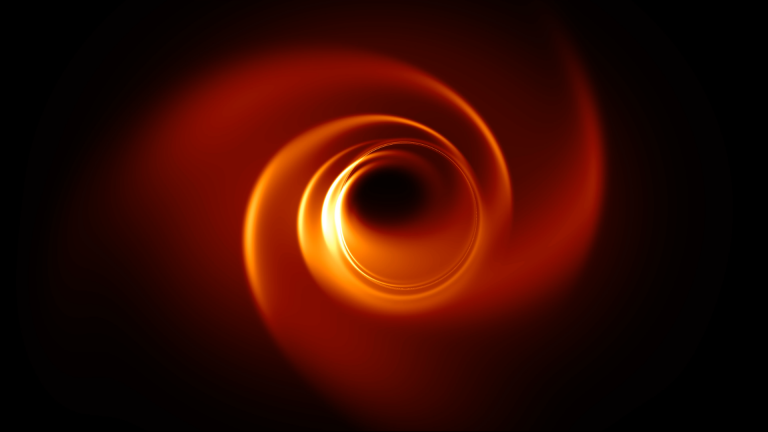
Imaging black holes is challenging because they are distant and appear tiny in the sky—for example, M87*’s observed ring spans just 42 microarcseconds. The black hole itself emits no light, so telescopes capture radio emission from superheated gas swirling outside the event horizon. The black hole’s intense gravity bends the paths of this light, shaping the bright ring that frames the central shadow.
The Event Horizon Telescope (EHT) addresses this challenge by linking 13 radio observatory stations across locations, including Hawaii, Chile, Spain, Mexico, and the South Pole, through very-long-baseline interferometry (VLBI). These stations record millimeter and submillimeter radio signals as high-speed voltage streams, which are synchronized and combined to reconstruct detailed images. The next-generation EHT (ngEHT) aims to add observing sites to improve image quality and track changes around black holes over time.
This post walks through GPU-based interferometry with cuPhoton.xBeam, from reading telescope recordings to generating visibilities and scaling across multiple GPUs. These measurements serve as inputs to downstream calibration and image reconstruction, which are outside the scope of this tutorial.
NVIDIA cuPhoton.xBeam performs GPU-based correlation for interferometry and organizes recorded data for parallel reads. It correlates signals from pairs of telescopes to produce one complex visibility for each pair of stations, each frequency channel, and each short time interval. The next step can involve constructing a 3D gas model from these visibilities via a distinct downstream process, such as Gaussian splatting. This method models the emitting gas as numerous compact, glowing blobs moving along orbits near a spinning black hole, optimized to match the observed visibilities. cuPhoton does not currently incorporate this second component.
Source: NVIDIA Technical Blog — Read the full article on the original site ↗