


“They do not sweat and whine about their condition,” Walt Whitman wrote of the other animals, “they do not lie awake in the dark and weep for their sins, they do not make me sick discussing their duty to God, not one is dissatisfied, not one is demented with the mania of owning things.”
Here was “the poet of the body and the poet of the soul” holding up a mirror to us creatures inhabiting an animal body complicated by a soul — that organ of want and worry which we ourselves invented to explain why we make art, why we fall in love, why we yearn to converse with reality in prayers and postulates.
It is daring enough to ask what a soul actually is. Carl Jung knew that it defies the substance we are made of: “The soul is partly in eternity and partly in time.” Virginia Woolf knew that it defies our best technology of thought: “One can’t write directly about the soul. Looked at, it vanishes.” It is doubly daring to question the age-old dogma that the soul is the province of the human animal alone. Even as we have incrementally and reluctantly admitted other creatures into the temple of consciousness, we have denied them souls — denied them, because our tools of communication and computation have failed to probe it, an inner life capable of imagination and play, of love and grief, of dreams and wonder. And yet our very language defies our denial: the word animal comes from the Latin for soul.
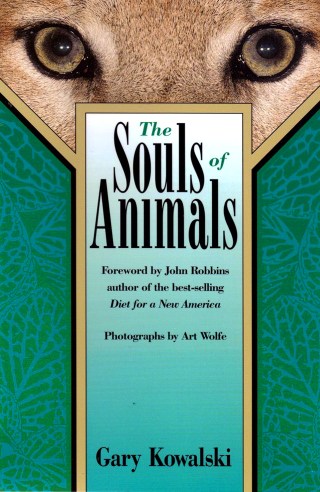
In 1991, long before we came to consider the soul of an octopus, long before fMRI and EEG studies revealed not only that birds dream but what they dream about, Gary Kowalski took up this daring question in The Souls of Animals (public library) — an inquiry into the “spiritual lives” (and into what that means) of whooping cranes, elephants, jackdaws, gorillas, songbirds, horses, dogs, and cats. At its center is the idea that spirituality — which he defines as “the development of a moral sense, the appreciation of beauty, the capacity for creativity, and the awareness of one’s self within a larger universe as well as a sense of mystery and wonder about it all” — is a natural byproduct of “the biological order and in the ecology shared by all life.” (There are in this view echoes of Kepler, who believed that the Earth itself is an ensouled body, and of myriad native cosmogonies that regard other animals as sources of more-than-human wisdom and emissaries of the numinous.)
Source: The Marginalian — Read the full article on the original site ↗