


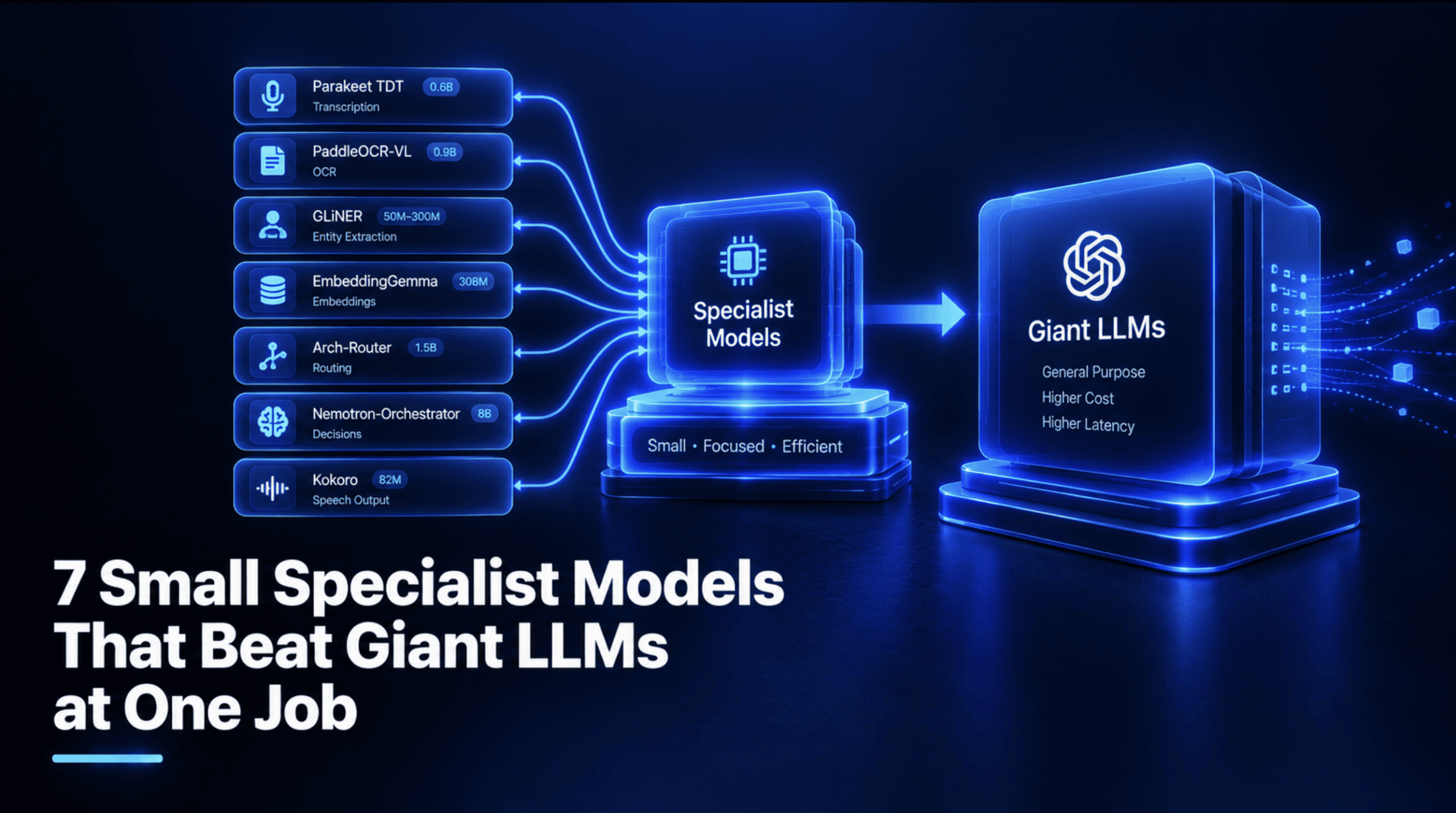
Meet seven open specialist models under 10 billion parameters that rival much bigger systems at one job each, from transcription and OCR to routing and speech.
Picture a support pipeline built the lazy way. A giant model transcribes the call, reads the attached invoice, pulls out the names and amounts, decides which team gets the ticket, and reads the reply back to the customer. It works, and every step is billed at frontier prices.
Most of those steps are single jobs, and small specialist models are built for exactly that. In this article, you will meet seven open models, each under 10 billion parameters, that go head to head with much bigger systems on one task. For each, you get the job it wins, its size and license, the published proof, and code to run it locally. These task-specific models won't replace a giant large language model (LLM) everywhere, and the last section covers where they don't.
Every model had to meet four rules: open weights, one clear job, published proof against something much bigger, and a footprint small enough for a single machine. "Giant" does not always mean "a chat LLM." Where the proof is against a bigger general model, I say so. Where it is against a closed API or a larger specialist, I say that instead.
Source: KDnuggets — Read the full article on the original site ↗