


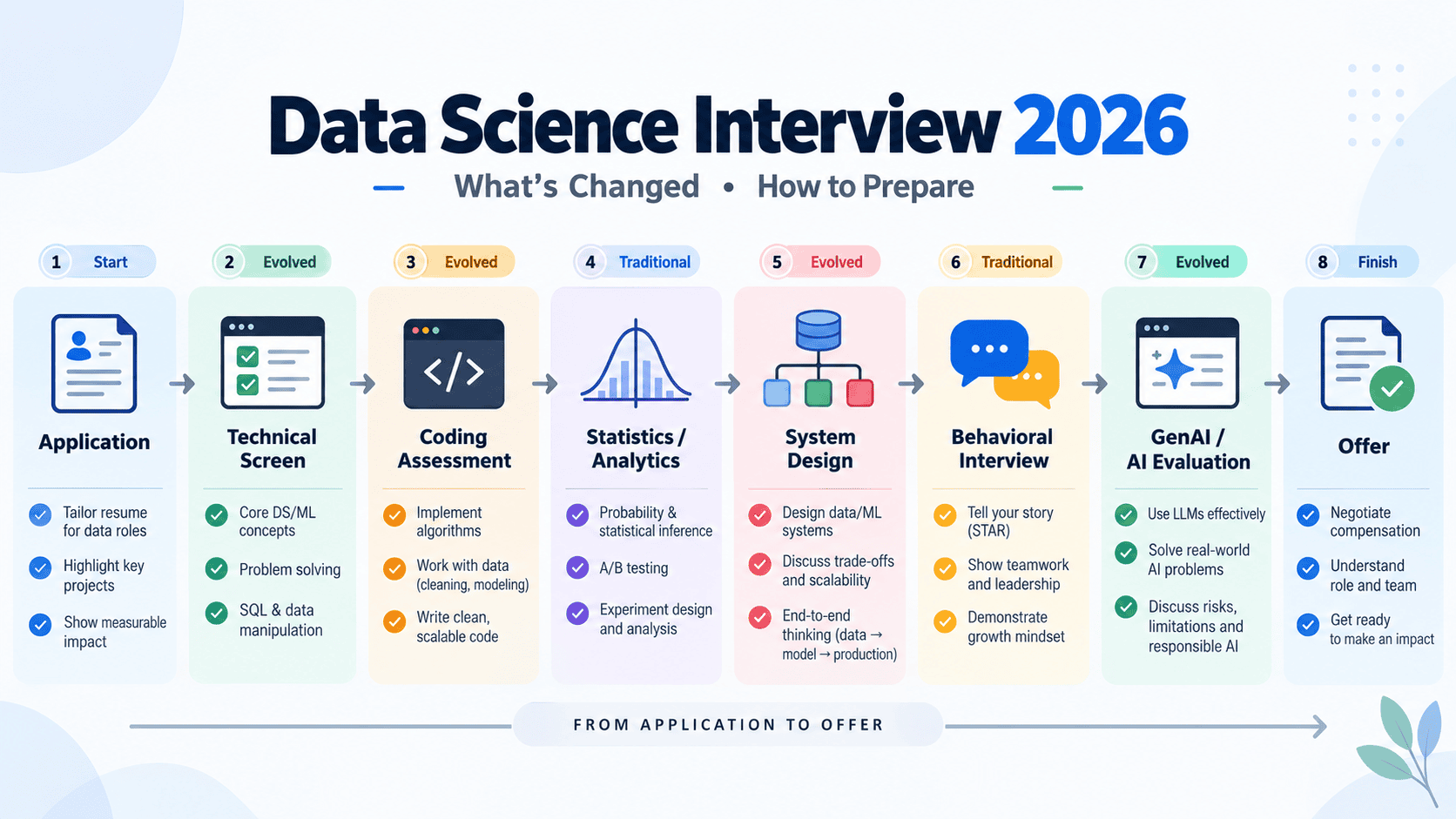
A round-by-round breakdown of how the hiring process has shifted, from AI-assisted coding rounds to GenAI evaluation questions, and what you need to do differently to be ready.
The data science interview has changed more in the past two years than in the previous five. If you prepped for interviews in 2023 or 2024 and you're back on the market now, the format you practiced for might not match what you'll actually face.
Some shifts are structural. Take-home assignments look different. AI tools are explicitly part of many live coding rounds. Machine learning system design questions, once reserved for senior loops, now show up at the mid-level. Other shifts are topical: generative AI (GenAI) and large language model (LLM) evaluation questions have become their own interview category, and behavioral rounds dig into how you handle AI-generated output, not just ambiguous data. And some shifts reflect a tighter market. Processes run longer, more rounds are common, and the bar for "good" in system design or business case rounds has gone up.
That said, a lot hasn't changed. SQL fluency still matters, and in some ways it's tested more rigorously, not less. Statistical reasoning and A/B testing are still core requirements. And the ability to explain analytical findings to a non-technical audience? That's still one of the most commonly cited differences between candidates who get offers and those who don't.
Source: KDnuggets — Read the full article on the original site ↗