El Niño has upended global weather, shaping the fate of societies, for millennia. Is this past a clue to a turbulent future?
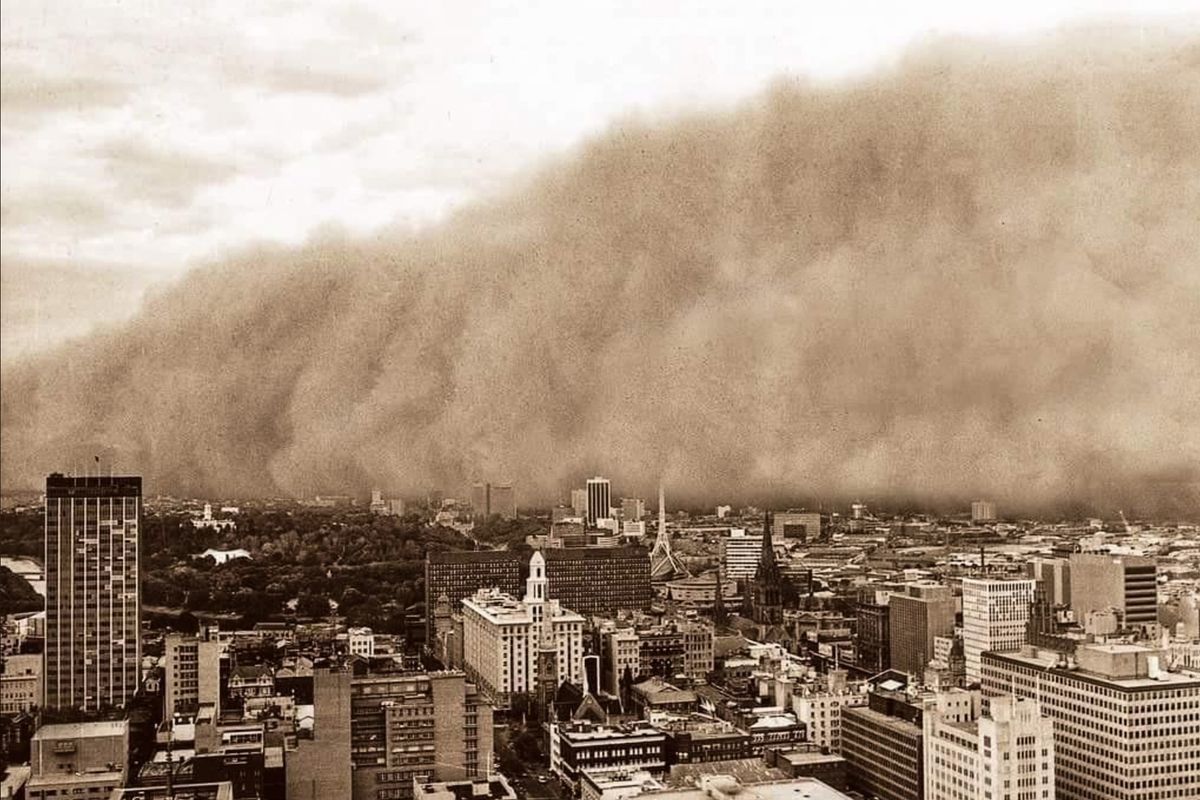
Massive clouds of dust roll into Melbourne on 8 February 1983 as a consequence of droughts induced by the extreme El Niño of 1982-83. Photo by Trevor Farrar/Australian Bureau of Meteorology
As I write these words, surface water temperatures across a great swath of the central and eastern Pacific Ocean have been rising for months. El Niño is the name for the recurring and sustained warming of this part of the Pacific. And temperatures are soaring to such highs, relative to their long-term averages, that the El Niño of 2026 may be the strongest in 1,000 years.
It’s still uncertain how the warming ocean will reshape global weather in the months to come, let alone how ecosystems – and human populations – will respond. The future is always murky. Still, when it comes to El Niño, the past could teach us what to expect. And not just the recent past, but also the deep past recently recovered by scientists, historians and archaeologists.
I’m an environmental historian. I work with climatologists to understand how climates have changed in the past. I study how communities understood and adapted to the climate’s changes. And my research suggests that history can help us understand even the most extreme events in today’s rapidly warming climate.
The past can help us see why El Niño is so hard to forecast, for example, or even define. It can show us that, while El Niño has contributed to the deaths of millions of people in the past, it has also enabled others to amass wealth and power.
El Niño indisputably scrambles worldwide weather patterns, but history teaches us that it’s as much a human creation as a natural reality. And this context may help us weather not only the effects of the 2026-27 El Niño in the months to come, but also El Niño’s future on a warming planet.
A vast current of cold water snakes up the western coast of South America. In December each year, that current breaks down for about a month. An influx of warm water delivers tropical fish and – because warm water evaporates more readily than cold water – abundant rainfall.
It’s impossible to know when people first noticed this annual reversal of water temperatures and precipitation. We do know that, sometime after the 16th-century Spanish conquest of the Inka Empire, fishermen named it El Niño, meaning literally ‘the boy’ or, when capitalised, ‘The Christ Child’. At least the reason for the name seems clear: the reversal of current happens around Christmas.
The colonised heartland of the Inka Empire, now known as Peru, won its independence in the 19th century. Towards the end of that century, Peru’s government joined many of its counterparts by establishing a society of geographers to describe the country’s environment and to catalogue its resources. In 1892, the society’s vice president, Camilo Carrillo, introduced the annual switch in water temperatures – and the term El Niño – to the scientific community.
When it entered scientific nomenclature, El Niño was therefore a cycle that was small in time (involving just one month every year), space (affecting only the Peruvian coast), and perceived importance (interesting only to a handful of local scientists).
El Niño is actually the oceanic expression of a colossal seesaw of atmospheric pressure over the Pacific
Only gradually did researchers detect a much bigger oscillation in Pacific Ocean temperatures, one that happened every two to seven years. This oscillation was eventually branded as El Niño. By the end of the 20th century, the effort to forecast its onset and worldwide impacts became a quintessential example of big, state-supported science.
The modern version of El Niño seems easy to define. It’s a dramatic warming of the central and eastern Pacific Ocean – a warming that’s confined to the tropics, lasts for many months, and tends to peak around the end of the year. It transfers a stupendous quantity of heat and moisture into the atmosphere, which the tropical jet stream redistributes, reshuffling weather patterns from one region to another.
But what causes these recurring warmings of Pacific Ocean water? And how, exactly, do they affect regional weather patterns?
Only recently have scientists been able to answer those questions. It turns out that El Niño is actually the oceanic expression of a colossal seesaw of atmospheric pressure over the Pacific Ocean, known as the Southern Oscillation. When air is tightly packed together over the eastern Pacific – when atmospheric pressure there is high, in other words – and when it’s low over the western Pacific, the pressure difference reinforces persistent winds that blow west along the equator.
These trade winds, as they’re called, can push so much warm surface water into the tropics of the western Pacific that they allow deeper, colder water to reach the top of the eastern Pacific. This is called La Niña. But when the difference in Pacific Ocean pressure dips, the trade winds falter, and the warm water of the western Pacific surges east. This we call El Niño.
Scientists have learned that the Southern Oscillation involves reinforcing relationships, known as feedbacks, between the air and sea. Usually, hot water in the western Pacific evaporates in towering storms, releasing heat. The air flows east, cools down, grows denser, falls, then surges back to the west, warming up.
This pattern, known as the Walker Circulation, strengthens the pressure differences of the Southern Oscillation and fuels the trade winds. But during an El Niño, warm water, evaporation and rains shift to the eastern Pacific, weakening transpacific differences in pressure and, in turn, the trade winds. This pattern helps explain the most important weather associated with El Niño: torrential rains across parts of the Western Hemisphere, and drought in Australasia.
Today, El Niño seems less like an event, and more like one end of a seesaw that perpetually teeters across the Pacific. But why does the seesaw behave as it does? There is still no scientific consensus, but the historical traces of both human societies and the natural world provide us with clues.
The most important questions about El Niño concern its impacts on global weather patterns – or in other words, the teleconnections that form between the warming of the equatorial Pacific and droughts, floods, storms or heatwaves around the world.
These teleconnections are usually presented as predictable and consistent from one El Niño to the next. They’re visualised in maps that supposedly depict how regional temperatures or precipitation change as El Niño intensifies in the Pacific Ocean
But no two El Niño events have exactly the same teleconnections. One reason is that the extent, intensity and duration of unusually warm water in the tropical Pacific differs from one El Niño to the next. Another is that El Niño is only one of many influences on regional weather, and its effects generally weaken with distance from the tropical Pacific.
Because El Niño’s impacts on regional weather are never identical, it’s impossible to predict exactly how a future El Niño will impact most of the world’s people and ecosystems. But it’s even harder to piece together the history of El Niño before the beginning of the 20th century, when ships began to regularly measure sea-surface temperatures. And it’s harder still before the middle of the 19th century, when scientists began to systematically gather data from rain gauges where El Niño reliably generates heavy precipitation.
Decades of research now reveals broad patterns in El Niño history that could give a rough sense of what’s in store
It’s a challenge, but not impossible. Climatologists – and a handful of historians and geographers – estimate the timing, strength and impacts of El Niño before the mid-19th century by consulting what they call the ‘archives of society’ and the ‘archives of nature’.
The archives of society were created by the people of the past. They include surviving texts that describe weather directly, such as the logbooks that sailors wrote aboard ships. They also include diverse sources of evidence – not only documents but also artefacts, ruins, even oral traditions – that record human activities so dependent on the weather that they can serve as proxies for it.
Unlike the archives of society, the archives of nature were created by Earth itself (even if they are, of course, interpreted by people). These archives are parts of the natural world that responded either to changes in the water temperature of the Pacific Ocean, or to the regional extremes in temperature and precipitation that can be associated with those changes. The responses leave a mark in natural archives, changing the composition of growth rings in trees or corals, for example. Each mark serves as a proxy for El Niño conditions in the distant past.
Neither societal nor natural archives can provide direct measurements of sea-surface temperatures or weather, so histories of El Niño are inevitably full of uncertainty. Trees, for example, can only grow (or stop growing) so much. It’s one reason why their rings can’t precisely measure the strength of past El Niño events (and one reason why we can’t easily pin down whether this year’s El Niño really is the strongest in a millennium).
Still, decades of research can now reveal three broad patterns in El Niño history that could give us a rough sense of what’s in store – not only in the coming year, but in our future on a warming world.
Above all, El Niño shaped humanity’s past by suddenly changing where water was available, how much there was, and how people could use it.
The foundations of human life – food, shelter and movement – depend to varying degrees on water. Human populations can use water in many different ways, so they have learned to thrive in very different environments. But it seems to have been much harder for them to adapt to the sudden disruptions in water that a strong El Niño – or that a trend towards stronger El Niño conditions overall – could bring about.
This is the first pattern in El Niño’s human history.
We can already see its outlines a little more than 4,000 years ago, when the first states and empires established themselves. At that time, El Niño conditions seem to have grown more frequent, intense and long-lasting. The reason may have been a multimillennial cycle in the wobble of Earth’s rotation that altered the amount of sunlight associated with different seasons, weakening the trade winds.
It all sounds convincing until – inevitably – new evidence emerges
Natural and societal archives suggest that some communities withered as El Niño intensified. In Peru, for example, populations appear to have deserted temple mounds, giant platforms that supported elaborate buildings and plazas. It’s easy to imagine that torrential floods sparked by strong El Niño conditions made it impossible to maintain these structures. But archaeological evidence hints at other changes that might have been partly responsible for population movements, including new trade networks and newly cultivated plants. How much can the coincidence of two trends really tell us about causation?
Maybe quite a lot, if similar coincidences pop up elsewhere. And it seems they do. A little under 3,000 years ago, for example, settlers established a community at Teouma, on the island of Efate in today’s Vanuatu. Chemical traces of human waste and leaves in nearby swamp sediments show that the settlers cultivated taro, a root vegetable, during a period of increasing rainfall. By around 2,600 years ago, however, a trend towards stronger or more frequent El Niño conditions seems to have made local rainfall more erratic. The trend appears to correlate with a decline in settlement and cultivation on Efate.
You’ll notice a lot of conditional language about possible changes and potential correlations. Deep history is like that. Natural and societal archives can let us identify probable trends, figure out roughly when they happened, and craft convincing theories for how one trend caused another. It all sounds convincing until – inevitably – new evidence emerges that compels us to re-date a trend, or propose another cause for it.
In general, evidence from the archives of nature and society is more abundant and precise the closer it dates to our present. Evidence from the previous millennium lets us identify not just trends in human and El Niño history, but discrete events.
Catastrophic famines partly linked to strong El Niño conditions appear to have killed millions
By the 16th century, for example, cave formations, tree rings and reports written by government officials let us reconstruct the likely impacts of individual El Niño years on the Indian summer monsoon. They reveal a series of devastating droughts across India in the late 16th century, the middle and end of the 17th century, and the late 18th century.
It may be that a series of explosive volcanic eruptions were partly responsible for these droughts. The cooling effect of the sulphur they launched into the upper atmosphere altered temperature differences between latitudes, and between land and water. These differences in temperature help create the winds that bring monsoon rains; when they changed, the rains did too.
But the droughts also coincided with El Niño conditions. In fact, there may be a connection, because the new wind patterns created by powerful eruptions seem to warm the eastern Pacific, relative to the west. Regardless, El Niño can also weaken the Indian monsoon by shifting warm water and rising air eastward across the tropical Pacific.
When the monsoon rains failed, harvests could too. Of course, rural populations and states had many ways of protecting themselves. Wells and granaries stored water and seeds, for instance, while trade networks could allow for emergency food imports. Still, these systems broke down when droughts lasted too long – and especially when states waged war.
In some El Niño events and in some parts of India, droughts provoked widespread famine only when armies demanded food from the already depleted countryside. In other Indian regions, the death toll soared when widespread malnutrition joined migration from drought-stricken regions to encourage the spread of epidemic disease. All told, catastrophic famines partly linked to strong El Niño conditions appear to have killed millions across 16th-, 17th- and 18th-century India.
Everywhere El Niño sparked extreme weather, communities suffered. Yet some prospered at their expense, and this is the second pattern we can discern in El Niño’s history.
The collapse of China’s Ming dynasty in the 17th century seems to provide a striking example. Growth rings in trees and corals indicate that El Niño conditions repeatedly contributed to a weakening of the East Asian monsoon in the late 16th and early 17th centuries. At first, droughts afflicted both northeastern China – home of the loosely connected Jurchen peoples – and northern China, the Ming heartland.
In the diverse environments of northeastern China, the Jurchen hunted, fished and farmed, a varied subsistence strategy that gave them some protection from drought. They also raided across the Great Wall into Ming territory, where they seized stockpiled grain. Eventually, droughts intensified in northern China, where soaring food prices and famine helped to destabilise the Ming regime. But drought seems to have yielded to above-average rainfall in Jurchen territories. Food provided by plentiful rain may have aided efforts to consolidate Jurchen communities into a united ‘Manchu’ state that was strong enough to exploit the Ming dynasty’s weakness, conquer China, and establish a new Qing dynasty.
Indeed, conquest and colonialism created a means by which the impacts of El Niño could be amplified for some communities, but alleviated or even exploited for others. This redistribution of vulnerability was never clearer or more catastrophic than in the late 19th century, when exceptionally strong El Niño conditions coincided with a global age of imperialism.
The exact connection between colonialism and crisis differed from place to place
In 1876, drought spread across India, then intensified with a strong El Niño in 1877-78. It was the heyday of the British Raj. Colonial officials had upended lives and livelihoods in many Indian farming communities by forcing them to plant cash crops such as tea or cotton. Now, there wasn’t enough food to go round. What grain could be harvested was either redirected from the poorest communities to areas where people could pay more, or exported out of India by colonial administrators who scorned market interventions.
Tens of millions died in the ensuing famines.
Similar tragedies played out wherever El Niño sparked drought in the late 19th century, though the exact connection between colonialism and crisis differed from place to place. In Eritrea and Ethiopia, for instance, Italian invaders arrived with cattle infected by rinderpest, a deadly disease that spread to local cattle before the arrival of another strong El Niño in 1890-91. Widespread mortality among cattle intensified food shortages, as did the arrival of immense locust swarms.
Perhaps a third of Ethiopia’s population perished.
The United States, however, often benefitted from El Niño conditions. As worldwide droughts drove up grain prices in 1877-78, US farmers exported enormous quantities of wheat to Europe. The resulting inflow of gold-backed credit strengthened US finances, and helped the government manage its Civil War debts. A century later, during another strong El Niño in 1972, the collapse of the Peruvian anchovy fishery, owing both to warming water and years of overfishing, deprived poultry producers of fishmeal. But that allowed US farmers to profit by planting soy, a substitute. In the even stronger 1982-83 event, torrential rains devastated California and other southern states, but overall, the US economy received a powerful stimulus from mild winter weather.
Source: Aeon — Read the full article on the original site ↗
Get the best of this topic in your inbox
Join the newsletter. A short, useful digest, no spam.