Preloader

AI Research Updates

When AI-assisted criticism scales, peer review needs an obligation threshold
ResearchNature Machine Intelligence1 week ago

When AI-assisted criticism scales, peer review needs an obligation threshold

With assistance from artificial intelligence (AI), a referee can now produce large volumes of manuscript-specific feedback in seconds. Yet determining whether a particular concern changes the paper’s central claim may still require substantial expert attention. AI therefore changes not only how criticism is produced but also its economics: the marginal…

Read original on Nature Machine Intelligence ↗
Putting a spotlight on AI, society, and humanity
ResearchMIT News - AI1 week ago

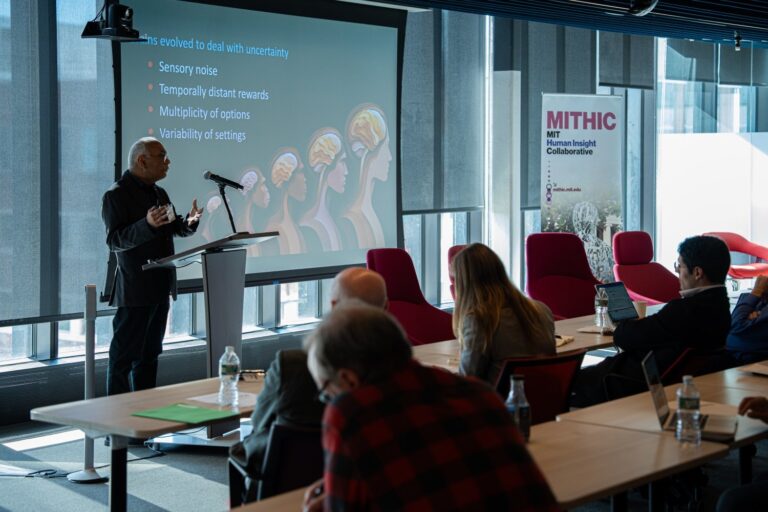
Putting a spotlight on AI, society, and humanity

MIT students are going to office hours less often. They’re spending less time working through problem sets, and with one another. Those were among the findings of MIT’s recent report on artificial intelligence and education, and they are one reason a growing number of MIT faculty are concerned about how generative…

Read original on MIT News - AI ↗
Can AI help build a healthier future?
ResearchMicrosoft Research1 week ago

Can AI help build a healthier future?

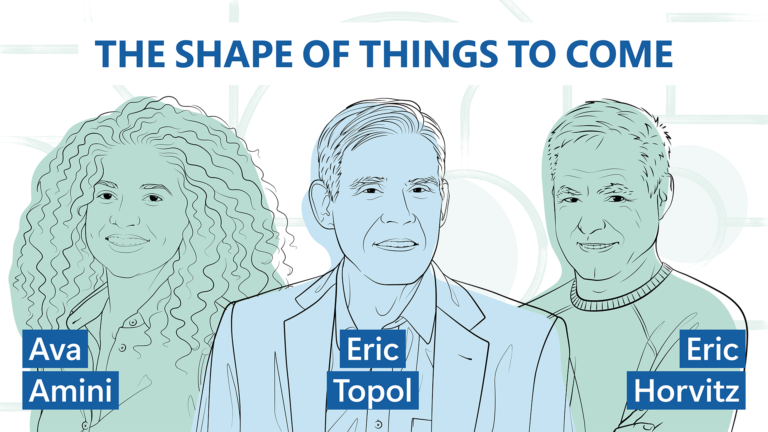
Technical advancement is moving at such a rapid pace that it can be challenging to define the tomorrow we’re working toward. In The Shape of Things to Come, Microsoft Research leader Doug Burger and experts from across disciplines tease out the thorniest AI issues facing technologists, policymakers, business decisionmakers, and other stakeholders today. The goal: to amplify the shared understanding…

Read original on Microsoft Research ↗
Scientists tracked kids for 8 years. What they found about screen time was surprising
ResearchScienceDaily - AI2 weeks ago

Scientists tracked kids for 8 years. What they found about screen time was surprising

An eight-year study of children in Finland has revealed a surprising connection between screen time and brain function. Researchers found that children who spent more time using screens tended to have better cognitive processing abilities as teenagers, challenging the widespread assumption that screen time is necessarily harmful to developing brains.

Read original on ScienceDaily - AI ↗
Learning the language of machine learning
ResearchMIT News - AI2 weeks ago

Learning the language of machine learning

When deploying deep learning models in high-stakes scenarios, researchers would like to understand how they work. Today, this requires unraveling an enormously complex network of internal processing nodes to understand what the model knows and how it will likely behave in practice.

Read original on MIT News - AI ↗
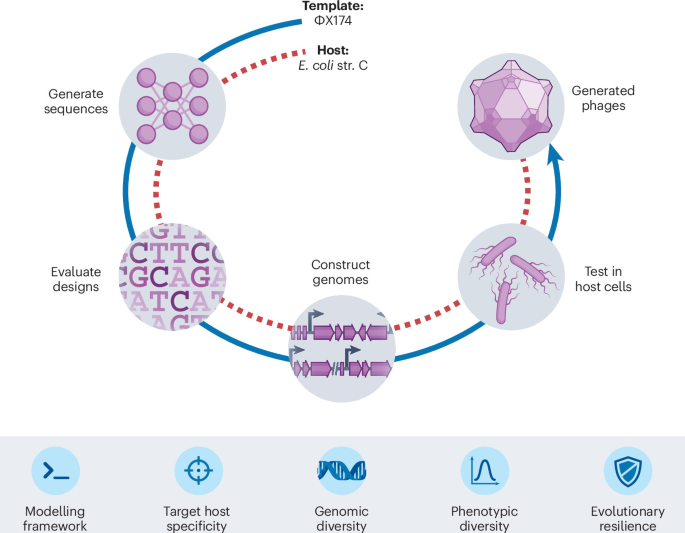
Generative genome design with DNA language models
ResearchNature - Machine Learning2 weeks ago

Generative genome design with DNA language models

Biological design has been successful at the scale of individual genes and gene circuits, but designing genomes remains more difficult. Genomes consist of coding sequences, regulatory elements and structural features carefully orchestrated for complex, emergent functions, where a single misplaced nucleotide can be lethal. Thus, navigating the space of possible…

Read original on Nature - Machine Learning ↗
Import AI 481: AI sub-contractors; a wet lab for AI; and subterfuge during development
ResearchImport AI2 weeks ago

Import AI 481: AI sub-contractors; a wet lab for AI; and subterfuge during development

AI systems are getting good at sub-contracting to make themselves better:…AI can now productively spend money to improve itself…Researchers have developed FrontierML, a benchmark “that measures how well agents turn capital into model performance on challenging, end-to-end machine learning tasks.” It shows that today’s frontier systems are already able to,…

Read original on Import AI ↗
BigCodeArena: Unveiling More Reliable Human Preferences in Code Generation via Execution
ResearcharXiv cs.AI2 weeks ago

BigCodeArena: Unveiling More Reliable Human Preferences in Code Generation via Execution

Crowdsourced model evaluation platforms, such as Chatbot Arena, enable real-time evaluation from human perspectives to assess the quality of model responses. In the coding domain, manually examining the quality of LLM-generated content is extremely challenging, as it requires understanding long chunks of raw code and deliberately simulating code execution. To…

Read original on arXiv cs.AI ↗
WaferTetris: Efficient Freeform Mapping on Wafer-Scale Accelerators
ResearcharXiv cs.CL (Language)2 weeks ago

WaferTetris: Efficient Freeform Mapping on Wafer-Scale Accelerators

Wafer-scale accelerators offer massive compute capacity through hundreds of thousands of processing elements (PEs) interconnected across a single wafer, but realizing this potential requires efficient application mapping. Their scale makes programming these systems and mapping applications onto them challenging. Existing approaches rely on template-based mappings to maintain productivity, but these…

Read original on arXiv cs.CL (Language) ↗
Directional Confusions Reveal Divergent Inductive Biases Through Rate-Distortion Geometry in Human and Machine Vision
ResearcharXiv cs.CV (Vision)2 weeks ago

Directional Confusions Reveal Divergent Inductive Biases Through Rate-Distortion Geometry in Human and Machine Vision

Humans and modern vision models can reach similar classification accuracy while making systematically different kinds of mistakes -- differing not in how often they err, but in who gets mistaken for whom and in which direction. We show that these directional confusions reveal distinct inductive biases that are invisible to…

Read original on arXiv cs.CV (Vision) ↗
When Simpler Is Better: Evaluating Translation Pipelines for Medieval Latin Manuscripts
ResearcharXiv cs.AI2 weeks ago

When Simpler Is Better: Evaluating Translation Pipelines for Medieval Latin Manuscripts

Despite remarkable progress in machine translation, Vision Language Models (VLMs) struggle on historical manuscripts, a domain that stresses core Natural Language Processing (NLP) capabilities: low-resource transliteration, archaic vocabulary, and noisy input signals. We present a systematic framework for evaluating the full image-to-translation pipeline on medieval Latin manuscripts, a setting in…

Read original on arXiv cs.AI ↗
1 … 4 5 6 7 8 … 15